
The best interior materials in Bangladesh are not one universal board, finish, or hardware range. The right specification depends on where the item will be used, its exposure to moisture and heat, the load it must carry, the finish you want, how often it will be handled, and how easily it can be maintained or repaired.
A kitchen cabinet, bedroom wardrobe, bathroom vanity, wall panel, and dining table do different jobs. Giving all five the same vague description, such as “premium board,” hides the decisions that affect performance. A dependable proposal names the substrate, thickness where relevant, surface finish, edge treatment, hardware, fixing method, and approved sample for each item.
Use this with the interior design guide for Bangladesh to make clear, room-specific choices.
Interior Material Choices at a Glance
| Material or component | Often considered for | Main question before approval |
|---|---|---|
| Plywood | Cabinet bodies, shelves, doors, furniture parts | Which grade, thickness, bond type, face quality, and intended use? |
| MDF | Smooth painted or routed surfaces and decorative panels | Is the selected product suitable for the location and edge detail? |
| Particleboard | Dry-area cabinet components and laminated furniture | What density, thickness, screw-holding need, and moisture exposure apply? |
| Laminate | Durable decorative surface over a suitable substrate | What type, texture, thickness, edge treatment, and cleaning method? |
| Natural veneer | Real-wood appearance over a stable core | What species, cut, matching method, finish, and acceptable colour range? |
| Solid wood | Frames, trims, selected doors, tables, and details | Is the timber properly dried, detailed for movement, and finished on all relevant faces? |
| Hardware | Hinges, channels, handles, connectors, and accessories | Is it matched to the load, use frequency, environment, and replacement plan? |
| Applied finish | Paint, stain, clear coating, polish, or protective system | What surface preparation, number of stages, sheen, sample, and care instructions apply? |
Start With Use, Not a Material Label
Material selection should begin with a performance brief. Record what the component must hold, how it will be used and cleaned, and whether it sits near water, heat, or an exterior wall.
Bangladesh Meteorological Department publishes monthly humidity normals because humidity changes by season and location. In a home, leaks, wet cleaning, steam, poor ventilation, and condensation can create far more severe local exposure than the outdoor average. “Moisture resistant” should never be read as “waterproof.”
Separate normal dry-area use from splash risk, persistent dampness, and direct water contact. Fix the moisture source first. A decorative sheet cannot compensate for leaking plumbing or a wet substrate.
Plywood, MDF, and Particleboard Are Not Interchangeable
These board names describe different constructions, not one quality ladder. The USDA Forest Products Laboratory explains that panel properties change with wood elements, adhesives, construction, and processing. The board name alone does not predict performance.
Plywood
Plywood is built from bonded veneer layers. It is available in different grades and bond classifications, with meaningful differences in face quality, internal defects, adhesive performance, and intended exposure. Bangladesh Standard BDS 799:2006 covers different grades and types of plywood for general purposes and defines defects such as blisters, borer holes, and delamination.
Request the relevant grade or standard, nominal thickness, face and core description, location, and supplier evidence. Terms such as “marine” should be supported by an applicable test or standard.
MDF
Medium-density fibreboard has a fine, uniform surface that can support smooth paint and routed profiles. Suitability still depends on the product, thickness, edge preparation, fixing, span, and exposure. Cut edges need particular attention.
Particleboard
Particleboard can provide a consistent substrate for dry-area laminated furniture when the product and construction suit the task. Shelf length, expected load, connector design, edge protection, and repeated dismantling matter. A low-load cabinet divider and a long bookshelf are not equivalent applications.
Do not approve a board only by tapping a sample or comparing colour. Ask for documentation that connects the product to the actual component.
Laminate Is a Surface System, Not the Whole Cabinet
Laminate can offer a broad choice of colours, patterns, textures, and cleanable surfaces. Its result depends on the substrate beneath it, the adhesive process, pressing quality, edge treatment, joint placement, and protection around cut-outs.
A tiny sample may hide pattern repetition or how gloss reveals fingerprints. Review a larger sample in the home’s lighting. Confirm whether the same code, finish, and batch can cover visible panels, and agree how unavailable products are replaced.
For kitchens, ask how edges near sinks, counters, appliance openings, and floor-level plinths will be detailed. For children’s rooms and high-touch storage, discuss cleaning and scratch visibility. No surface stays new without suitable use and care.
Veneer and Solid Wood Need Honest Expectations
Natural veneer is a thin layer of real wood applied over a core. It can deliver a genuine grain character while allowing larger, more stable panels than many solid-wood arrangements. The visual result depends on species, veneer cut, leaf matching, panel matching, stain, and clear finish.
Natural variation is part of the material. Approving one small piece does not mean every door will have identical grain and colour. The Architectural Woodwork Institute recommends documenting veneer species, cut, matching, orientation, and finish samples within the submittal process.
Solid wood can be appropriate for selected frames, trims, doors, legs, and tabletops. Wood exchanges moisture with surrounding air, so its dimensions can change. The USDA’s moisture guidance says correct drying, handling, and storage help reduce later movement, while coatings slow moisture exchange but do not stop it.
Ask how the timber was dried, stored, joined, and detailed to allow normal movement. Wide solid panels, narrow frames, and veneered panels behave differently. They should not be promised as visually or dimensionally identical.
Hardware Must Match the Furniture
Hinges and drawer channels are working parts. Suitability depends on shutter weight, drawer load, opening frequency, mounting material, corrosion exposure, and installation accuracy.
Avoid approving “good hardware” as a line item. Record the maker and model or a clearly defined approved equivalent, finish, quantity, load or cycle evidence where relevant, and replacement availability. Special corner units, lift systems, sliding doors, and tall pull-outs also need clear space and fixing requirements.
Hardware cannot rescue a poorly aligned cabinet. The body must be square, fixing points must be sound, and doors or drawers must have the planned clearances. Include operation checks in the planned interior design handover checklist for Bangladesh.
Finishes Depend on Preparation and Application
Paint, stain, clear coating, and polish should be specified as systems. A colour name alone says nothing about substrate preparation, primer or sealer, application method, coat sequence, drying conditions, final sheen, or repair procedure.
The USDA Wood Handbook notes that wood properties, moisture, preparation, application, and exposure affect finish performance. Ask for a labelled sample made on the same type of substrate as the final work. View it vertically and horizontally, under daylight and artificial light. Gloss can emphasise unevenness and fingerprints, while very textured surfaces may hold dust in detailed areas.
Compare written technical information and maintenance guidance. More coats do not automatically produce a better result.
Plan for Moisture, Heat, and Everyday Cleaning
Bangladeshi homes need location-specific detailing rather than fear-based material claims.
- Keep cabinet bases and vulnerable edges away from standing water.
- Repair plumbing leaks and damp walls before installing furniture.
- Provide appropriate ventilation where cooking or bathing adds moisture.
- Protect panels from direct heat sources according to appliance and material instructions.
- Use removable access panels where valves or service points need maintenance.
- Follow the approved cleaner guidance instead of using harsh chemicals on every surface.
- Wipe spills promptly and allow wet cleaning areas to dry.
Heat resistance, water resistance, stain resistance, and fire performance are different properties. Ask for evidence about the property that matters in the proposed location. A generic “heatproof” or “waterproof” claim is not a specification.
Match the Specification to Each Room
| Room or element | Exposure to discuss | Specification focus |
|---|---|---|
| Kitchen base units | Plumbing leaks, spills, steam, heat, cleaning | Protected edges, service access, suitable substrate, hardware, ventilation clearances |
| Wardrobes | Clothing load, repeated opening, exterior-wall dampness | Shelf spans, back detail, hinges or sliding system, airflow, wall condition |
| Bathroom vanity | Splashing, floor cleaning, hidden plumbing | Moisture strategy, sealed cut-outs, raised or protected base, access for repairs |
| TV and display unit | Equipment heat, cables, dust, shelf loads | Ventilation, cable access, fixing, cleanable surfaces, safe clearances |
| Children’s furniture | Frequent handling, impact, changing needs | Rounded details where suitable, stable fixing, repairable finish, accessible storage |
| Dining table | Spills, hot serving items, abrasion | Top construction, finish limits, care routine, movement allowance if solid wood |
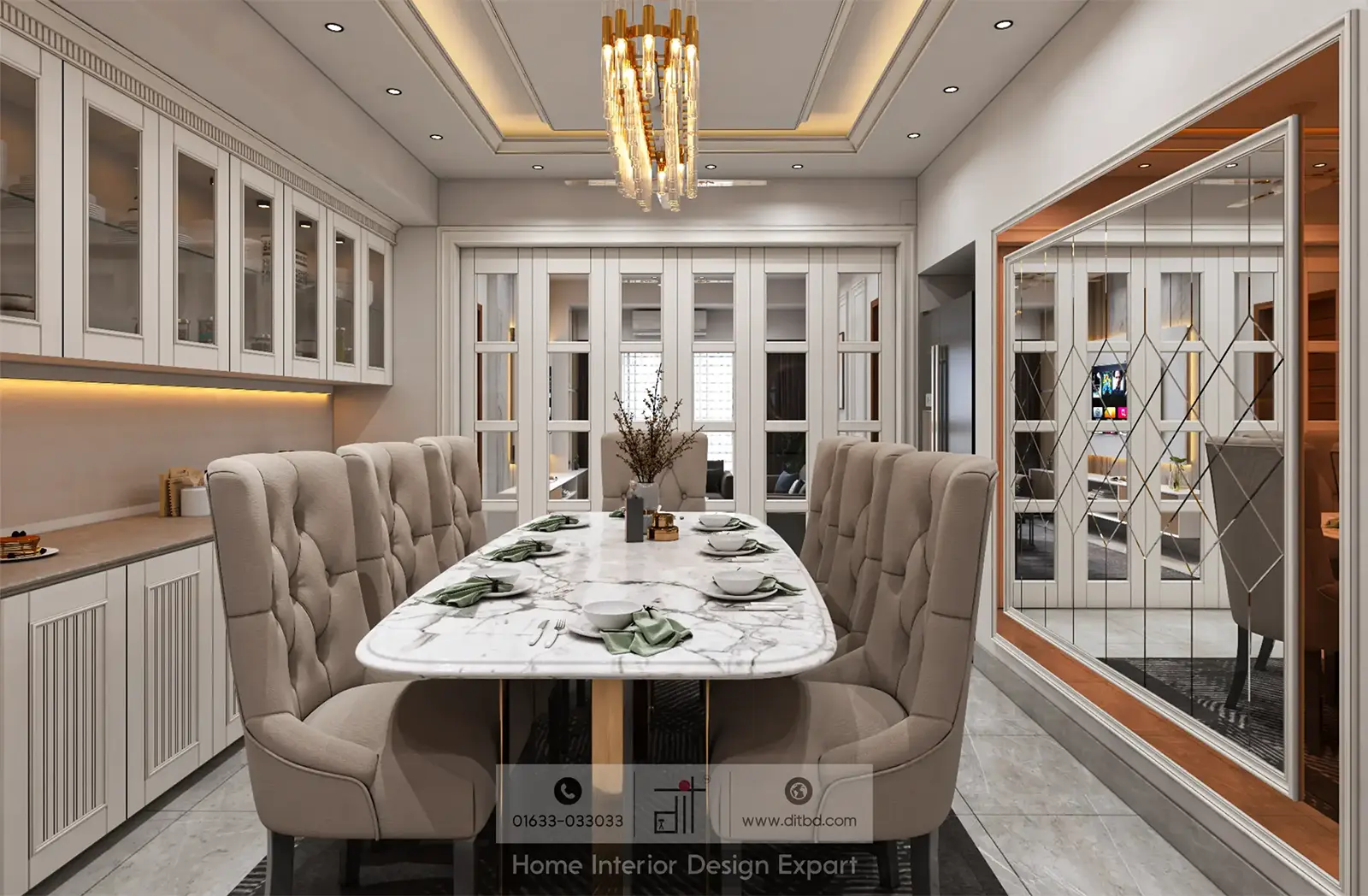
Use 3D home interior design in Bangladesh to review colour, grain direction, panel joints, and visible hardware. Then use technical drawings and samples to approve what the image cannot prove.
Questions to Put in the Material Schedule
Before approving furniture or finishes, ask:
- What is the exact substrate for the body, shutter, shelf, back, and decorative panel?
- What grade, thickness, product code, and referenced standard apply?
- Which surfaces and edges receive laminate, veneer, paint, or another finish?
- How are exposed edges, cut-outs, sink zones, and floor-level areas protected?
- What hardware model, finish, load basis, and quantity are included?
- Which sample controls colour, texture, grain, and sheen?
- What natural variation should we expect?
- What cleaning products and maintenance actions are allowed?
- Which substitutions require written approval?
- What will be recorded and checked at handover?
The AWI submittal standard treats material data, shop drawings, samples, hardware, and finishes as coordinated information. That principle is useful even when a Bangladeshi residential project does not formally adopt AWI standards.
Compare Value Through the Full Specification
The cheapest surface is not automatically the lowest-cost decision, and the most expensive board is not automatically best. Spend according to exposure, load, use, appearance, repairability, and expected service.
Review low-budget interior design priorities in Bangladesh before simplifying hidden construction or wet-area details. Then compare the materials, quantities, hardware, labour, and exclusions that shape interior design cost in Bangladesh.
For a deeper look at production controls, read how a custom furniture factory in Dhaka should manage quality.
Plan Your Home With Clear Material Approvals
DIT Studio is a residential-first Home Interior Specialist established in 2011, with 15+ years of experience and 500+ completed projects. If you are evaluating the best interior design company in Bangladesh, ask each team to replace broad quality labels with room-specific specifications, approved samples, and documented substitutions.
Explore DIT Studio’s custom furniture design service or book a consultation. Bring your floor plan, storage priorities, reference images, and maintenance concerns so the material discussion can begin with how your household actually lives.