
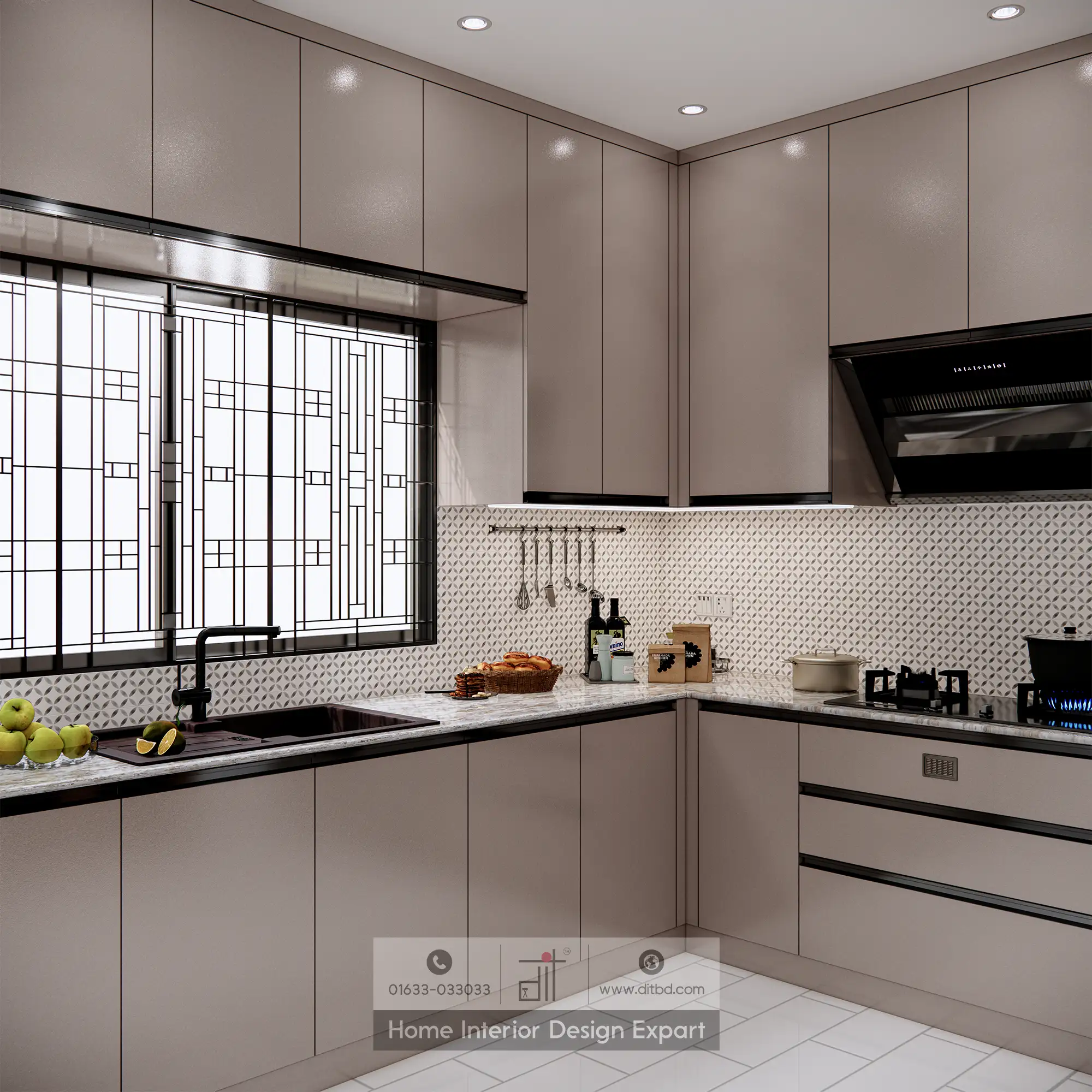
Your kitchen countertop takes more abuse than almost any other surface in your home. Hot pots from the gas hob. Mustard oil splashed during tempering. Raw fish on the cutting board. Constant scrubbing with water, soap, and cleaning agents. In a Bangladeshi kitchen where cooking happens multiple times a day, choosing the wrong countertop material is an expensive mistake.
Granite is our most-specified countertop material in traditional Dhaka kitchens, largely because it’s locally available (sourced from Rajasthan and other Indian states) and because it handles the heat from a pressure cooker or kadai being set directly on the counter without damage. That’s something you can’t say about quartz or HPL. But the right choice for your kitchen depends on how you cook, your budget, and how much maintenance you’re prepared to commit to.
This guide gives you an honest comparison of all three, with real performance data to back it up.
Key Takeaways
- Granite withstands temperatures up to 480°F (248°C) under sustained contact and has a melting point between 2,200-2,300°F, making it the most heat-resistant natural stone option (Superior Granite, 2024)
- Quartz countertops begin to risk cracking or discolouration from heat at approximately 149-177°C (300-350°F) due to resin binder degradation (Marble.com, 2026)
- HPL laminate tolerates brief heat exposure up to around 130°C (266°F), making trivets non-negotiable near any hob (Material Intelligence, 2024)
Why Countertop Material Choice Matters More in Bangladeshi Kitchens
Bangladeshi cooking is genuinely demanding on kitchen surfaces. High-temperature frying in mustard oil, heavy stone mortar use on countertops, frequent water exposure from washing vegetables, and direct placement of pressure cooker bodies on the slab: all of these create stress that a kitchen countertop in a Western context rarely faces.
Add Dhaka’s climate: high humidity year-round, temperatures that climb well above 35°C in summer, and the natural expansion and contraction this causes in porous materials. Choosing a countertop for a Bangladesh traditional kitchen means choosing one that handles all of this, reliably, for 10 to 20 years.
So which material wins? The honest answer is: it depends on your priorities. Let’s look at each one properly.
Granite Countertops: The Bangladesh Standard, and Why It Earned That Status
Granite is Bangladesh’s most common countertop material for a straightforward reason: it works. Indian granite quarries in Rajasthan and other states supply affordable, high-quality slabs that arrive at Bangladeshi stone yards at prices significantly lower than imported alternatives. For most families renovating a traditional kitchen, granite is the rational first choice.
Heat resistance: Granite’s melting point lies between 2,200 and 2,300°F. For practical kitchen purposes, this means you can set a pressure cooker body directly on granite without concern. Under normal cooking conditions, up to 480°F of sustained heat, granite countertops will not crack, stain, or discolour from heat contact (Superior Granite, 2024). This is a meaningful real-world advantage for Bangladeshi cooking.
Hardness: Granite ranks 6 to 7 on the Mohs hardness scale, which makes it harder than stainless steel and most kitchen knives. Daily knife use won’t scratch granite, though cutting directly on the stone surface will dull your knives faster than a cutting board.
Porosity: This is granite’s main limitation. It’s a natural porous stone. Without regular sealing, granite absorbs liquids, including mustard oil, fish juices, and turmeric, all of which stain. In our experience, a kitchen used heavily every day in Dhaka needs sealing every 12 to 18 months. Ignore this schedule and you’ll see turmeric and oil staining appear within a few months. The process takes about an hour with a good-quality stone sealer, so it’s not a major burden, but it is a real commitment.
Durability: Granite’s compressive strength often exceeds 200 MPa. A properly installed granite slab, correctly supported at the edges, will not crack under normal kitchen use. The standard countertop overhang is 30-40mm beyond the cabinet face; exceeding this without additional support risks edge cracking over time.
Aesthetic: Every granite slab is unique. The natural veining and colour variation in Indian granite, particularly Kashmir White, Black Galaxy, and Tan Brown, gives kitchens a premium appearance at an accessible price point. Our kitchen renovation in Bashundhara R/A features granite countertops paired with contemporary cabinetry to strong effect.
Cost in Bangladesh: BDT 150 to 350 per square foot for Indian granite, depending on variety and thickness (20mm vs 30mm). Full kitchen countertop in a standard Dhaka flat: approximately BDT 15,000 to 40,000.
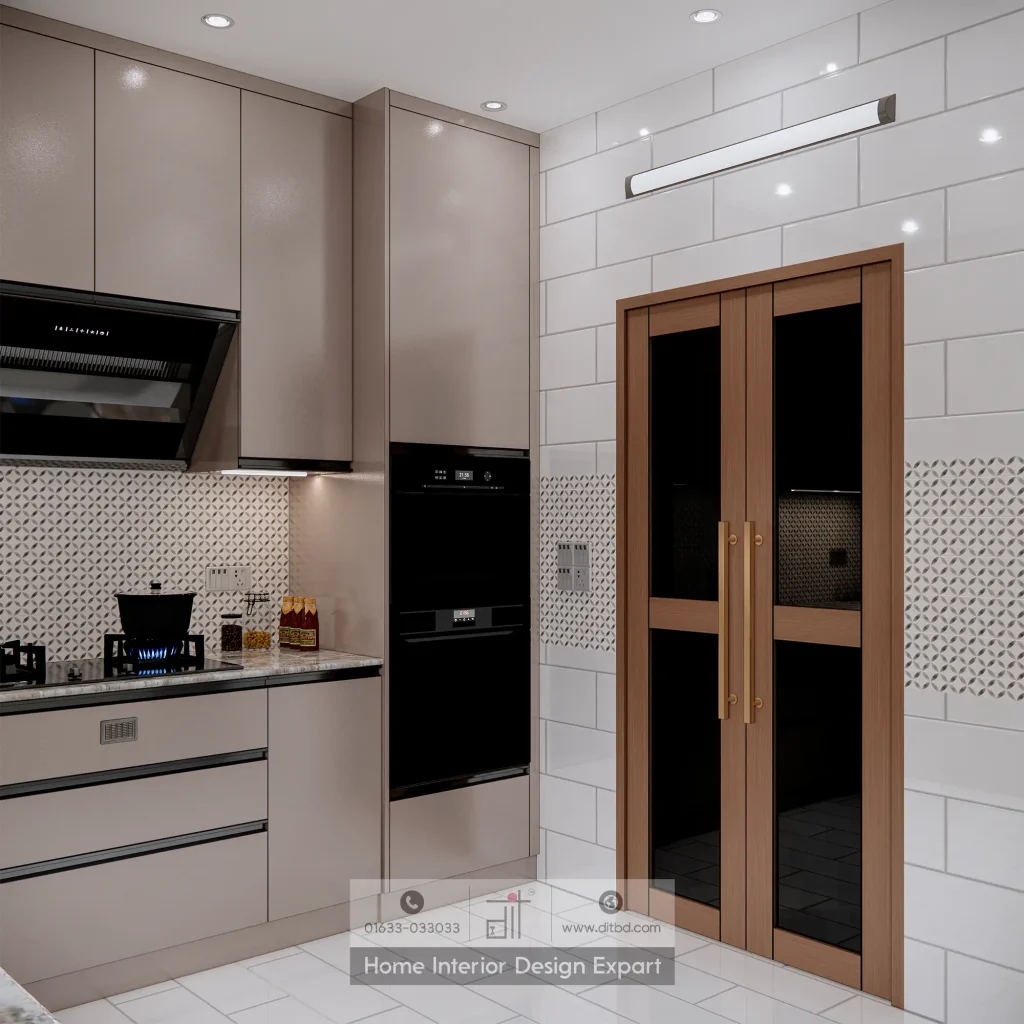
Quartz Countertops: The Premium Option with Important Tradeoffs
Engineered quartz is a composite material, approximately 93% natural quartz stone bound with 7% polymer resins. This combination produces a surface that’s non-porous, consistent in appearance, and highly resistant to staining. Quartz is growing in popularity for premium kitchen renovations in Dhaka, though it comes primarily through imports and carries a higher price tag.
Heat resistance: This is quartz’s most significant limitation in a Bangladeshi kitchen context. The polymer resin binders that give quartz its non-porous, consistent finish begin to degrade at around 149-177°C (300-350°F) (Marble.com, 2026). Placing a hot pressure cooker or a cast iron tawa directly on quartz can cause thermal shock, cracking, or permanent discolouration of the resin. Trivets are not optional with quartz. They’re mandatory.
For a kitchen where heavy pots come straight off the gas hob to the counter frequently, this is a real daily inconvenience. We’re direct with clients about this: if you cook Bangladeshi meals daily and you don’t want to think about trivets every time, quartz is not the most forgiving choice.
Stain resistance: Where quartz genuinely excels. Its non-porous surface means mustard oil, turmeric water, fish juices, and dal splashes sit on the surface rather than absorbing into the stone. A quick wipe cleans most spills completely. No sealing required, ever.
Scratch resistance: Quartz is slightly harder and more uniform than granite. Laboratory testing shows properly sealed quartz surfaces withstand up to 25% more direct force without chipping or cracking than granite under controlled conditions (Bedrock Quartz, 2024).
Maintenance: Extremely low. No sealing, no special cleaning products, no periodic treatment. This is a genuine long-term advantage, particularly for busy families who cook daily and don’t want to track maintenance schedules.
Aesthetic: Consistent, predictable, and available in a wide range of colours and veining patterns that mimic natural stone. The engineered nature means no unexpected colour variation between slabs, which matters when matching countertops across an L-shaped kitchen.
Cost in Bangladesh: BDT 400 to 700+ per square foot, depending on source and design. Full kitchen countertop: approximately BDT 40,000 to 80,000. Quartz is predominantly imported, which is why prices are higher and availability is more variable than Indian granite.
You can see quartz used in our Dhanmondi 10A modular kitchen project, where it pairs beautifully with handleless cabinet designs.
HPL Laminate Countertops: The Budget Option with Real Limitations
High Pressure Laminate (HPL) is made by bonding layers of paper and resin under extreme heat and pressure, then applying a decorative surface layer. It’s lightweight, inexpensive, and available in a vast range of finishes that can mimic wood, stone, concrete, or solid colour. In many budget Dhaka kitchen renovations, HPL is the default countertop choice.
Is it a bad material? Not across the board. But we’ll be honest: for a Bangladeshi kitchen where heavy cooking happens daily, HPL near the hob is genuinely not suitable. Here’s why.
Heat resistance: HPL tolerates brief heat exposure up to approximately 130°C (Material Intelligence, 2024). For reference, a pressure cooker base or a kadai placed directly on an HPL surface routinely exceeds this. The result is scorching, blistering, or delamination of the surface, which is both unsightly and irreversible. In this respect, HPL is the weakest of the three options for Bangladesh’s actual cooking habits. Trivets aren’t just advisable. They’re essential every single time, without exception.
Moisture vulnerability: HPL’s core layers are sensitive to sustained moisture. Edge joints, seams, and the area immediately around the sink are particularly vulnerable. Moisture infiltration at the edges causes swelling, delamination, and eventually structural failure of the countertop slab. In Dhaka’s humidity and with the water volumes that daily Bangladeshi cooking generates, this is a meaningful long-term concern.
Stain resistance: The decorative surface layer resists most surface stains adequately if wiped promptly. However, once the surface layer is scratched or worn, the underlying layers are vulnerable to absorption.
Repairability: Unlike granite, a damaged HPL countertop cannot be restored by polishing or re-sealing. Surface damage is permanent unless the countertop panel is replaced entirely.
Where HPL genuinely works well: As a carcass material (the structural body of cabinets), as door surfaces for upper cabinets away from direct heat and water, and in kitchens with very light cooking use. HPL is not our first recommendation for a Bangladeshi kitchen used daily for heavy cooking, but it can be appropriate in secondary kitchens, modular units for light-use areas, or as a cost-managed option when budget is the overriding constraint.
Cost in Bangladesh: BDT 60 to 150 per square foot for HPL countertop sheet material. Full kitchen: approximately BDT 6,000 to 18,000. It’s the lowest upfront cost, though replacement costs over a 10-year period often make it less economical than granite.
Side-by-Side Comparison
| Factor | Granite | Quartz | HPL Laminate |
|---|---|---|---|
| Heat resistance | Excellent (up to 480°F sustained) | Moderate (149-177°C, then risky) | Limited (up to 130°C briefly) |
| Stain resistance | Good when sealed | Excellent (non-porous) | Moderate (surface only) |
| Scratch resistance | Very good (Mohs 6-7) | Excellent | Poor (surface wears) |
| Moisture resistance | Good when sealed | Excellent | Poor at edges/seams |
| Maintenance required | Every 12-18 months (heavy use) | None | None |
| Upfront cost | Moderate | High | Low |
| Long-term durability | 20+ years | 15-25 years | 5-10 years before issues |
| Repairability | Polishing/re-sealing | Limited | Not repairable |
| Available in Bangladesh | Widely available (Indian quarries) | Import-dependent | Widely available |
| Best for daily Bangladeshi cooking | Yes | Yes (trivets required) | With caution near heat |
Who Should Choose Each Material?
Choose granite if:
You cook full Bangladeshi meals daily, you want to place hot cookware directly on the counter without worrying, and you want a natural, premium-looking surface at a reasonable price. Granite is the most practical and proven choice for the traditional Bangladeshi kitchen. It requires sealing every 12-18 months under heavy use but rewards you with decades of reliable performance.
Choose quartz if:
You prioritise zero-maintenance surfaces, you cook moderately or are willing to consistently use trivets for hot pots, and you have the budget for a premium material. Quartz’s non-porous surface is genuinely superior for stain resistance and is the right choice for homeowners who find maintenance schedules burdensome.
Choose HPL if:
Your budget is the primary constraint, you have a secondary or light-use kitchen, or you plan to renovate again within 5-7 years. It’s also a reasonable choice for countertop areas away from the hob and sink.
Our traditional kitchen design service and modular kitchen design service work across all three materials. We help you match the right countertop to your cooking habits, your aesthetic vision, and your realistic budget. For a broader view of the decisions that go into a successful kitchen renovation, our article on interior design challenges in Bangladesh is a useful companion read.
A Note on Stainless Steel
Traditional and older Dhaka kitchens sometimes feature stainless steel countertops. Steel is virtually indestructible, genuinely heat-resistant, hygienic, and easy to clean. It’s the standard in commercial kitchens for good reason. The drawbacks: it scratches visually over time (though the surface remains functional), it conducts cold in winter, and it produces a more utilitarian aesthetic that doesn’t suit most modern residential kitchen designs. If you’re drawn to its practicality, it’s worth a conversation with our design team.
FAQ
Does granite need to be sealed in Dhaka’s climate?
Yes, and Dhaka’s heat and humidity actually accelerate how quickly the sealant degrades. In a kitchen with heavy daily use, plan to re-seal every 12 to 18 months. The process takes about an hour and protects the stone from oil and moisture absorption. Unsealed granite in a Bangladeshi kitchen will show turmeric and mustard oil staining within months.
Can I place a hot pressure cooker directly on quartz?
We advise against it. Quartz withstands up to approximately 149-177°C, and a pressure cooker base can exceed this temperature. Thermal shock from sudden heat can crack or discolour the resin matrix. Always use a trivet or wooden board. With granite, direct placement of hot cookware is generally safe for normal cooking temperatures.
What’s the most popular countertop we install at DIT Studio for traditional kitchens?
Granite remains our most frequently specified countertop material for traditional enclosed kitchens in Dhaka. Indian granite from Rajasthan and Kashmir offers excellent heat resistance and a premium look at prices that make sense for most renovation budgets. See examples in our Moghbazar project and Tolarbag kitchen.
Is HPL safe to use near the kitchen sink?
HPL requires careful edge sealing near the sink to prevent moisture from reaching the core layers. A routed and sealed drip groove at the front edge and a fully sealed sink cutout are essential. Without proper edge protection, HPL near a sink in a heavily used Bangladeshi kitchen typically shows delamination within 2-4 years.
How do I choose the right countertop thickness?
For granite and quartz, 20mm is the standard residential thickness and handles all normal kitchen use comfortably. 30mm slabs offer a more premium, substantial look and added edge strength, but at higher material and fabrication cost. The standard countertop overhang beyond the cabinet face is 30-40mm. For HPL, 12mm or 18mm board thickness is standard, with a post-formed or square-edge finish.
How do I care for a granite countertop long-term?
For practical care guidance on granite and other kitchen surfaces, our guide on caring for interior designed homes in Bangladesh covers maintenance routines specific to Dhaka’s climate.
Conclusion
For most traditional kitchens in Bangladesh, granite remains the best all-round countertop choice. It handles the heat of daily Bangladeshi cooking better than any other accessible material, looks beautiful, and lasts decades with basic maintenance every 12-18 months. Quartz is an excellent premium alternative for homeowners who prioritize zero maintenance and superior stain resistance, provided trivets become a consistent habit. HPL suits tight budgets and light-use scenarios but deserves honest caution for kitchens where heavy cooking happens daily near the hob.
As a trusted interior design company in Bangladesh, DIT Studio has specified and installed countertops across hundreds of Dhaka kitchens since 2011. We know which materials perform and which ones disappoint after two monsoon seasons. If you’d like honest advice tailored to your specific kitchen, cooking habits, and budget, reach out to our team. We’re here to help you make the right choice the first time.
Written by the DIT Studio design team — Bangladesh’s specialist home interior firm since 2011. Traditional enclosed kitchens are the most common kitchen type we design across Dhaka, and we’ve refined our approach across hundreds of projects spanning compact flats to premium full-floor renovations.