
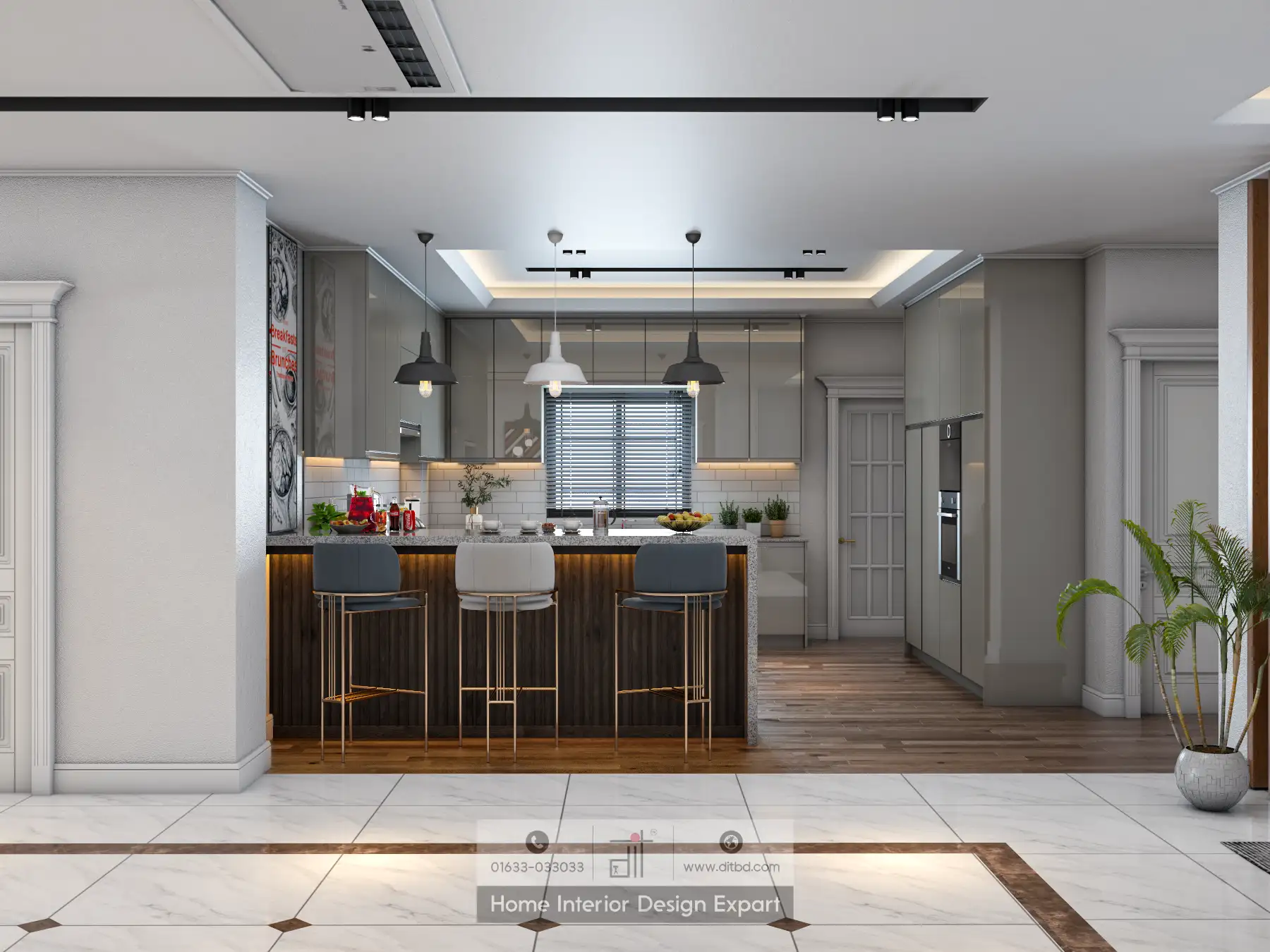
Dhaka’s apartment market has changed. The newer developments in Bashundhara, Gulshan, and Dhanmondi are being built with open-plan living in mind. Kitchens are no longer hidden behind a door. They open into dining and living spaces, becoming the visual centrepiece of the home. But not every layout works in every flat.
The right open kitchen configuration depends on your room’s dimensions, your cooking intensity, and your lifestyle. According to the 2025 U.S. Houzz Kitchen Trends Study, which surveyed 1,620 renovating homeowners, more than half (58%) add or upgrade a kitchen island during a remodel, signalling how central the kitchen has become to modern home design.
As a leading interior designer in Bangladesh, DIT Studio has designed open kitchens across Dhaka’s most varied apartment types, from narrow pre-2000 flats in Mohammadpur to spacious premium developments in Gulshan and Bashundhara. Here are five open kitchen layouts we recommend for Dhaka apartments, each suited to a different floor plan and family size.
Key Takeaways
- More than 58% of homeowners add or upgrade a kitchen island when remodelling (Houzz Kitchen Trends Study, 2025)
- The NKBA recommends a minimum of 1,050mm of clear walkway on all sides of a kitchen island; the absolute minimum is 900mm
- Galley layouts work efficiently in narrow kitchens as small as 7–8 feet wide; L-shaped layouts suit the most common Dhaka flat kitchen dimensions of 8–10 feet
- For all open kitchens in Bangladesh, a ducted chimney rated at 600–900 CFM is essential to manage cooking odours from heavy Bangladeshi cooking
- L-shaped kitchens require a minimum of 50 sq ft (4.6 m²); island configurations require 120 sq ft or more
Layout 1: The L-Shaped Open Kitchen with Breakfast Bar
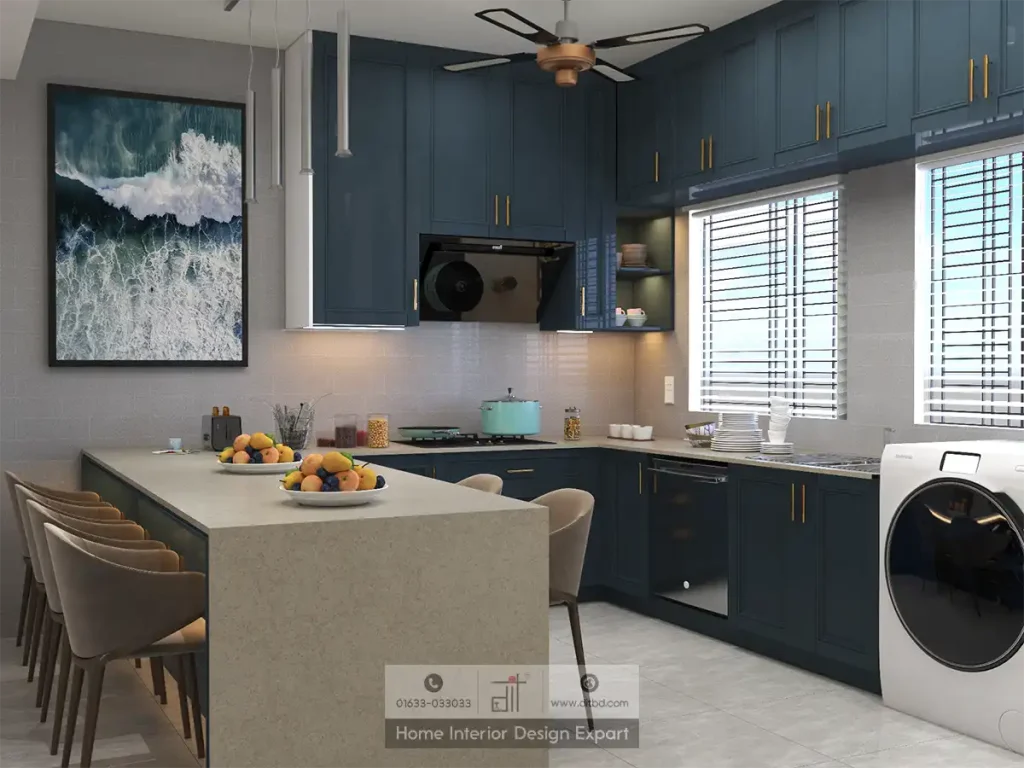
The L-shaped open kitchen is the most versatile layout for Dhaka apartments and the one we recommend most often. It uses two adjoining walls for cabinetry and appliances, leaving the room open on two sides. This creates a natural connection between the kitchen and the adjacent dining or living space without requiring major structural changes.
An L-shaped kitchen functions effectively in spaces as small as 50 sq ft (approximately 4.6 m²), which aligns well with kitchen dimensions in most 1,200–1,600 sq ft Dhaka flats. This makes it one of the few configurations that works across a wide range of apartment sizes.
What makes it work in Dhaka: The L-shape keeps the cooking zone on two walls, so your chimney sits cleanly in the corner above the hob. There’s a clear air path for the exhaust to carry cooking odours away before they spread to the living area. The open sides of the “L” allow light to travel freely across the kitchen and dining space.
The breakfast bar addition: Position a slim breakfast bar along the open edge of the shorter arm of the “L.” This creates a natural boundary between the kitchen and the dining area without blocking the visual flow. It seats two to three people comfortably on bar stools, making it perfect for morning tea, a quick meal, or keeping guests nearby while you cook.
Minimum flat size: Works in kitchens of 50 sq ft and above. Ideal for 2 and 3 BHK apartments in the 1,200–1,800 sq ft range.
Storage notes: Overhead cabinets along both walls give you generous upper storage. Use a tall pantry unit at the end of one arm for dry goods, spices, and oils. Corner space between the two arms benefits from a magic corner or carousel unit to prevent dead storage zones.
Workflow notes: Place the hob on the longer arm, the sink on the same arm or at the corner transition, and the refrigerator at the end of the shorter arm. This creates a compact, efficient work triangle. You can see this layout executed in our modern open kitchen design in Mohammadpur.
Is your kitchen currently too narrow for an L-shape? The galley layout below may be a better fit.
Layout 2: The Galley Open Kitchen with Dining Bar on One Side
A galley kitchen runs along two parallel walls with a walkway between them. In its traditional form, it’s a closed, corridor-style kitchen. In an open-plan version, one of the two walls is removed or replaced with a raised dining bar, opening the kitchen to the dining area on one side. This transformation is one of the most dramatic ways to open up a previously closed kitchen.
A galley kitchen needs a minimum clearance of 4 to 6 feet between the two parallel work surfaces. In the open-plan version with one side replaced by a bar, that clearance becomes the dining zone itself.
What makes it work in Dhaka: This layout is excellent for narrow kitchens where creating an L-shape or island isn’t possible. If your kitchen is 7–8 feet wide and runs longer (12–15 feet), a galley open-plan configuration gives you efficient counter space on one wall and an open dining counter on the other. It’s a common solution in older Dhaka apartments where the kitchen is longer than it is wide.
In our experience, the open galley with a dining bar works particularly well in older Dhaka buildings (pre-2000 construction) where the kitchen was originally a long, narrow enclosed room. The duct routing is also simpler in these cases because the chimney can exit through the back wall, which typically faces an external side or ventilation shaft.
Minimum flat size: Works in kitchens 7–8 feet wide and 12 feet or longer. Suitable for 2 BHK apartments of 900–1,300 sq ft.
Storage notes: All storage concentrates on the back wall. Use full-height overhead cabinets along the entire working wall. A built-in pantry tower at one end handles dry goods. The dining bar side gets no overhead storage, so plan accordingly.
Workflow notes: The single working wall means your hob, sink, and prep area all align in a row. This is efficient for one cook. It can feel limited if two people cook simultaneously, so consider appliance placement carefully. The chimney sits directly above the hob on the working wall and ducts through the ceiling or upper wall behind the cabinets.
Layout 3: The L-Shaped Kitchen with Centre Island
This is the aspirational layout for many Dhaka homeowners, and it’s genuinely achievable in the right flat. It combines an L-shaped cabinet configuration on two walls with a freestanding or built-in island in the centre of the room. The island adds prep space, storage, and often seating, creating a multi-functional social hub in the kitchen.
The key constraint is space. The National Kitchen and Bath Association (NKBA) specifies a minimum of 1,050mm of clear walkway on all sides of a kitchen island (900mm is the absolute minimum). A standard island measuring 600mm x 1,200mm, plus 1,050mm clearance on all sides, means your kitchen needs to be at least 10 feet wide and 12 feet long to accommodate this layout safely. In practice, a kitchen of at least 120 sq ft is required before introducing a fixed island. Anything less and the circulation space becomes uncomfortable.
What makes it work in Dhaka: This layout suits premium apartments in Gulshan, Banani, and Dhanmondi where kitchen areas often reach 120–180 sq ft. The island becomes the natural divider between the kitchen zone and the dining or living area, providing both physical and visual separation without a wall.
Minimum flat size: Kitchen of at least 120 sq ft. Best in apartments of 2,000 sq ft or above where the kitchen-dining zone is generously proportioned.
Storage notes: The island itself adds considerable storage below. Use deep drawers on both sides of the island for pots, pans, and baking trays. The L-shaped wall cabinets handle overhead and tall storage needs.
Workflow notes: Position the hob on one wall arm, the sink on the other arm or on the island (if plumbing routing permits), and the refrigerator at the end of one arm. The island serves as your primary prep surface. The chimney above the hob requires careful positioning to ensure the duct can route externally without crossing the island. Our open kitchen design in Maona Gazipur shows this layout in action in a spacious modern apartment.
Layout 4: The U-Shaped Open Kitchen Opening to a Dining Area
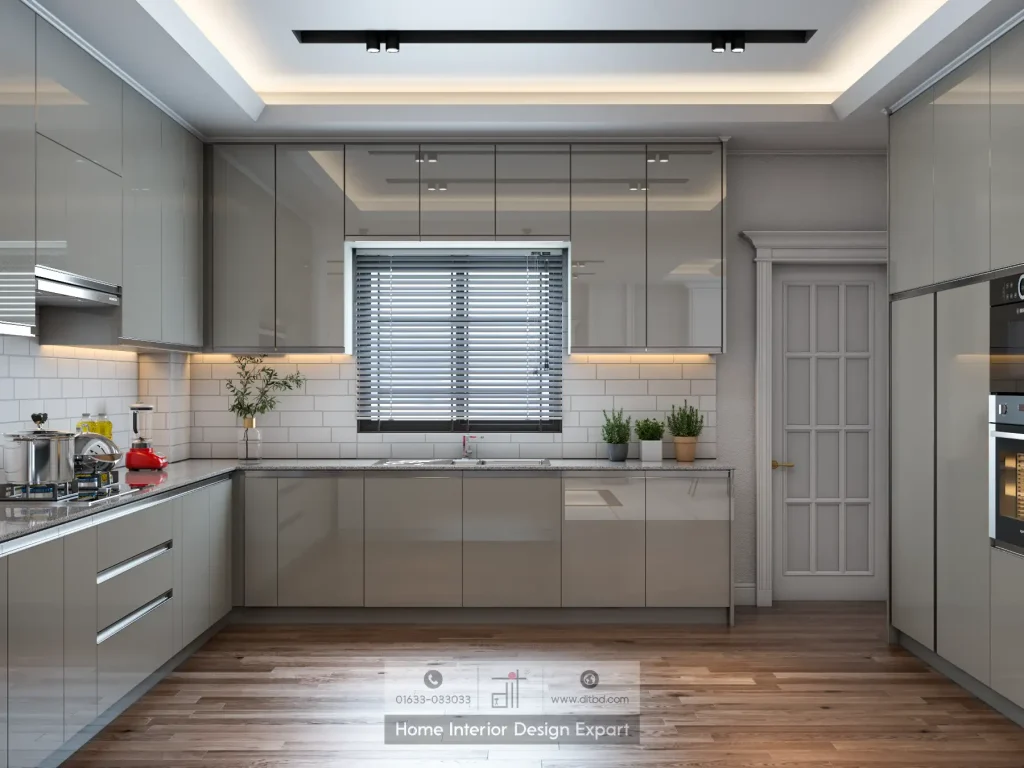
A U-shaped kitchen uses three walls for cabinetry and counters, creating the most storage-rich and workflow-efficient layout of all configurations. In an open-plan version, the fourth side (the opening of the “U”) faces the dining room directly, with no wall between them. This creates a clear visual separation between the kitchen zone and the dining area while maintaining the open, connected feel.
The U-shaped layout produces a naturally tight and efficient work triangle. The National Kitchen and Bath Association (NKBA) recommends a work triangle perimeter of no more than 26 feet for comfortable cooking. U-shaped kitchens in properly sized rooms typically produce work triangles well within this range, reducing steps and fatigue during long cooking sessions.
What makes it work in Dhaka: This layout is ideal for households that cook multiple dishes simultaneously, which is common in Bangladeshi family cooking. All three stations (hob, sink, refrigerator) are within steps of each other. The opening of the “U” facing the dining area gives the cook a direct view of the dining table and living space.
Minimum flat size: Kitchen of 107–120 sq ft minimum, with at least 5 feet of clearance between opposing counters. Best in 3 and 4 BHK apartments of 1,800 sq ft or above, particularly in premium developments. You can see how this layout transforms a premium dining space in our luxury dining space design in Gulshan 2.
Storage notes: Three walls of cabinetry provide maximum storage. Use the middle wall (the back of the “U”) for the hob and overhead cabinets. Corner spaces benefit from carousel or magic corner units. A tall pantry tower fits naturally at one end of a side arm.
Workflow notes: The U-shape is excellent for two cooks working simultaneously, as the layout provides separate zones on each arm. Ventilation planning is critical here. The chimney typically sits on the middle wall above the hob, and the duct must route through the wall or ceiling to exit the building. Budget for a 900 CFM or above ducted chimney given the enclosed nature of the layout.
What if your building doesn’t allow full wall removal? The partial partition layout below covers that scenario directly.
Layout 5: The Open Kitchen-Dining Combination with Partial Partition
Not every home is ready for a full wall removal. Not every budget supports a complete structural conversion. The partial partition approach gives you the benefits of an open kitchen without the engineering complexity or cost. Instead of removing the wall between the kitchen and dining area completely, you remove the upper portion of the wall, creating a low partition (typically 90–110 cm height) that serves as a breakfast counter or pass-through shelf.
This approach is growing in popularity among younger Dhaka homeowners who want a modern, connected feel but are renting, living in older buildings, or working with tighter budgets.
What makes it work in Dhaka: The partial partition approach suits almost any building type, including older load-bearing masonry buildings, because you’re not removing the structural portion of the wall. The lower section remains, carrying any load above, while the upper section becomes open space. A 2024 study on kitchen ventilation found that even partial openings between kitchen and dining spaces improve natural air circulation significantly compared to fully closed kitchens. Pair this with a quality ducted chimney and you get excellent odour management.
We’ve designed partial partition kitchens in several older Dhaka buildings where structural constraints ruled out full wall removal. Clients are consistently surprised by how much the atmosphere changes with just the upper wall open. Light flows through, the cook can see the dining table, and the space feels genuinely connected, not just visually enlarged.
Minimum flat size: Suitable for kitchens of any size. Works particularly well in apartments of 900–1,400 sq ft where a full wall removal is impractical.
Storage notes: The low partition itself can incorporate shelving or display niches on the dining side, adding practical storage while creating an attractive design feature. On the kitchen side, mount the chimney directly above the hob. Full-height overhead cabinets remain along the working walls.
Workflow notes: The kitchen retains its original layout (L-shaped, galley, or single-wall) on the kitchen side. The partition creates a visual boundary while allowing sound, light, and conversation to flow between the two spaces. This is also the most reversible option if your circumstances change.
For help selecting the right combination of layout, partitioning, and common space design for your Dhaka apartment, our team at DIT Studio is ready to assist.
Frequently Asked Questions
Which open kitchen layout works best for a 1,200 sq ft Dhaka apartment?
For a typical 1,200 sq ft Dhaka flat, the L-shaped open kitchen with a breakfast bar is the most practical choice. It fits in kitchens as small as 50 sq ft, doesn’t require major structural work if the wall between kitchen and dining is non-load-bearing, and the breakfast bar creates a social dining option. Pair it with a 600 CFM ducted chimney for odour control.
Can I fit a kitchen island in a standard Dhaka apartment?
Only if your kitchen is at least 10 feet (approximately 3 metres) wide and has 120 sq ft or more of total floor area. The NKBA recommends 1,050mm of clear walkway around all sides of an island (minimum 900mm). In practice, this means your kitchen needs at least 120 sq ft. Many 3 BHK and 4 BHK apartments in Gulshan, Banani, and Dhanmondi meet this requirement, but you should measure before committing to the layout.
What is the most storage-efficient open kitchen layout?
The U-shaped layout provides the most storage, with three full walls of cabinetry. However, it requires the largest footprint (107–120 sq ft minimum). For smaller kitchens, a well-planned L-shaped layout with tall pantry towers and overhead cabinets can approach U-shaped storage levels while fitting in a smaller room.
How do I manage cooking smells in an open kitchen in Bangladesh?
The single most effective solution is a high-quality ducted chimney rated at 600–900 CFM, installed directly above the hob and ducted to the outside of the building. Recirculating (ductless) chimneys are not effective for heavy Bangladeshi cooking. Research from the Journal of Building Engineering (2024) confirms that extracting (ducted) ventilation significantly outperforms recirculating systems for odour, smoke, and moisture removal. Our detailed guide on solving cooking odour problems in open kitchens covers this topic in full.
Which open kitchen layout suits two people cooking at the same time?
The U-shaped layout and the L-shaped layout with island both provide enough space and separate work zones for two cooks. The U-shaped kitchen is particularly effective because each arm of the “U” can serve as an independent work zone. The galley layout, while efficient, creates a single corridor that can feel cramped for two cooks working simultaneously.
Which layouts genuinely don’t work in smaller Dhaka flats?
The L-shaped island layout and the U-shaped layout both require kitchens of 120 sq ft or more. In a typical 900–1,100 sq ft Dhaka flat where the kitchen is 50–70 sq ft, these configurations simply can’t be done safely. The L-shaped layout with breakfast bar or the partial partition layout are more realistic choices for those apartment sizes. It’s better to know this upfront than to discover it after design has begun.
Conclusion
Choosing the right open kitchen layout for your Dhaka apartment is about matching the configuration to your space, your cooking habits, and your vision for how you want to live. The L-shaped layout with a breakfast bar suits most mid-range apartments. The U-shaped open kitchen maximises storage and workflow for larger premium flats. The galley open plan transforms long, narrow kitchen rooms. The island configuration is aspirational and achievable in the right space. And the partial partition offers a practical, budget-friendly step toward openness.
Whatever layout you’re drawn to, the success of your open kitchen depends on meticulous planning: the right chimney, the right structural assessment, and a design that treats ventilation as a priority, not an afterthought.
For more guidance on planning your home design holistically, our articles on space-saving interior design ideas for small flats in Dhaka and modular kitchen vs traditional kitchen are useful companion reads.
At DIT Studio, we’ve crafted open kitchens across Dhaka’s most varied apartment types. We’ll help you identify which layout suits your flat and bring your vision to life with care and precision. Explore our open kitchen design service or contact us to begin your kitchen transformation today.
Written by the DIT Studio design team — Bangladesh’s specialist home interior firm since 2011. We’ve designed both open and enclosed kitchens across hundreds of Dhaka homes, navigating the practical realities of Bangladeshi cooking culture and apartment layouts.