
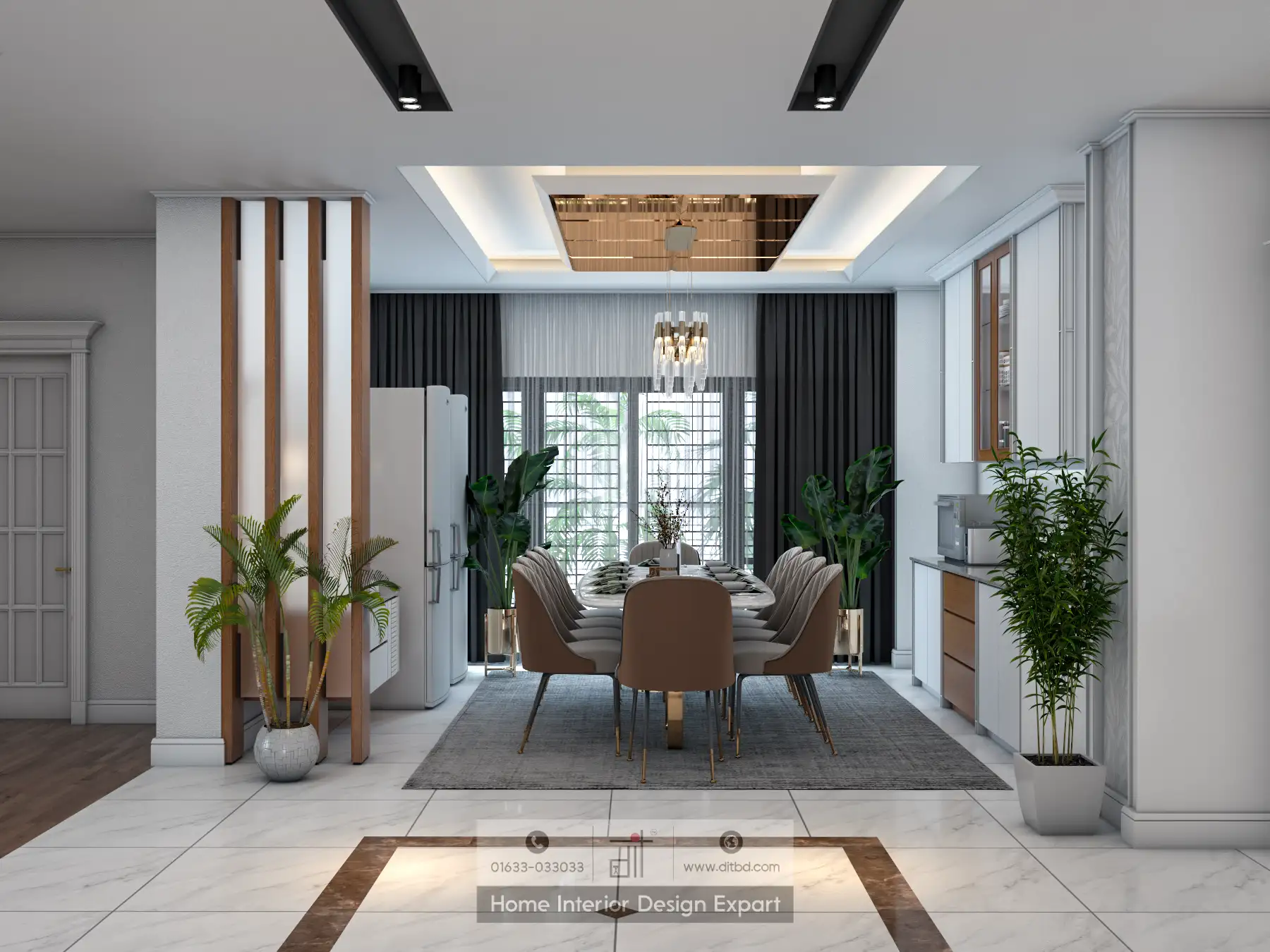
Flat interior design is one of the biggest financial decisions a homeowner makes, and the anxiety that comes with it is completely normal. Where do you start? How much does a full apartment renovation cost in Dhaka? How long will it take before you can move in? Will you have to live elsewhere during the work? What happens if the final result looks nothing like the plan? DIT Studio has spent over 15 years answering exactly these questions for hundreds of Dhaka families, and this guide is built from that real-world experience.
Interior design for a Dhaka flat goes beyond aesthetics. A well-planned flat uses every square foot efficiently, holds up against the city’s heat and humidity, and reflects the way a specific family actually lives. A rushed or poorly planned interior tends to look dated within three years and requires expensive repairs within five. The difference comes down to process, material knowledge, and timeline discipline.
In this guide, we explain every phase of a complete flat interior design project in Dhaka, from the first planning meeting through the final quality check, with honest cost ranges, honest timelines, and clear advice on where to spend and where to save.
The Three Phases of a Complete Flat Interior Design in Dhaka
Professional home interior design in Dhaka follows a structured three-phase process. Each phase builds on the previous one, and skipping any part of the sequence is the single most common cause of cost overruns and client disappointment.
Phase 1: Planning and Concept (Weeks 1 to 2)
Every successful apartment interior design project starts with a thorough site assessment. A designer measures every room with precision, notes architectural features such as windows, door swings, and structural walls, and maps the natural light pattern at different times of day. These measurements are not optional formalities, they are the foundation on which every design decision rests.
Lifestyle conversations happen alongside the measurements. How does the family cook? Do they entertain frequently? Does anyone work from home? Are there young children or elderly residents whose movement patterns affect layout decisions? A flat designed around the real daily routine of its occupants functions far better than one designed around a generic floor plan.
Style preferences, budget ceilings, and clear priorities are all finalised in Phase 1. The output is a written brief that becomes the reference point for every decision made afterward. Families who invest time in this phase almost always finish on budget and on schedule. Those who skip it almost always do not.
Phase 2: Design and Material Selection (Weeks 2 to 4)
Detailed layout plans come first in Phase 2. Furniture placement, traffic flow routes, storage placement, and spatial organisation are all mapped out before any material is selected or any money is committed. A 3D rendering of each major room lets the client see the finished space on screen before a single nail is driven.
Material selection follows layout approval. Paint palettes, flooring options, tile finishes for bathrooms and kitchens, upholstery fabrics, cabinetry laminates, and hardware finishes are all reviewed together as a system, not individually. The interaction between a floor color, a wall color, and a natural light source matters enormously in Dhaka’s varied apartment orientations.
The Phase 2 output is a detailed specification document covering every material, every dimension, every finish code, and a week-by-week execution timeline. This document prevents misunderstandings and creates clear accountability for everyone involved in the project.
Phase 3: Execution and Quality Check (Timeline Varies by Project Size)
Custom furniture manufacturing begins in Phase 3, alongside on-site civil work such as wall preparation, flooring installation, and electrical routing. A project manager conducts regular inspections at each stage to verify that dimensions match the specification, finishes are applied correctly, and materials match the approved samples.
The final quality check is a comprehensive walk-through of the completed flat with the client before handover. Every door, drawer, switch, and fitting is tested. Every painted surface is inspected under direct light. Any issue caught at this stage costs nothing to fix. The same issue discovered after the client has moved in costs both time and money.
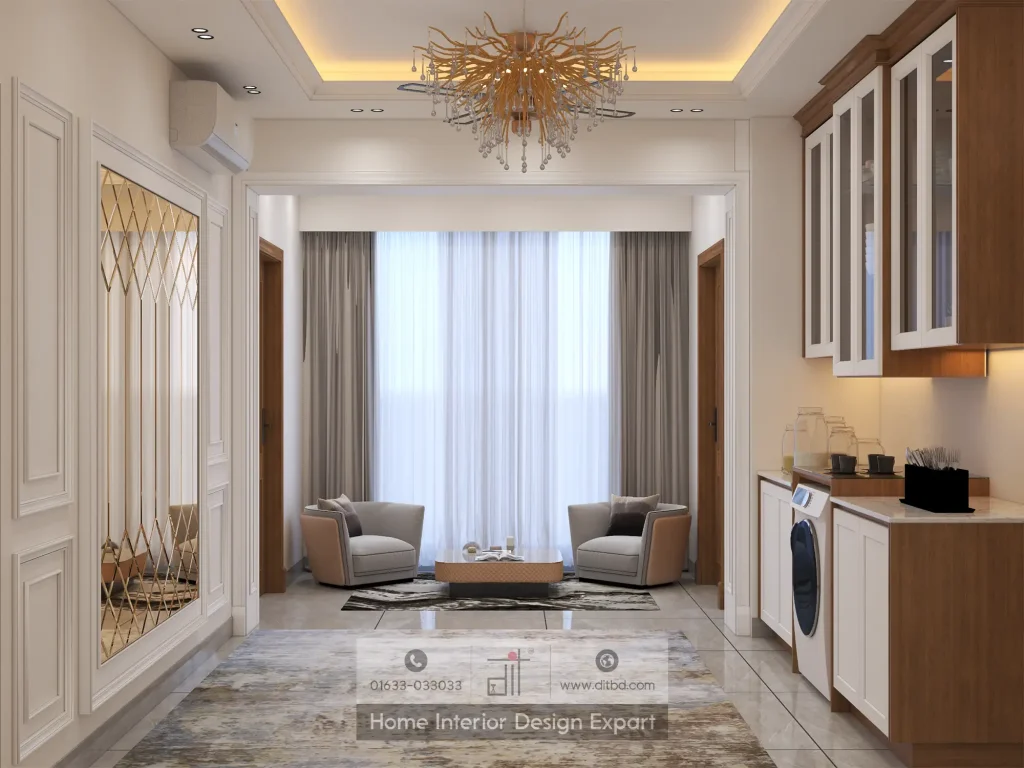
Flat Interior Design Cost in Dhaka: What You Will Actually Spend
Budget planning is where most Dhaka homeowners feel the most uncertainty. Realistic cost ranges exist for every flat size and finish level, and understanding them prevents the two most common problems: under budgeting and getting surprised mid-project.
Cost Ranges by Flat Size and Finish Level
1,000 to 1,200 sq ft, functional setup: Tk 4 to 7 lakhs
A well-designed functional interior at this budget covers quality paint, essential built-in storage, durable flooring, and practical furniture. The result is a tasteful, cohesive home where nothing is wasted and everything works. This tier does not include premium finishes or extensive customisation, but it does include professional planning that prevents the layout mistakes a DIY approach produces.
1,200 to 1,500 sq ft, comfortable design: Tk 7 to 12 lakhs
The Tk 7 to 12 lakh range is the sweet spot for most Dhaka families. Better material choices, a higher proportion of custom furniture, improved lighting design, and more refined storage solutions all become possible. The space feels curated rather than assembled. Personality comes through in the finishes and proportions.
1,500 to 1,800 sq ft, premium setup: Tk 12 to 20 lakhs and above
Premium apartment interior design in Dhaka at this budget level includes imported or high-specification local materials, extensive customisation across every room, sophisticated lighting layers, and design details that make a flat feel genuinely unique. Bespoke custom furniture design dominates at this tier, with every piece built to the exact dimensions and specifications of the space.
Where the Budget Goes
- Custom furniture and cabinetry (40 to 50%): Built-in wardrobes, modular kitchen cabinetry, dining storage, and bedroom joinery make up the largest single budget category. Quality matters here more than anywhere else because poor-quality plywood warps in Dhaka’s humidity and forces expensive replacement within three to four years.
- Hard finishes such as paint, flooring, and tiles (20 to 25%): Flooring and paint establish the visual foundation of every room. A well-chosen floor colour and paint palette make a standard-sized Dhaka flat feel larger and more coherent.
- Lighting and electrical fixtures (10 to 15%): Lighting design is consistently underestimated by first-time homeowners. Recessed lighting, wall sconces, under-cabinet task lighting, and pendant fixtures each serve different functions, and a flat without a proper lighting plan feels flat and lifeless after dark.
- Soft furnishings and accessories (10 to 15%): Curtains, rugs, cushions, wall art, and indoor plants add warmth and personality. These are also the easiest elements to update later without touching the rest of the interior.
- Contingency (5 to 10%): Every flat renovation project in Dhaka encounters at least one unforeseen issue, whether a structural surprise inside a wall, a material that arrives in the wrong specification, or a design refinement the client decides to make mid-project. A 10% contingency is not pessimism, it is discipline.
DIT Studio operates an in-house manufacturing facility, which eliminates the middleman markup that applies when designers outsource to external vendors. The direct control over production means better quality verification, faster turnaround, and a single point of accountability for the entire project.
Three Budget Myths That Cost Dhaka Homeowners Money
Myth 1: Off-the-shelf furniture saves money compared to custom.
Store-bought furniture rarely fits a Dhaka flat’s walls, corners, and structural columns efficiently. Homeowners end up buying two or three pieces to fill a space that a single custom-built unit would serve better and at lower total cost. A Tk 1 lakh custom wardrobe designed for a specific wall provides more usable storage than three Tk 40,000 off-the-shelf pieces that leave gaps and block door swings.
Myth 2: Cutting corners on furniture quality saves money.
MDF and low-grade plywood absorb moisture and begin to swell within two to three years in Dhaka. The replacement cost exceeds the original saving within a single furniture cycle. Marine-grade plywood and high-pressure laminates cost more upfront and last 15 years or more without structural issues in Bangladesh’s climate.
Myth 3: Cosmetic changes can be done later without penalty.
Delayed decisions extend timelines and raise costs. Workers who leave a site and return for a second mobilisation charge accordingly. Decisions made separately from the original project lack the coordination that produces a coherent interior. Doing everything in one planned sequence is always cheaper and faster than phasing it by necessity.
Interior Design Timeline for Dhaka Flats: Realistic Expectations
The most common question from Dhaka homeowners planning an apartment renovation is when they can move in. The honest answer depends on the flat size and the complexity of the design decisions.
Small Flat (1,000 to 1,200 sq ft): 6 to 8 Weeks Total
Design and material selection takes two to three weeks. Execution takes four to five weeks. Most small flats are move-in ready within eight weeks of the first design meeting, provided decisions are made promptly during the design phase.
Medium Flat (1,200 to 1,500 sq ft): 8 to 10 Weeks Total
The design phase extends to three weeks for medium flats because more rooms and more material combinations require more review. Execution takes five to seven weeks. The 8 to 10 week total is the most common project duration for Dhaka families undertaking a complete interior design.
Larger Flat (1,500 sq ft and Above): 10 to 14 Weeks Total
Larger apartments require more coordination between manufacturing, civil work, and installation teams. The design phase runs three to four weeks, and execution takes seven to ten weeks. The additional weeks are not padding, they reflect the genuine complexity of coordinating multiple trades across a larger space.
Factors That Shift the Timeline
- Custom versus modular choices: Fully bespoke furniture requires longer manufacturing lead times than modular systems. Budget two to three additional weeks for projects with a high proportion of fully custom pieces.
- Monsoon season (June to September): Dhaka’s monsoon introduces humidity-related precautions for certain finishes and occasional delivery delays. Projects starting during monsoon typically run one to two weeks longer.
- Imported materials: Imported tiles, hardware, or specialty finishes have longer lead times than locally sourced equivalents. Finalise material selections early and confirm availability before committing to a timeline.
- Structural changes: Moving electrical outlet positions, relocating plumbing for an open kitchen design, or removing non-structural walls all extend the execution phase significantly.
- Client decision speed: Delayed approvals are the most common cause of timeline extension across all project sizes. Families who arrive at design review meetings with clear preferences and who approve specifications promptly finish weeks ahead of those who deliberate excessively.
DIT Studio runs design development and manufacturing preparation in parallel where possible, so the factory begins material preparation while the client is finalising finish selections. This sequencing reduces the total project duration by one to two weeks compared to strictly sequential workflows.
Why Rushing a Dhaka Flat Renovation Costs More Than It Saves
Compressed timelines produce preventable problems. Paint that has not cured properly before furniture installation marks and chips within months. Flooring laid over a substrate that has not fully dried lifts at the joints within a year.
Furniture built in a hurry has alignment issues that are visible every time a drawer is opened. These are not abstract risks, they are the consistent outcomes of rushed apartment renovation in Dhaka, and fixing them after handover costs significantly more than taking the time to do them correctly the first time.
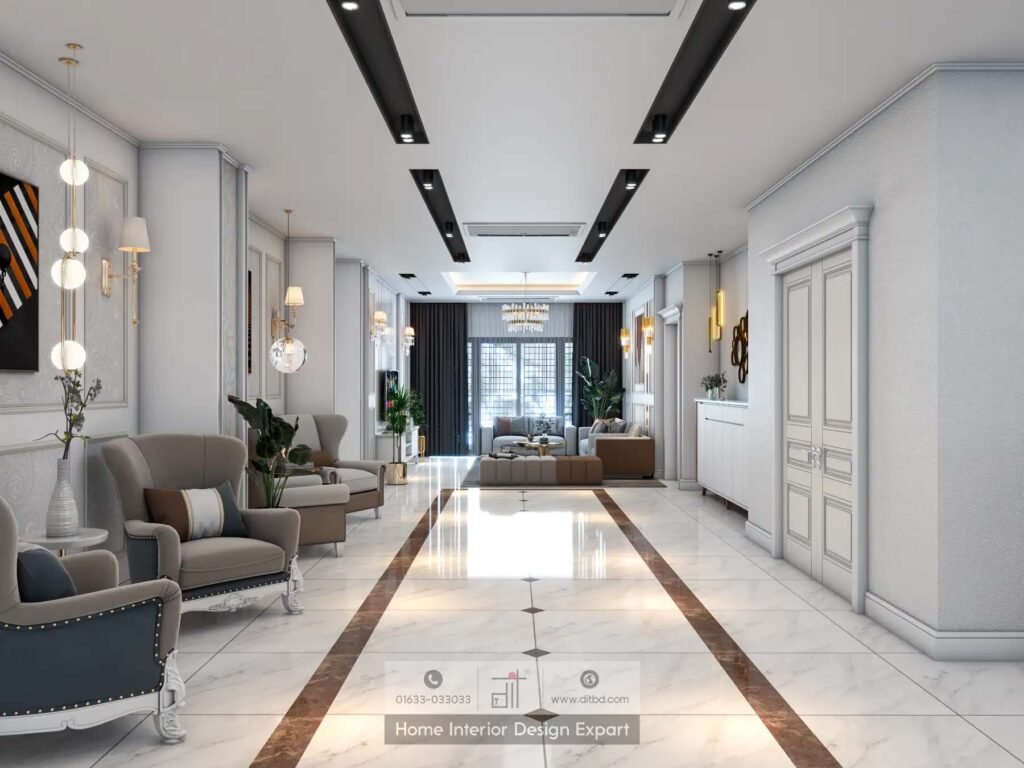
Material Selection for Dhaka’s Climate: What Performs and What Fails
Dhaka’s climate is hot, humid for at least six months of the year, and dusty during the dry season. Interior materials that perform well in Europe or in drier parts of Asia often fail prematurely in these conditions. Material knowledge is one of the most important things an experienced Dhaka interior designer brings to a project.
Flooring Options
Ceramic and porcelain tiles
Ceramic tiles are durable, heat-resistant, and completely unaffected by Dhaka’s humidity. Porcelain tiles are denser and even more resistant to moisture absorption. Both are available in a wide range of finishes, from matte stone-look to polished marble-effect. Pricing runs from Tk 80 to Tk 150 per sq ft for ceramic and Tk 120 to Tk 250 per sq ft for porcelain. The primary limitation is thermal comfort in bedrooms, where a cold tile floor underfoot is less pleasant than a warmer surface.
Engineered wood
Engineered wood provides the warmth and visual richness of timber with better moisture resistance than solid wood. Pricing ranges from Tk 150 to Tk 300 per sq ft depending on the species and quality. Proper installation with moisture barriers and sealed edges is essential for performance in Dhaka. Without these precautions, even engineered wood warps at the joint lines within two to three monsoon seasons.
Luxury vinyl plank
Luxury vinyl plank flooring at Tk 40 to Tk 80 per sq ft is the most cost-effective option for moisture-prone areas or tight budgets. Modern luxury vinyl mimics stone and wood convincingly at lower price points. The material is completely waterproof and requires minimal maintenance.
Marble and natural stone
Marble and natural stone flooring at Tk 200 to Tk 500 per sq ft make a strong visual statement in living areas and foyers. Proper sealing against moisture and staining is non-negotiable in Dhaka’s climate. Sealed correctly, marble lasts decades without significant deterioration.
Furniture Materials and Climate Performance
The plywood-versus-MDF decision is one of the most consequential material choices in a Dhaka flat renovation. MDF is cheaper and machines cleanly, but absorbs moisture and loses structural integrity within three to four years in Bangladesh’s humidity.
Marine-grade plywood is approximately 30% more expensive and lasts three to four times longer under the same conditions. For built-in wardrobes, bedroom storage furniture, and kitchen cabinetry, marine-grade plywood is the correct choice every time.
Upholstery fabrics in Dhaka face two challenges: humidity-related mildew growth and UV fading from strong tropical sunlight. Synthetic microfibre and solution-dyed acrylic fabrics resist both. Natural cotton and linen are more comfortable but require proper treatment and more frequent professional cleaning to remain fresh in a humid environment.
Metal furniture frames perform well when they are stainless steel or properly powder-coated. Untreated mild steel corrodes within two monsoon seasons in Dhaka’s humidity. The powder-coating or stainless specification is worth the additional cost.
Paint and Surface Coatings
Premium paint brands with moisture-resistant formulations outperform budget local paints in Dhaka’s climate because their binders resist the humidity-driven osmotic pressure that lifts cheaper paint from the substrate. The price difference per litre is modest compared to the labour cost of repainting every three years.
For bathroom design and kitchen surfaces, moisture-resistant coatings are not a luxury, they are a functional requirement. Standard emulsion paint in a bathroom without adequate ventilation begins to show mould and peeling within two years.
Material Mistakes That Add Up
- Low-grade plywood in built-in furniture warps and swells, requiring full replacement within four to five years.
- Unsealed or inadequately sealed wood surfaces absorb moisture, darken, and soften at fastener points.
- Budget upholstery fabric fades noticeably within two years under Dhaka’s UV exposure and develops a musty odour without regular professional cleaning.
- Standard emulsion paint in wet areas peels within two to three years, requiring frequent repainting and ongoing labour costs.
Thinking in 10-year cost terms rather than upfront cost terms almost always favours the higher-quality material choice. A Tk 3 lakh flooring investment that lasts 20 years costs far less per year than a Tk 1.5 lakh floor that needs replacing after seven.
Five Interior Design Mistakes Dhaka Flat Owners Make Most Often
Mistake 1: Ordering Furniture Without Verified Measurements
Furniture ordered without precise site measurements is one of the most common and most frustrating mistakes in Dhaka flat renovations. A sofa that does not pass through a bedroom door, a dining table that blocks the kitchen entrance, or wardrobes that clash with the door swing arc are all entirely preventable with a proper measured floor plan. Laser measurement tools produce accuracy to within two millimetres. Every design decision starts from verified dimensions.
Mistake 2: Designing Without Considering Traffic Flow
Traffic flow is how people actually move through a space. Living room design that places seating in the natural path from the entrance to the kitchen forces every household member to navigate around furniture all day. In Dhaka’s compact flats, traffic flow planning is especially important because there is little margin for error. Good spatial design makes movement feel natural and effortless. Poor spatial design makes a flat feel smaller than it measures.
Mistake 3: Ignoring the Flat’s Natural Light
Dhaka apartments face different directions, and each orientation creates a different quality of natural light throughout the day. North-facing flats are consistently cooler and dimmer. South-facing flats receive strong light that shifts through the space during the day. East-facing rooms are brightest in the morning.
West-facing rooms receive intense afternoon sun. Paint colours, flooring tones, and curtain weights all need to be chosen with the specific light character of each room in mind. A dark colour that looks rich in a brightly lit south-facing room looks oppressive in a north-facing bedroom. Visiting the flat at different times of day before finalising a colour palette eliminates this problem entirely.
Mistake 4: Following Trends That Date Quickly
Interior design trends cycle faster than a flat renovation. Bold accent colours, novelty textures, and statement furniture that look compelling on social media tend to feel dated within 18 to 24 months.
The smarter approach is to build timeless bones, neutral wall colours, quality flooring, well-proportioned furniture layouts, and to use trend-led choices only in easily replaceable accessories such as cushions, artwork, and small decorative objects. The bedroom colour palette guide from DIT Studio covers exactly this balance between current preferences and long-term livability.
Mistake 5: Making Delayed Decisions and Absorbing the Costs
Decision delays cost money in two ways: extended contractor time on-site and the cascading effect of one delayed decision on every subsequent step. When a flooring choice is delayed, installation is pushed back. When installation is pushed back, furniture delivery is rescheduled.
When furniture delivery is rescheduled, the entire project end date moves. Families who come to design review meetings prepared, who review options in advance, and who approve specifications within 24 hours of receiving them consistently finish on budget. Families who treat each decision as an opportunity to reconsider everything from the beginning consistently exceed both budget and timeline.
Room-by-Room Design Priorities for a Dhaka Flat
Living Room and Drawing Room
The living room design in a Dhaka flat performs multiple functions: daily family relaxation, guest reception, and often a secondary workspace. Layout decisions need to accommodate all three without forcing compromises that make any one function uncomfortable.
Understanding the difference between a living room and a drawing room matters in Dhaka flats where both terms are used interchangeably but the design priorities differ. A drawing room for formal guests needs different furniture spacing and lighting from a living room for daily family use.
For small living spaces, smart living room design ideas for small Dhaka flats include wall-mounted storage, light-reflective paint palettes, multi-function furniture, and carefully positioned mirrors to extend perceived depth.
Bedroom Design
Bedroom interiors in a Dhaka flat need to balance storage, comfort, and the thermal reality of the local climate. Built-in wardrobes designed for the exact wall dimensions provide far more storage than freestanding alternatives at comparable cost.
Bedroom interior design in smaller flats benefits enormously from purpose-built storage solutions. The DIT Studio guide to practical storage solutions for small bedrooms covers under-bed storage platforms, vertical wardrobe systems, and headboard storage integration in detail.
Lighting in the bedroom deserves specific attention. The guide on how lighting transforms a bedroom explains the layered approach that most Dhaka bedrooms lack: ambient overhead lighting for general use, task lighting for reading, and warmer accent lighting for relaxed evening use.
Kitchen Design
Kitchen layout is one of the most consequential decisions in a complete flat interior design. The choice between modular kitchen design and traditional kitchen design affects both the budget and the long-term functionality of the space.
The DIT Studio comparison of modular kitchen versus traditional kitchen for Dhaka homes covers material differences, cost implications, and maintenance requirements in full detail. For open-plan layouts, open kitchen design integrates the cooking and dining zones into a cohesive social space that works especially well in medium and larger flats.
Bathroom Design
Bathroom design in Dhaka flats is primarily a waterproofing and ventilation challenge alongside an aesthetic one. A bathroom that looks beautiful but has inadequate waterproofing behind the tiles will begin to show problems within two to three years, often after the warranty period of a lower-quality contractor has expired. Bathroom design at DIT Studio addresses waterproofing as a primary specification, not an afterthought, and uses fittings rated for the water pressure and quality conditions common in Dhaka apartment buildings.
Common Spaces
Entry areas, dining zones, and family rooms are addressed under common space design. These spaces often receive less attention than bedrooms and kitchens during the planning phase, but they are the areas of the flat where the overall quality of the design is most visible to guests and most experienced by the family daily. A well-designed dining zone anchors the home socially. A neglected entry creates a negative first impression that no amount of beautiful bedroom design can overcome.
Questions to Ask Before Hiring an Interior Designer in Dhaka
Not every designer operating in Dhaka has the experience, the manufacturing capacity, or the project management systems to deliver a complete flat interior design reliably. These questions reveal the ones who do.
What does your design process look like from the first meeting to handover?
A confident, detailed answer signals a mature process. A vague or inconsistent answer signals improvisation.
Do you have an in-house manufacturing facility or do you outsource production?
In-house manufacturing means faster turnaround, lower cost, and a single accountable point for quality. Outsourced production adds layers of coordination risk and cost.
Can you show completed Dhaka projects at a similar flat size and budget level?
Portfolio examples from the same market and budget category are far more relevant than beautiful projects from a different context.
How do you handle design changes after the project specification is agreed?
A clear change-management process with written documentation protects the client. Informal verbal agreement on changes is a consistent source of disputes.
What happens if I am not satisfied with the work at handover?
A warranty policy and a clear process for addressing defects are the minimum acceptable standard. Vague reassurances are not.
Who is my primary contact throughout the project, and how do I reach them?
A named project contact and clear communication channels prevent the frustration of chasing information from multiple people who are each partially informed.
How do you manage delays caused by material unavailability or monsoon weather?
Good project management includes contingency planning for the risks that are predictable in Dhaka. Designers who have not thought about this have not managed enough projects.
What is included in the quoted price, and what costs extra?
A detailed line-item quotation protects the client from surprises. A global sum quotation without a breakdown is a warning sign.
Your Next Steps: Planning Your Dhaka Flat Interior Design
Planning a complete flat interior design becomes straightforward once you know the process, the realistic costs, and the common mistakes to avoid. These are the steps to take now.
Step 1: Book a consultation
DIT Studio offers free initial consultations. The conversation covers your flat size, your lifestyle needs, your budget range, and your timeline. Both parties use this meeting to determine whether there is a good fit before any commitment is made. View our completed projects beforehand to develop a clear sense of the design directions that appeal to you.
Step 2: Prepare a priorities list before the meeting
What problems does the current space have? What style do you gravitate toward? What is your firm budget ceiling? What is your target move-in date? Clear answers to these questions make the first meeting productive immediately.
Step 3: Set a realistic budget with a 10% contingency
Use the cost ranges in this guide to establish a starting point. Reserve 10% above your target figure for unforeseen conditions. A project with a built-in contingency stays calm when surprises happen. A project budgeted to the last taka creates stress every time a small issue emerges.
Step 4: Review the DIT Studio portfolio and client references
Before-and-after photographs of completed Dhaka flats at comparable sizes and budgets are the most reliable indicator of what the finished result will look like. Client references from completed projects tell you about the experience of working with the team, not just the appearance of the final product.
Step 5: Request a detailed written proposal
A complete proposal includes a scope of work, a material specification list, a week-by-week timeline, a cost breakdown by category, and the process for handling changes or unforeseen conditions. Any proposal that does not include all of these elements is incomplete.
Step 6: Establish communication expectations at the start of the design phase
Agree on how often you will meet, how updates are shared, what the expected response time is for approval requests, and who contacts whom in an emergency. Clear communication norms established at the beginning prevent the misunderstandings that derail projects mid-execution.
Frequently Asked Questions About Flat Interior Design in Dhaka
Can the project be completed in phases to spread the cost?
Phasing is possible and is a practical choice for many Dhaka families. Completing the bedrooms and living areas first, then returning for the kitchen in a later phase, is a common approach.
The cost implication of phasing is that it requires two separate contractor mobilisations rather than one, which adds overhead. Phasing should be discussed with the designer at the beginning so that the Phase 1 work does not conflict with Phase 2 plans.
The DIT Studio article on space-saving ideas for small Dhaka flats is useful reading for families working within a tighter budget in the first phase.
How much of the budget should go to contingency?
Ten percent is the standard recommendation for a complete flat renovation in Dhaka. Structural surprises behind walls, material substitutions when a specified product is unavailable, and small client-driven design refinements all draw on this reserve. The 10% contingency is not expected to be spent in full on most projects, but it is expected to be needed in part on almost every project.
What is the most affordable way to refresh a dated Dhaka flat?
Fresh paint, new flooring, and updated lighting deliver the highest visual impact per taka spent. A complete repaint at Tk 1 to 2 lakhs, a flooring replacement at Tk 2 to 4 lakhs, and a lighting update at Tk 50,000 to Tk 1 lakh transform a dated flat for a total of Tk 3 to 7 lakhs, without touching furniture or cabinetry.
The accent wall guide for drawing rooms in Bangladesh is a useful reference for homeowners who want a dramatic visual change at minimal cost.
Is it worth hiring a professional designer for a small budget project?
Professional design adds value at every budget level. A Tk 5 lakh project with a designer avoids Tk 1 to 1.5 lakhs in preventable layout mistakes, wrong material purchases, and rework. The designer’s fee is recovered through error prevention. A DIY approach at the same budget frequently produces a result that requires expensive correction within two to three years.
DIT Studio designs and builds complete flat interiors in Dhaka with full in-house manufacturing capacity, transparent pricing, and a structured project management process. To discuss your flat’s specific requirements, visit our contact us page to book a free initial consultation.