
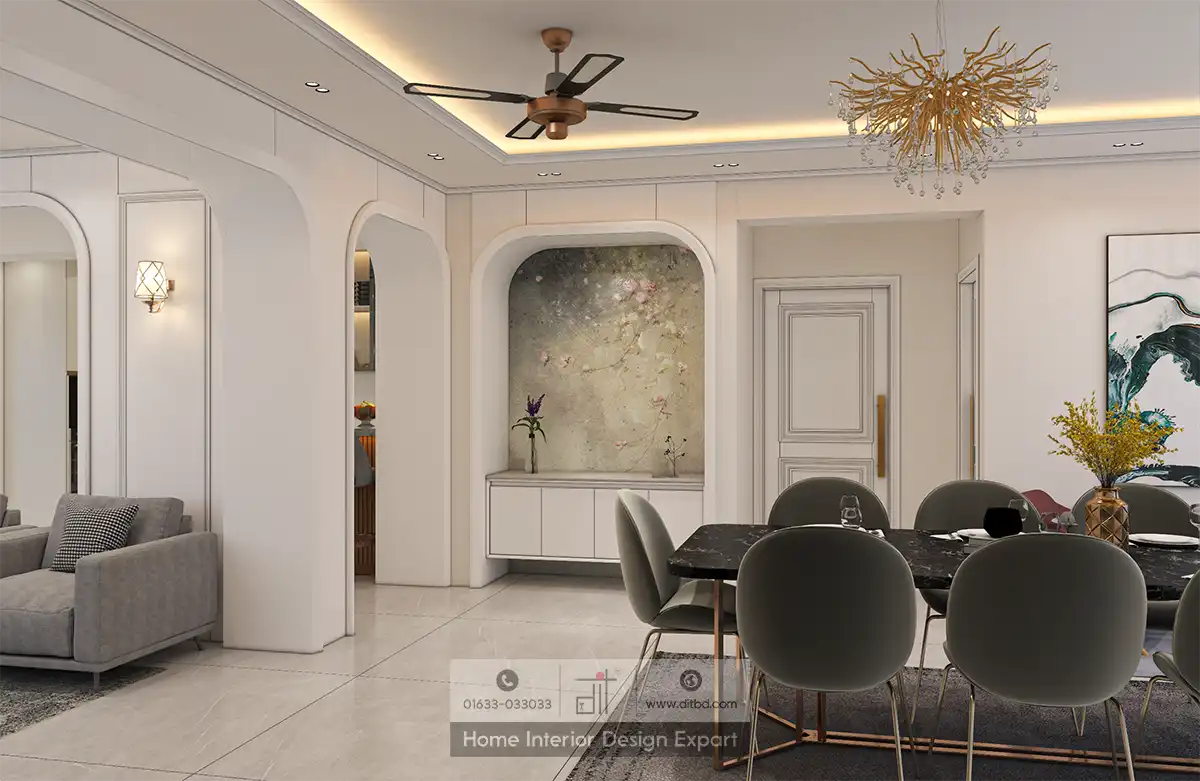
Your foyer is the first thing guests see when they walk into your home. It sets the tone, signals your taste, and shapes how people feel about everything that follows. Yet in most Dhaka apartments, the entryway gets little more than a coat rack and an afterthought. According to behavioral research cited by the National Association of Realtors, 63% of buyers say an entryway “strongly influenced” their first impression of a property. If it matters that much to someone visiting for the first time, imagine how much it matters to you every single day. Here, we share five foyer design ideas we’ve refined through years of common space design projects across Dhaka.
Key Takeaways
- 63% of home visitors say the entryway strongly shapes their first impression (National Association of Realtors)
- A steel entry door replacement delivers 188% ROI, the highest of any home improvement project (Remodeling Magazine / Zonda, 2024 Cost vs. Value Report)
- Built-in shoe cabinets and wall-mounted storage are the most practical upgrades for compact Dhaka foyers of 20–40 sq ft
- Accent lighting and mirror panels can visually double the perceived width of a narrow entryway
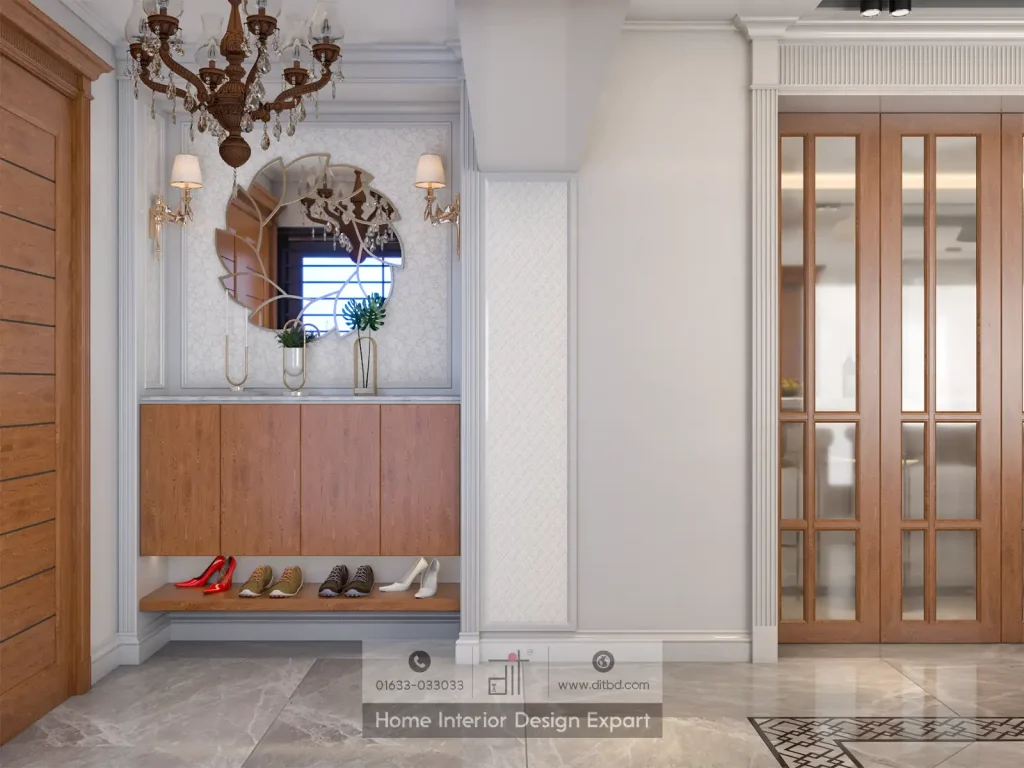
1. Built-In Shoe Cabinets: Function First, Style Always
In Bangladeshi homes, shoes come off at the door. It’s cultural, it’s hygienic, and it’s non-negotiable. The trouble is that without a proper system, footwear piles up at the entrance and creates clutter that makes even a beautiful foyer feel chaotic.
A built-in shoe cabinet is the single most practical upgrade you can make to a Dhaka foyer. We design these to run floor-to-ceiling, maximising every centimetre of vertical space. The lower section holds everyday shoes, while upper compartments store seasonal footwear or bags. Closed-front cabinetry keeps the look clean and uniform. A slim bench integrated into the bottom of the unit gives you a place to sit while putting on or removing footwear.
We’ve learned a few things from doing this across dozens of projects. Cabinet depth matters: 300–350mm is the sweet spot for standard shoe sizes without the cabinet projecting awkwardly into circulation space. Anything shallower forces shoes to sit at an angle and the door gaps around them. Anything deeper starts to eat into a foyer that’s already tight. In a Wari apartment we redesigned last year, the homeowners had a 300mm-deep cabinet that had been installed flush with the door architrave. It was invisible when closed and stored 28 pairs of shoes across the family of five.
According to the global home storage and organisation market report by Global Growth Insights (2024), modular and multi-purpose storage designs now comprise 41% of consumer demand, driven largely by compact urban living. In Dhaka’s apartment stock, where foyers often measure just 20–40 sq ft, this kind of wall-hugging furniture is not a luxury. It’s a necessity.
We’ve incorporated built-in shoe storage into projects like our luxury common space design in Dhanmondi 6A, where the entryway cabinet became an architectural feature rather than an afterthought. Finish options include matte lacquer panels, veneer wood, and PVC-wrapped MDF, each suited to different humidity conditions in Dhaka.
One honest tradeoff worth knowing: built-in cabinetry costs more than off-the-shelf furniture and takes longer to deliver. But in a compact Dhaka apartment, a unit built to your exact wall dimensions does a job that no standard-size product can match. We almost always recommend the built-in route for foyers under 50 sq ft.
Design note: Choose a flush-handle or push-to-open mechanism. Protruding handles eat into your walking space and snag clothing in a tight corridor.
2. Mirror Panels: Expand Space Without Expanding Walls
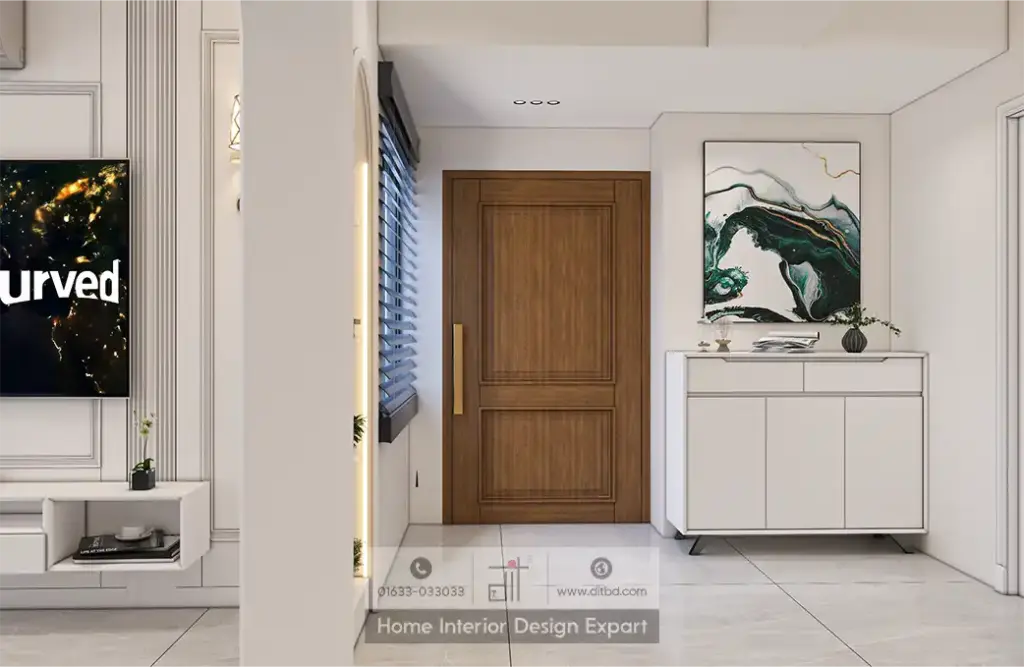
A narrow foyer doesn’t have to feel cramped. One of the most reliable tools in our design kit is the floor-to-ceiling mirror panel. Positioned strategically, it creates the illusion of width and bounces available light deep into the space.
Research published by the Rocky Mountain College of Art and Design confirms that placing large mirrors along a wall can effectively double a room’s perceived size. In hallways and foyers, this works especially well because the sightline is linear. Your eye follows the reflection and reads it as continuation of the room.
For the effect to actually work, the mirror needs to be large enough. In our experience, a minimum width of 600mm is needed for a meaningful spatial expansion in a foyer. Smaller decorative mirrors look nice but don’t change how the space feels. Floor-to-ceiling height is ideal. If that’s not feasible, a panel from 300mm above the floor to 300mm below the ceiling reads as near-continuous and achieves most of the same effect.
In Dhaka’s climate, mirror panels serve a double purpose. Natural light is abundant but inconsistent due to building density and window placement. A large mirror near the entrance amplifies whatever light enters and reduces reliance on artificial sources during the day. During power outages, which remain a reality in many Dhaka neighbourhoods, this becomes genuinely valuable.
We combine frameless mirror panels with slim accent frames in brushed gold or matte black to add depth and definition. Some clients prefer a mirror positioned opposite a small piece of art or a pendant light, creating a visual loop that adds dimension. See how this approach works in our common area design in Dhanmondi 10A. For more ideas on how light and reflection work together across a compact home, our guide to lighting tips for Bangladeshi home interiors goes deeper on the subject.
Design note: Avoid placing mirrors directly opposite the main door. In Vastu and Feng Shui traditions common among Bangladeshi families, this can feel unsettling. A 45-degree offset is both aesthetically and culturally more comfortable.
3. Accent Lighting: Set the Mood from the First Step
Lighting is the fastest way to transform a foyer’s atmosphere, and it’s often the most underestimated. Most Dhaka apartments default to a single overhead bulb. That produces flat, clinical light that flattens surfaces and makes even a well-designed space feel institutional.
The U.S. Energy Information Administration reported in 2024 that 63% of homes now use LED bulbs as their primary indoor lighting source, up from just 4% in 2015. LED adoption is growing quickly in Dhaka’s premium residential projects as well, and for good reason: LEDs use up to 80% less electricity than incandescent bulbs, which matters in a city where power costs are a real household concern.
For foyers, we layer lighting across three levels. At the ceiling, recessed downlights provide even base illumination. At mid-level, wall sconces or a slim pendant add warmth and visual interest. At floor or baseboard level, concealed LED strip lights under the shoe cabinet create a floating effect that looks polished and feels welcoming.
Warm white temperatures between 2700K and 3000K work best for entryways. This range creates an inviting glow rather than the harsh brightness associated with cool-white or daylight bulbs. If you receive guests frequently, and in Bangladeshi culture, most households do, this warmth signals welcome before a single word is spoken.
Our luxury common space design in Gulshan 2 used a layered lighting scheme across the entryway and corridor that clients often describe as the detail that makes the biggest daily impact. That project also taught us something we now apply everywhere: under-cabinet LED strip lighting adds more perceived depth to a compact entry space than almost any other single change. It costs very little to add during construction and is difficult to retrofit neatly afterward, so plan it in from the start.
Design note: Add a dimmer switch to your foyer circuit. It costs almost nothing extra and gives you full control over the mood, from bright morning light to a soft evening glow for dinner parties.
4. Accent Wall with Textured Panelling: Make a Statement
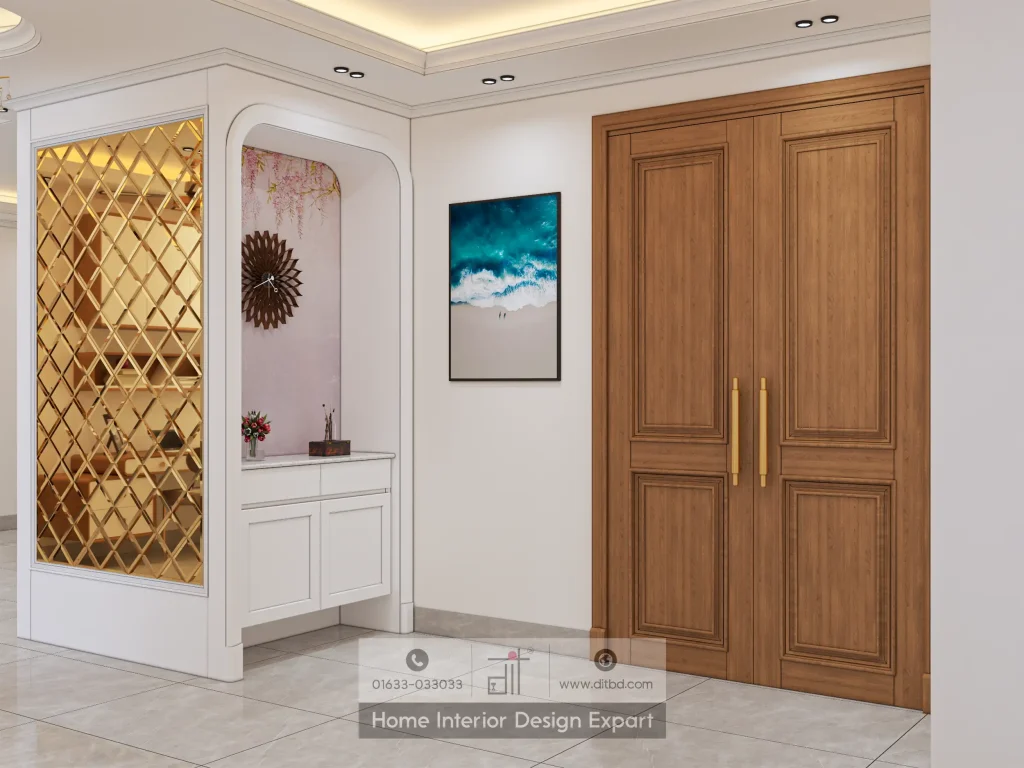
When floor space is limited, the walls become your canvas. An accent wall in the foyer, finished with textured panelling, microcement, or bold wallpaper, can transform a plain corridor into a design moment. It costs less than a full renovation and delivers an impact that far exceeds its footprint.
The Bangladesh interior design market has grown four-fold over the past decade, according to The Business Standard, and now stands at approximately Tk 20,000 crore. This growth reflects a shift in how Dhaka homeowners think about their spaces. Aesthetics are no longer secondary to function; they’re part of the same decision.
For foyer accent walls, we most commonly work with fluted MDF panels, which add texture without bulk. A coat of matte paint in a deep tone, charcoal, forest green, or terracotta, anchors the space and creates a sophisticated backdrop. Paired with a wall-mounted console table and a single pendant light, this treatment turns a blank wall into a considered composition.
Wood panelling is another strong choice, particularly in homes that favour a warmer, more traditional aesthetic. In humid Dhaka conditions, we recommend moisture-resistant MDF or WPC (wood-plastic composite) boards rather than natural timber, which can warp over time. This is a tradeoff worth naming honestly: WPC costs slightly more upfront than natural timber in the Dhaka market, but it sidesteps the warping and delamination issues we’ve seen on natural wood panels installed in ground-floor or poorly-ventilated foyers.
Our common space design in Aftabnagar features a panelled accent wall that connects the foyer to the living room, creating a visual narrative that runs through the common areas. If you’re thinking about how colour choices interact with textured surfaces, our guide to choosing home colours for Bangladeshi homes covers the principles in practical terms.
Design note: Keep the accent wall to one surface only. Applying textured treatment to multiple walls in a small foyer makes the space feel busy rather than bold.
5. Console Table with Smart Storage: The Multi-Tasker Your Foyer Needs
A slim console table is one of the most versatile pieces you can place in a foyer. It provides a surface for keys, a phone charging spot, a vase of fresh flowers, or a small tray for outgoing deliveries. Below, it can house a basket or two for umbrellas, bags, or extra footwear.
In Dhaka apartments, where guests arrive frequently and common areas are visible from the entrance, the console table also performs a social function. It signals that this is a home that has been thought about. A curated surface, even a simple one, reads as intentional and hospitable.
The global small space furniture market was valued at USD 23.4 billion in 2023, according to Future Market Insights, growing at a CAGR of 5.25%. This growth is driven by the reality of smaller urban apartments across Asia, including Bangladesh, where the average mid-range flat sits between 600 and 1,200 sq ft.
We design console tables as custom furniture pieces to fit exact foyer dimensions. A table that is 900mm wide and 300mm deep fits comfortably in most Dhaka entryways without blocking circulation. Floating versions, wall-mounted without legs, free up floor space entirely and make the room easier to clean. That 300mm depth matters: it’s enough surface area to be genuinely useful but shallow enough that a person carrying shopping bags can pass alongside it without brushing it.
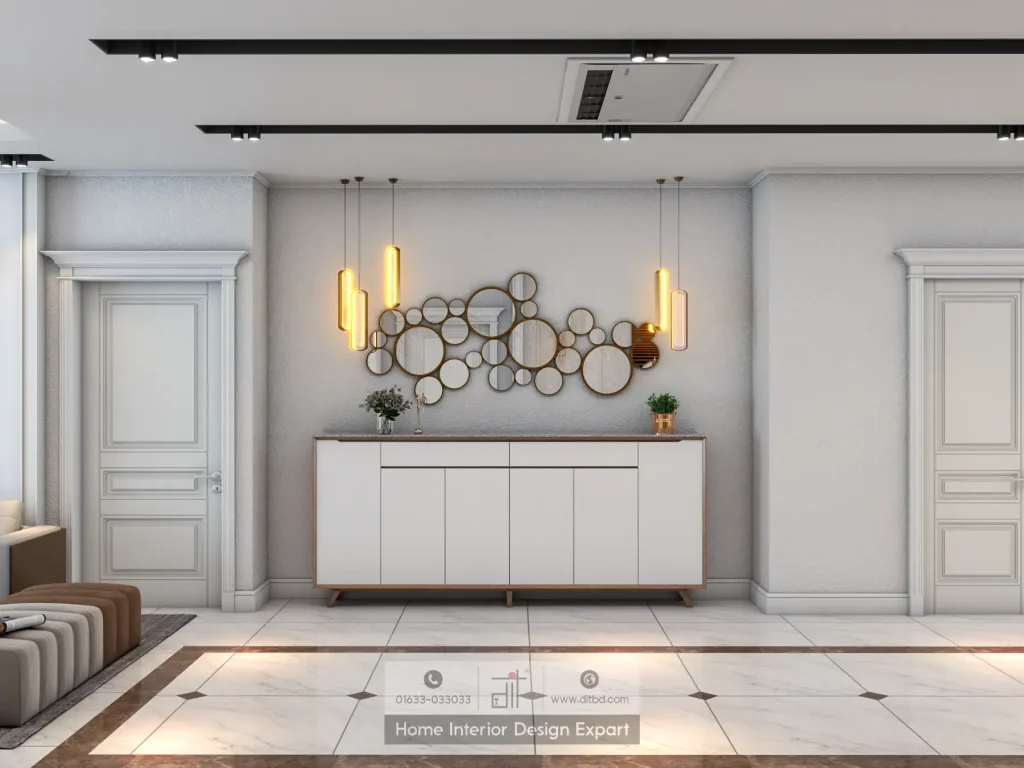
Pair the console table with a small round mirror above it and a pendant light or wall sconce on either side for a foyer vignette that feels complete. Our luxury common space design in Maona, Gazipur demonstrates how a well-chosen console table anchors an entryway and creates a sense of arrival. For broader ideas on fitting smart furniture into compact Dhaka homes, our article on multifunctional furniture solutions for small apartments is worth reading alongside this one.
Design note: Choose a console table finish that connects to your living room palette. The foyer should feel like a preview of what’s inside, not a separate space with its own unrelated aesthetic.
FAQ: Foyer Design for Dhaka Apartments
How much does it cost to design a foyer in a Dhaka apartment?
Foyer design costs vary based on scope. A focused update with a built-in shoe cabinet, mirror, and lighting can fall within a moderate budget, while a full custom design with panelling, bespoke furniture, and premium finishes sits at a higher range. DIT Studio’s minimum project size is $10,000, which typically covers a complete common space redesign. Contact us for a project-specific estimate based on your exact foyer dimensions and goals.
What’s the best flooring for a Dhaka apartment foyer?
Ceramic or porcelain tiles are the most practical choice for Dhaka foyers. They’re durable, easy to clean, and handle the humidity and footwear traffic well. In 2024, porcelain slabs became increasingly popular in premium entryways for their large-format, minimal-grout look. For a warmer feel, some clients opt for engineered wood or vinyl planks with a stone-look finish. Natural stone looks beautiful but requires regular sealing in Dhaka’s humid climate; porcelain is the lower-maintenance alternative that performs just as well visually.
How do I make a very small foyer (under 30 sq ft) functional?
Prioritise vertically. Wall-mounted shoe storage at 300–350mm depth, a floating console table, and a full-height mirror of at least 600mm wide will give you all the function you need without consuming floor space. Recessed lighting rather than pendant lights keeps the ceiling feeling open. A single accent colour on one wall adds personality without adding mass. Our common space design services are specifically built around compact Dhaka layouts.
What lighting works best for a dark apartment foyer?
Layer your sources: recessed ceiling lights for base illumination, wall sconces for warmth, and LED strip lighting under cabinets for depth. According to the U.S. Energy Information Administration (2024), LED adoption now covers 63% of homes. In Dhaka, LED fixtures are increasingly standard in new builds. Choose warm white (2700–3000K) for an inviting feel and consider battery-backed lighting for power outage periods.
Should I hire an interior designer for a foyer-only project?
Yes, especially if your foyer connects visually to the living room or corridor. A designer ensures material choices, lighting, and proportions flow cohesively through the common areas. At DIT Studio, we’ve completed over 500 residential projects across Dhaka since 2011 and regularly work on focused-scope projects as well as full-home renovations. A well-designed foyer pays back in comfort and impression every single day.
Transform Your Entryway with DIT Studio
Your foyer isn’t wasted space. It’s an opportunity, compressed into a few square metres, to make a lasting impression on every person who enters your home. From built-in shoe cabinets and mirror panels to layered lighting and a curated console table, each of these five ideas is achievable within a Dhaka apartment’s typical constraints.
We’ve helped hundreds of Dhaka families turn overlooked entryways into spaces they’re genuinely proud of. DIT Studio is a leading interior design company in Bangladesh with 500+ completed residential projects, and whether you want a focused foyer update or a full common space redesign, our team is ready to craft something that works for your space, your lifestyle, and your budget.
Get in touch with DIT Studio to start the conversation. We’d love to see what your entryway can become.
Written by the DIT Studio design team – Bangladesh’s specialist home interior firm since 2011, with 500+ completed residential projects across Dhaka. Our work spans compact apartment interiors to large floor-through homes in Gulshan and Dhanmondi.