
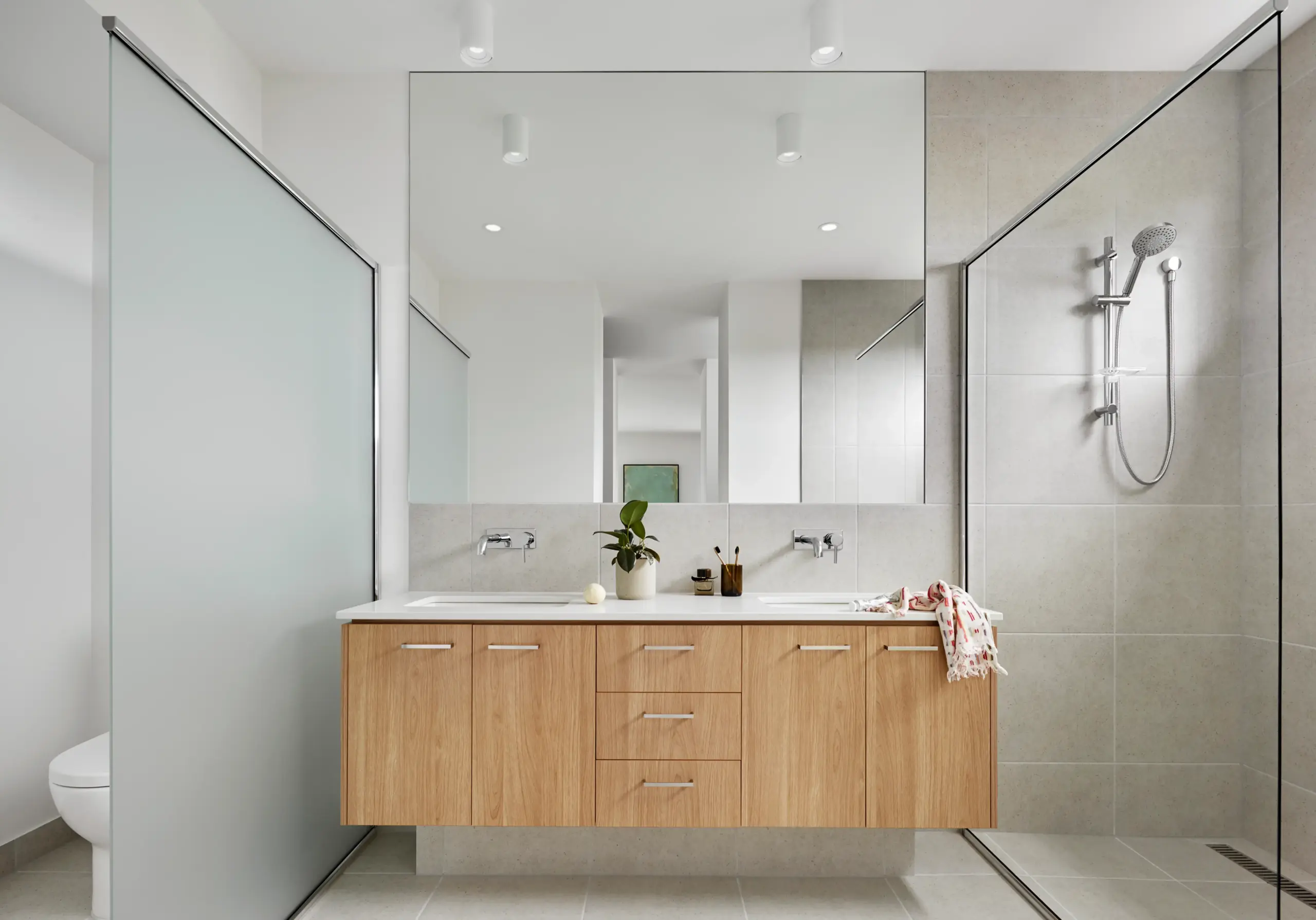
A small bathroom does not have to mean a compromised bathroom. According to a survey of renovating homeowners cited by Houzz, 82% of homeowners use ceramic or porcelain tile for their bathroom walls, largely because these materials let designers use visual tricks that make tight spaces feel open, clean, and genuinely pleasant. In Dhaka, where apartments typically offer bathrooms between 35 and 60 square feet, clever design isn’t optional — it’s what separates a bathroom you dread from one you enjoy every morning.
The seven strategies below are ones we use regularly in our bathroom design projects across Dhaka. Each one has a measurable impact on how a small bathroom looks, feels, and functions. We’ve applied these ideas across hundreds of Dhaka flats since 2011, and the results are consistent: these strategies work, even in the most space-constrained apartments.
Key Takeaways
- 82% of homeowners choose ceramic or porcelain tile for bathroom walls, in part because they support space-amplifying design strategies (Houzz Bathroom Trends Study, 2024)
- Wall-hung vanities free up floor space and create the visual impression of a larger bathroom — particularly effective in bathrooms under 50 sq ft
- Large-format tiles (600mm x 600mm and above) reduce grout line frequency, creating a continuous visual surface that makes small bathrooms feel significantly bigger
1. Install a Wall-Hung Vanity to Open Up the Floor
The floor is the most powerful visual cue in any small room. When you can see more of the floor, the room reads as larger. A wall-hung (floating) vanity lifts the basin and cabinet off the floor entirely, which is the single most impactful change you can make in a compact Dhaka bathroom.
The practical benefits go beyond appearances. A floating vanity exposes the floor underneath for easy mopping, which matters in a bathroom that sees daily splashing. It also lets you position the basin at exactly the height that suits your household, rather than accepting a standard dimension. For families with mixed heights, this flexibility is genuinely useful.
In terms of storage, modern wall-hung vanities are designed intelligently. Soft-close drawers with internal organisers, built-in power points for electric toothbrushes, and under-basin cabinets with moisture-resistant interiors mean you don’t sacrifice storage capacity for the visual benefit. A well-specified floating vanity actually stores more than a typical pedestal basin with an afterthought shelf unit beside it.
In a project we completed in Aftabnagar, a 42 sq ft bathroom felt genuinely cramped with its floor-standing pedestal basin and surrounding clutter. We replaced it with a 650mm wall-hung vanity and the floor suddenly felt twice as large — not because we changed the dimensions, but because we changed what the eye could see. The client’s exact words were: “I didn’t know my bathroom could feel like this.” Our Aftabnagar bedroom design project gives you a sense of how we approach spatial transformation in that neighbourhood.
The one consideration in Dhaka flats is wall strength. Wall-hung vanities require solid fixing into a structural wall, not just a partition board. Our design team always assesses the wall construction before specifying this option.
Common mistake: Choosing a vanity that’s too wide for the space. Aim for 600mm to 750mm wide for bathrooms under 50 sq ft. Anything wider starts to crowd the floor area and defeats the purpose entirely.
2. Use Large-Format Tiles to Reduce Visual Clutter
Tile choice is one of the most misunderstood decisions in small bathroom design. Many people assume smaller tiles suit smaller rooms. The opposite is often true. Large-format tiles — those measuring 600mm x 600mm or larger — have far fewer grout lines. Fewer grout lines mean fewer visual interruptions. The eye reads the surface as continuous and expansive rather than segmented and busy.
A 600mm x 600mm tile on a 3-metre wall produces just five grout lines. The same wall in 200mm x 200mm tiles produces fifteen lines. The visual difference in perceived room size is real and immediately noticeable. Interior design research consistently shows that large-format tiles make small bathrooms feel significantly more spacious without adding a single centimetre to the actual dimensions.
For Dhaka’s climate, large-format porcelain tiles have a further advantage: they’re less porous than traditional ceramic, which means they resist moisture penetration more effectively and are harder for mould to colonise. Given that Dhaka’s monsoon season runs from June through October, and humidity remains high for most of the year, this is a practical benefit, not just an aesthetic one.
We recommend carrying the same tile from floor to wall in very small bathrooms. When you eliminate the visual boundary between floor and wall surfaces, the eye struggles to locate the “edge” of the room, making the space feel genuinely larger. In a Mirpur project last year, we used a single 600mm x 1200mm rectified porcelain across both the floor and feature wall. The bathroom was 38 sq ft. Every client who saw it guessed it was at least 55 sq ft. See this approach in action in our Mogbazar home interior project.
Expert tip: Use rectified tiles (tiles with precisely cut edges) for large-format applications so grout lines can be kept to 2-3mm. Wider grout lines partially undo the visual benefit of a large tile — and wider grout also traps mould more readily in Dhaka’s humidity.
3. Install a Frameless Glass Shower Partition Instead of a Curtain or Framed Screen
Shower curtains and heavy framed shower screens do the same thing to a small bathroom: they cut the room in half. The eye sees two separate zones, each smaller than the room as a whole. A frameless glass partition eliminates that visual divide. The bathroom reads as a single continuous space, even when the shower area is clearly defined.
Frameless glass also has a cleaning advantage in Dhaka’s humid climate. Traditional framed shower screens collect moisture in the metal channels, which creates mould. Frameless glass, when specified with a quality water-repellent coating, is far easier to maintain. A weekly wipe-down keeps it looking pristine.
From a light perspective, frameless glass allows natural daylight to move freely through the entire bathroom. This matters enormously in Dhaka flats where bathrooms often sit in the interior of the apartment with limited window access. Every bit of light you can move around the space reduces the sense of enclosure.
The investment is higher than a curtain or basic framed screen. For a quality frameless 8mm-10mm toughened glass panel with proper fittings, expect to budget between BDT 25,000 and BDT 60,000 depending on size. We should be honest here: this is a meaningful cost. But the transformation in how the bathroom looks and feels is typically the best single upgrade you can make after the tiles. We specify this option in nearly all our bathroom design projects across Dhaka’s premium residential areas.
Does it require more maintenance than a curtain? Marginally. The glass needs a weekly spray and wipe. A shower curtain needs replacing every 6-12 months in Dhaka’s mould-prone climate and costs nearly as much over two years.
Practical tip: Opt for a 180-degree door swing rather than a sliding panel if you have the floor space. Sliding panels accumulate moisture in the track mechanism and are harder to clean thoroughly.
4. Add Recessed Shelving and Shower Niches to Eliminate Surface Clutter
Clutter is the enemy of a small bathroom. Shampoo bottles lined up on the edge of a bath, six different products competing for space on a vanity surface, a toilet roll holder that juts three inches into the room — these details shrink perceived space more than the actual square footage does.
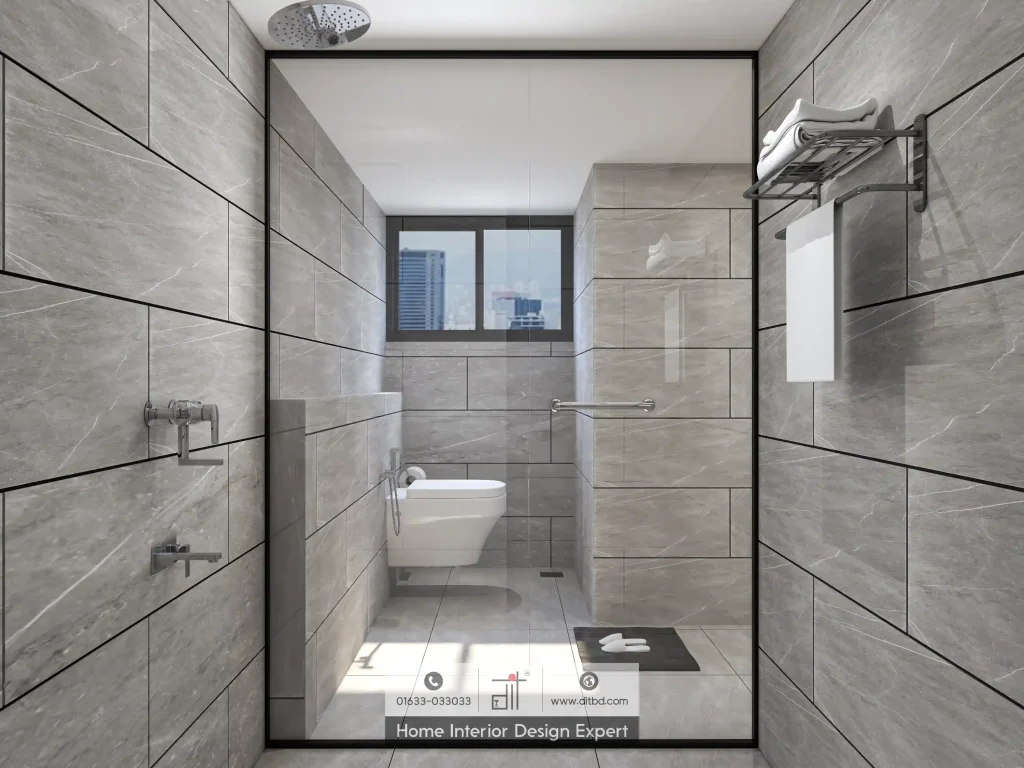
Recessed shelving solves this by building storage into the wall cavity rather than adding it on top of the wall. A shower niche set into the shower wall eliminates the need for a freestanding caddy or a shelf that sticks out. A recessed medicine cabinet above the basin provides mirror functionality plus hidden storage without protruding into the room.
The structural requirement here needs careful attention. In Dhaka flats, partition walls between bathrooms are often brick or lightweight block. Recessing into these requires cutting the cavity carefully and waterproofing the niche thoroughly — especially in the shower area, where the niche is exposed to direct water every day. Poor waterproofing of a shower niche is one of the most common sources of moisture problems in Dhaka bathrooms. Our bathroom waterproofing guide explains exactly what a properly detailed niche should include.
Done correctly, however, a well-waterproofed tiled niche will last decades. We designed niches into a pair of bathrooms in a Gulshan 2 flat renovation a few years ago — the clients came back to us for their living room design two years later and mentioned the niches as one of the things they use and appreciate every single day.
For bathrooms where wall recessing isn’t possible, magnetic or adhesive-mount corner organisers inside the shower are a good secondary option. They don’t require cutting but do require monthly cleaning to prevent mould at the adhesive point.
Expert tip: Design shower niches at elbow height (approximately 120-130cm from the floor) for adults. This is the most natural reach for picking up products during a shower, and it keeps the niche out of the main sight line, reducing visual clutter further.
5. Choose a Wall-Mounted Toilet to Gain Visible Floor Area
The toilet is typically the largest fixture in a small bathroom, and how it connects to the floor has a substantial impact on the perceived spaciousness of the room. A traditional floor-mounted toilet sits on a visible base and draws the eye downward. A wall-mounted toilet, by contrast, appears to float — and the floor beneath it is fully visible and easy to clean.
The concealed cistern of a wall-mounted toilet is built into the wall behind a slim panel, which reduces the depth the toilet projects into the room. Standard floor-mounted toilets project 700-750mm from the wall. Wall-mounted versions typically project only 500-550mm, which adds roughly 200mm of usable floor space in front of the toilet. In a bathroom under 50 square feet, 200mm is meaningful.
Installation requires a suitable structural wall for the cistern frame, and the overall cost is higher than a standard toilet: expect BDT 30,000 to BDT 80,000 for quality wall-hung toilet units in Dhaka, including the in-wall cistern frame. Maintenance access must also be planned, typically through a removable flush plate panel. When these details are designed correctly from the start, wall-mounted toilets are no more difficult to maintain than standard ones.
Our interior design services include full bathroom specification, where our team accounts for wall structures, plumbing rough-ins, and access panel placement before any installation begins. We address this in the context of full flat design in our article on complete flat interior design in Dhaka.
Non-negotiable technical check: Always verify that the wall behind the proposed toilet location is structural and can bear the load of the in-wall frame and the toilet bowl. This is not a step to skip or guess at.
6. Use Mirrors and Lighting Strategically to Double the Space Visually
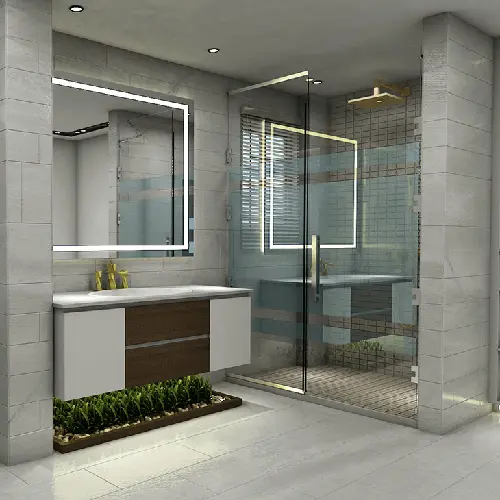
A mirror does something no physical renovation can: it optically doubles the room. A full-width mirror above the vanity, running from the top of the basin to the ceiling, turns the entire wall into a perceived depth. The bathroom feels twice as wide because the eye sees a reflection extending away from it.
This effect is amplified when the mirror is backlit. LED mirror lighting — either with a halo effect from behind the mirror or with a built-in LED strip along the top edge — eliminates shadows on the face and bounces warm, even light throughout the room. Standard overhead light fixtures in Dhaka flat bathrooms often create harsh downward shadows. Mirror lighting corrects this and makes the entire space feel brighter and more open.
Over our years working in Dhaka homes, we’ve found that a full-height backlit mirror is the highest-impact, lowest-cost upgrade in a small bathroom. In a Wari apartment project a couple of years back, we installed a 600mm x 1,800mm backlit mirror in a 36 sq ft bathroom. The before-and-after photos looked like two different bathrooms. The mirror alone cost under BDT 12,000 and changed everything. For more on this subject, our article on lighting tips for Bangladeshi home interiors goes into considerably more detail.
Given that power cuts remain a reality in parts of Dhaka, natural light deserves equal attention. If your bathroom has or can have a window, protect it with frosted glass for privacy rather than a curtain, which blocks light. A frosted glass louvre window lets in daylight and air while maintaining privacy — ideal for Dhaka’s warm, humid climate.
For bathrooms without exterior walls, a frosted glass interior partition adjacent to a corridor window can channel ambient light inward. This requires structural coordination but is achievable in many flat layouts.
Practical tip: Install mirror lighting at eye level, not above the mirror. Eye-level lighting eliminates facial shadows and creates a flattering, even illumination that makes the room feel larger and more luxurious.
7. Optimise Ventilation to Protect Every Design Investment You Make
The best tile work, the most elegant vanity, and the most carefully waterproofed shower are all vulnerable to one thing: moisture that doesn’t escape. In Dhaka, where ambient humidity is high for much of the year and the monsoon season runs from June to October, a bathroom without proper ventilation deteriorates faster than almost any other room in a flat.
Mould on grout lines is not just unsightly. It indicates moisture is settling into surface layers and working toward the substrate. The U.S. EPA estimates that approximately 47% of U.S. homes have dampness or mould problems, largely due to inadequate ventilation in wet areas. In Dhaka’s climate, that risk is amplified significantly without deliberate ventilation planning.
A quality exhaust fan rated at a minimum of 50 CFM (cubic feet per minute) for bathrooms under 50 sq ft, or 80 CFM for larger bathrooms, removes humid air from the space within minutes of a shower. The fan should vent to the outside of the building, not simply into a ceiling cavity. In Dhaka flats where outdoor venting isn’t always straightforward, an inline duct fan with extended ducting to an external louvre is the solution we most commonly specify.
When we redesigned a pair of bathrooms in a Mohakhali flat, the previous contractor had connected the exhaust fan to the ceiling void rather than the exterior. The result was mould appearing on tiles within 18 months of the original renovation. Re-routing the duct to an exterior louvre during our renovation eliminated the problem entirely. The proper route costs slightly more upfront and lasts indefinitely. The shortcut costs nothing upfront and costs significantly more over time.
Where an exhaust fan isn’t possible due to building constraints, a high-set ventilation window combined with a low-set intake vent creates natural convection. Hot, humid air rises and exits through the high vent while cooler corridor air enters below. This passive system works reasonably well in Dhaka’s climate, though an active fan is always the stronger solution. Our team factors ventilation into every bathroom design project from the very beginning, not as an afterthought.
Practical tip: Run your exhaust fan for at least 20 minutes after each shower, not just during it. Moisture lingers in the air well after the water stops, and cutting the fan too early lets it settle onto surfaces.
Frequently Asked Questions
What is the minimum bathroom size for a wall-mounted toilet in a Dhaka flat?
Wall-mounted toilets work in bathrooms as small as 30 square feet because they project 150-200mm less from the wall than floor-mounted units. In fact, smaller bathrooms benefit most from this choice. Plan for at least 600mm of clearance on either side of the bowl for comfortable use. Our design team can assess your specific layout — get in touch to discuss your bathroom’s constraints and what will work best.
Do large-format tiles cost more than standard tiles in Bangladesh?
Large-format tiles (600mm x 600mm and above) do generally carry a higher unit price than smaller ceramic tiles. However, because fewer tiles cover the same area, the tile count is lower. Labour costs can also be slightly lower because fewer cuts are needed. The net cost difference for an average Dhaka bathroom is often smaller than homeowners expect — typically BDT 5,000-15,000 more for tiles alone.
How do I prevent mould on grout lines in a humid Dhaka bathroom?
Use epoxy grout rather than standard cement grout for shower areas. Epoxy grout is non-porous and does not harbour mould. Combined with a quality exhaust fan and regular cleaning with a mild bathroom spray, properly grouted large-format tiles should remain mould-free for years. The EPA has established that controlling moisture is the primary factor in preventing mould growth indoors.
Can I fit all seven of these ideas into a single small bathroom?
Yes, and we do it regularly. All seven strategies work together. A wall-hung vanity, large-format tiles, frameless glass, a shower niche, a wall-mounted toilet, strategic mirrors, and proper ventilation can all coexist in a bathroom as small as 40 square feet. The result is a bathroom that feels two to three times larger than its actual dimensions. See examples in our Bashundhara R/A project portfolio.
What’s the most impactful single change I can make to a small Dhaka bathroom on a tight budget?
A large mirror from vanity top to ceiling costs relatively little and has an outsized impact on perceived space. If you can do only one thing, install a full-width backlit mirror. It addresses both the visual space problem and the lighting problem in a single purchase. From there, large-format tiles are the next highest-impact upgrade for a modest additional investment. For more ideas on working with space constraints across your whole flat, our guide on space-saving interior design for small flats in Dhaka has practical strategies that apply beyond the bathroom.
Transform Your Bathroom With DIT Studio
Every small bathroom in a Dhaka flat has more potential than it initially appears. The seven strategies above, applied thoughtfully and executed with quality materials, can make a 40-square-foot bathroom feel like a space you’re genuinely proud of.
As a trusted interior designer in Bangladesh, DIT Studio has crafted bathroom transformations for over 500 clients across Dhaka since 2011. We understand Dhaka’s building realities, its climate demands, and the specific material options available locally. Our team will assess your bathroom, identify the strategies that will have the greatest impact for your budget, and carry the design through to a finished space you’ll use and enjoy every day.
Explore our full range of interior design services or get in touch with us to start a conversation about your space. If you’re considering a full flat makeover, our article on smart space solutions for small flats in Bangladesh is a useful starting point.
Written by the DIT Studio design team — Bangladesh’s specialist home interior firm since 2011, with 500+ completed residential projects across Dhaka. Our bathroom design work spans compact flat renovations to full-floor luxury master bathrooms.