
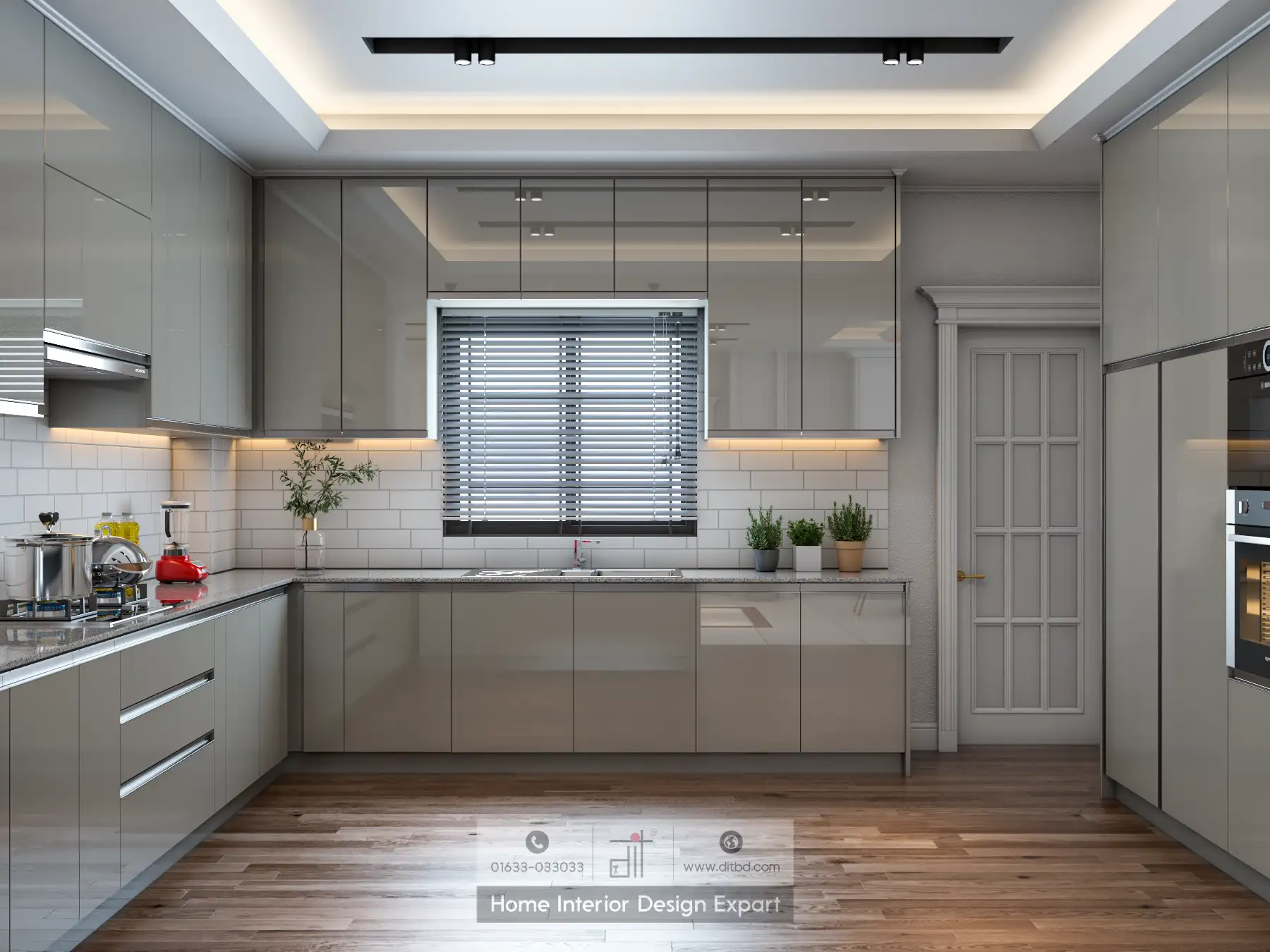
Most Dhaka homeowners we speak with want an open kitchen. They’ve seen it in magazines, in showrooms, in the newer premium developments in Gulshan and Dhanmondi. It looks effortlessly modern. But the moment they think about cooking a whole fish in mustard oil, or a pot of biryani at full flame, the excitement dims. “Won’t the smell go everywhere?” is the question we hear most.
It’s a fair one. Choosing between an open kitchen and a closed kitchen involves real trade-offs, and the right answer depends on your cooking habits, your flat’s layout, and your budget. This guide covers every factor so you can make a confident, informed decision.
Open kitchen projects are among our most requested designs at DIT Studio, particularly in newer Dhaka developments in Bashundhara and Gulshan. But they’re also the projects where we spend the most time on ventilation planning. Getting the chimney hood specification wrong is not something you can easily fix after construction is done.
Key Takeaways
- Open-plan kitchen layouts can add up to 20% to property value, according to research cited by HSBC
- Ducted exhaust hoods remove cooking odours and VOCs physically from the home; ductless (recirculating) hoods do not, making ducted systems essential for Bangladeshi cooking (Journal of Building Engineering, 2024)
- Most Dhaka apartments have load-bearing walls between kitchen and living room; always get a structural assessment before removing any wall
- A chimney with 600–900 CFM extraction capacity is the minimum required for open kitchens used for heavy Bangladeshi cooking (Proline Range Hoods)
What Is the Real Difference Between an Open Kitchen and a Closed Kitchen?
The distinction matters more than it first appears. A closed kitchen has four walls and a door, keeping cooking activity fully separated from the living and dining areas. An open kitchen removes one or more walls so the kitchen space flows directly into the dining room, living room, or both.
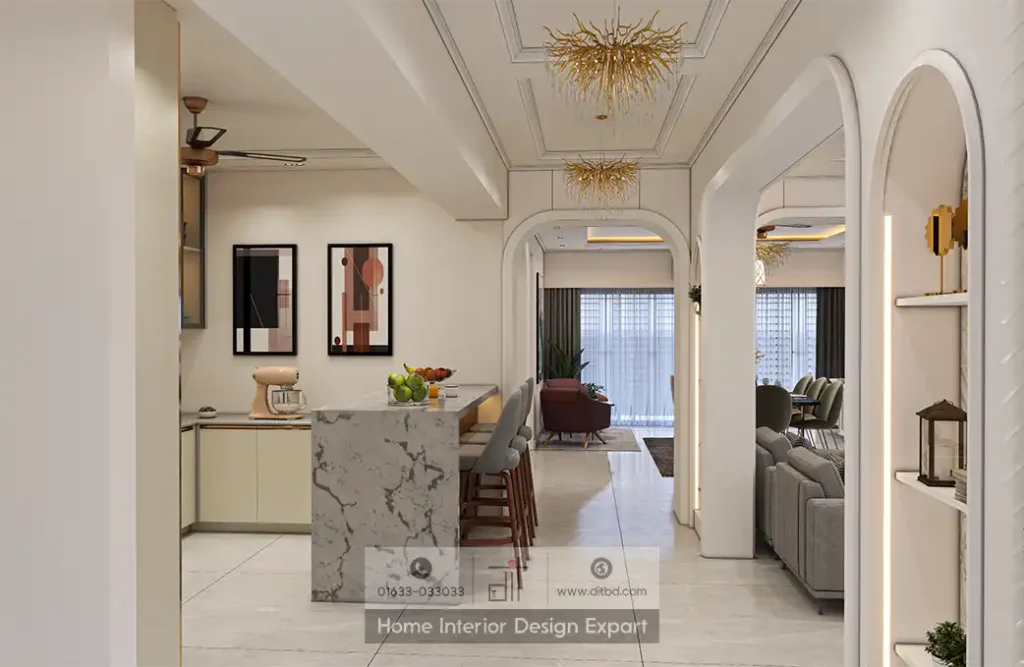
Research by HSBC found that open-plan kitchen-diner layouts are among the most sought-after features in residential properties, with open-plan designs potentially adding up to 20% to a home’s resale value. In Dhaka, the most common variant is a combined kitchen-dining space rather than a fully open kitchen-living configuration. This is a practical middle ground that many of our clients at DIT Studio’s open kitchen design service find works best for Bangladeshi lifestyles.
In our experience working across 500+ residential projects in Dhaka, the kitchen-dining open plan is far more practical for Bangladeshi cooking than a fully open kitchen-living space. It gives you the connected feel without the odour challenge of having the kitchen open directly to the sofa and TV.
A closed kitchen, by contrast, remains the default in older Dhaka buildings. It keeps smells, sounds, and visual clutter contained. It also feels smaller and can make the person cooking feel isolated from guests or family. Neither layout is universally better. The right choice depends on your daily habits.
How Does Cooking Odour Actually Behave in an Open Kitchen?
This is the core concern for every Bangladeshi homeowner considering an open kitchen, and it deserves a direct answer. A 2024 study published in the Journal of Building Engineering measured how kitchen hoods and ventilation openings affect indoor air quality after cooking. It found that extracting (ducted) ventilation significantly outperformed recirculating (ductless) systems in removing smoke, odour, and moisture from the cooking zone. With a high-quality ducted chimney, odour spread is manageable even in an open kitchen used for heavy cooking.
The problem isn’t the open layout itself. The problem is inadequate ventilation. When you cook fish curry or fry mustard oil in a closed kitchen with a small wall exhaust fan, the smell still permeates the flat because the fan doesn’t have the power to capture and expel it. In an open kitchen with a properly ducted chimney rated at 600–900 CFM, the extraction happens at the source before odours can travel.
We designed an open kitchen in a Maona Gazipur apartment where the client cooked fish daily. We specified a 900 CFM ducted chimney with an 8-inch duct run straight through the exterior wall. The client reported zero odour issues in the dining area after six months of use. You can see how ventilation is integrated into our completed project at modern open kitchen design in Maona Gazipur.
For heavy Bangladeshi cooking, including biryani, fish frying, and mustard-oil tempering, a ductless hood is simply not sufficient. It recirculates filtered air back into the room, which means grease and moisture remain. A ducted system is the non-negotiable foundation of any successful open kitchen in Bangladesh.
Open Kitchen vs Closed Kitchen: A Direct Comparison
The table below covers the factors that matter most to Dhaka homeowners making this decision.
| Factor | Open Kitchen | Closed Kitchen |
|---|---|---|
| Odour control | Requires high-CFM ducted chimney | Easier to contain odours |
| Space feel | Larger, airier, connected | More compact, defined |
| Natural light | Better distribution across rooms | Limited to kitchen only |
| Social connection | Cook while engaging with family or guests | Cook in isolation |
| Resale value | Can add up to 20% (HSBC Research) | Neutral to slight negative |
| Structural work needed | Often yes, load-bearing wall assessment required | No |
| Cost to create | Higher (wall removal, chimney, finishes) | Lower |
| Suitable for heavy cooking | Yes, with 600–900 CFM ducted chimney | Yes, any standard exhaust |
| Noise containment | Lower (cooking sounds carry) | Higher |
| Visual clutter | Requires tidy kitchen habits | Mess stays hidden |
| Best for Dhaka context | Larger flats, premium areas | Any flat size |
Is Your Dhaka Apartment Structurally Ready for an Open Kitchen?
Structural readiness is the first question to answer before anything else. Most apartment buildings in Dhaka, particularly those built before 2010, use masonry construction with load-bearing brick walls. Unlike modern frame-structure buildings where walls can often be removed freely, load-bearing walls carry the weight of the floors above. Removing them without proper engineering creates serious structural risk.
The 2025 U.S. Houzz Kitchen Trends Study found that 35% of homeowners who renovated expanded their kitchen’s footprint, most commonly by incorporating adjacent dining rooms. In Dhaka, this expansion typically requires removing the wall between the kitchen and the dining area.
In a Mohammadpur project we completed recently, a client wanted an open kitchen but the wall between the kitchen and living room turned out to be load-bearing. We brought in a structural engineer and designed a partial opening with a steel beam, creating a half-open kitchen that still dramatically improved the feeling of space. The client got the connected feeling they wanted without compromising the building’s integrity. See the result at modern open kitchen design in Mohammadpur.
Do not rely on a contractor’s verbal assurance that “it’s fine.” Get a written structural report. Our team at DIT Studio coordinates structural assessments as part of the design process so nothing is left to guesswork.
What Are the Pros and Cons for Bangladeshi Cooking Specifically?
Open kitchen advantages for Bangladeshi homes:
Bangladeshi families tend to be social around food. Cooking is not a private task; it’s a communal one. An open kitchen lets you watch the children, talk with guests, and stay connected with the household while cooking. It also makes the flat feel significantly larger, which matters enormously in Dhaka where apartment sizes are often modest.
Open kitchen disadvantages for Bangladeshi homes:
Bangladeshi cooking is aromatic and high-heat by nature. Fish, mustard oil, whole spices, and pressure cooking all generate significant odour, steam, and oil vapour. Without a powerful ducted chimney, these will reach every corner of the living room. Cleaning also becomes more demanding. Grease particles travel further in an open layout, settling on sofas, curtains, and decorative items. You’ll need to commit to more frequent cleaning of the living area.
It’s worth being direct here: ductless recirculating hoods are nearly useless for biryani or fish frying. The charcoal filters saturate quickly with strong aromatic compounds, and all they do is return the filtered air to your living room. We tell every client this before they sign off on a chimney specification.
Closed kitchen advantages for Bangladeshi homes:
The closed kitchen is forgiving. You can fry, smoke, and spice at full intensity without worrying about the smell reaching your guests. It contains mess visually. It reduces cooking noise from reaching living spaces. For households that cook very frequently with strong-smelling ingredients, particularly dried fish (shutki), the closed kitchen remains the more practical choice.
Across our projects, clients who cook shutki or heavily spiced dishes more than four times a week almost always prefer maintaining a closed or semi-closed kitchen arrangement, even when they originally requested an open plan. We guide them toward a kitchen-dining open layout rather than a full kitchen-living open plan. That honest conversation happens early, not after construction begins.
Cost Implications: What Does Each Option Cost in Dhaka?
Creating an open kitchen from a previously closed one involves several cost components beyond the kitchen cabinetry itself. Below are realistic estimates for Dhaka-based residential projects.
| Cost Component | Open Kitchen Conversion | Closed Kitchen Renovation |
|---|---|---|
| Structural assessment | BDT 15,000–30,000 | Not required |
| Wall removal and beamwork | BDT 50,000–2,50,000 | Not required |
| High-CFM ducted chimney (600–900 CFM) | BDT 35,000–90,000 | BDT 15,000–40,000 (standard) |
| Duct routing to exterior | BDT 10,000–25,000 | BDT 5,000–15,000 |
| Additional finishing (paint, flooring continuity) | BDT 20,000–60,000 | BDT 10,000–30,000 |
| Modular kitchen cabinetry | BDT 1,50,000–4,00,000 | BDT 1,00,000–3,00,000 |
| Approximate total | BDT 2,80,000–8,55,000 | BDT 1,30,000–3,85,000 |
These are indicative ranges. Your actual cost will vary with flat size, material selection, and the extent of structural work. Our modular kitchen design service includes a detailed cost consultation specific to your apartment.
One point worth noting on chimney cost: premium ducted chimney brands like Elica, Faber, and Hindware cost 3–5 times more than budget options, but the performance difference for heavy Bangladeshi cooking is significant. A budget chimney rated at 600 CFM on paper may deliver far less in practice due to weaker motor quality and filter construction. We’ve seen this trade-off play out many times across our projects.
Who Should Choose an Open Kitchen, and Who Should Keep It Closed?
Choose an open kitchen if:
- Your flat is in a newer building with frame construction (Gulshan, Banani, Bashundhara developments)
- You have space for a 600–900 CFM ducted chimney with proper external duct routing
- Your household cooks moderately aromatic meals (not shutki or daily heavy frying)
- You value aesthetics, social connection, and resale value
- Your kitchen is at least 60–70 sq ft and connects to a dining area of similar size
- You cook for gatherings frequently and want the kitchen integrated with the entertaining space
Keep a closed kitchen if:
- Your building has load-bearing walls that are complex or costly to address
- Your household cooks shutki, strong fish curries, or heavily spiced dishes daily
- You prefer a tidier, lower-maintenance approach to the living space
- Your budget doesn’t accommodate a high-quality ducted chimney installation
- You have young children and prefer a defined, safety-separated cooking zone
And to be direct: some Dhaka apartments simply aren’t suitable for open kitchens. Structural constraints, cooking habits, and duct routing limitations all factor in. If two of those three are working against you, a closed or semi-closed kitchen is genuinely the right answer, not a compromise. We tell clients this, and they appreciate it.
For a connected look without full wall removal, consider a common space design that uses a serving window, breakfast bar, or partial partition. This gives you visual openness and improved social connection while keeping most of the cooking contained.
For broader context on how interior design decisions interact in a Dhaka home, our guides on complete flat interior design in Dhaka and interior design challenges in Bangladesh are worth reading alongside this one.
Frequently Asked Questions
Can I have an open kitchen in a small Dhaka flat?
Yes, but with caveats. A combined kitchen-dining open layout works well in flats from 900–1,100 sq ft. A full kitchen-living open plan typically needs a larger floor plate. The key requirement is a ducted chimney with at least 600 CFM extraction to manage odour. In smaller flats, a breakfast bar or serving window offers a practical alternative to full wall removal.
How much does a good chimney cost in Bangladesh for an open kitchen?
A quality ducted chimney suitable for Bangladeshi cooking (600–900 CFM) costs between BDT 35,000 and BDT 90,000 for the unit alone. Duct installation adds another BDT 10,000–25,000 depending on the routing distance to an external wall. Avoid ductless (recirculating) models for open kitchen use, as research consistently shows they are less effective at removing cooking odours and VOCs (Journal of Building Engineering, 2024).
Does an open kitchen reduce resale value in Dhaka?
The opposite is true in premium segments. Research by HSBC found open-plan kitchen-diner layouts are among the most sought-after features in residential properties, potentially adding up to 20% to property value. In Dhaka’s premium areas like Gulshan, Banani, and Dhanmondi, open kitchen designs are increasingly standard in new developments. For mid-range market apartments, the impact on resale is neutral to modestly positive.
Do I need a structural engineer before opening my kitchen?
Yes, absolutely. In most Dhaka residential buildings, particularly pre-2010 masonry construction, the wall between the kitchen and dining room may be load-bearing. Removing a load-bearing wall without engineering support creates serious structural risk. Always commission a written structural assessment from a licensed structural engineer before any wall removal work begins.
What is the difference between a ducted and ductless kitchen chimney?
A ducted chimney extracts cooking air, smoke, grease, and odours through a duct to the outside of the building. A ductless (recirculating) chimney filters air through charcoal filters and returns it to the room. For heavy Bangladeshi cooking, only ducted chimneys are effective. A 2024 study in the Journal of Building Engineering confirmed that extracting ventilation significantly outperforms recirculating systems for smoke, odour, and moisture removal.
Conclusion
The open kitchen vs closed kitchen decision comes down to three things: your cooking habits, your flat’s structure, and your ventilation investment. For most Dhaka homeowners who cook full Bangladeshi meals regularly, a combined kitchen-dining open layout with a high-quality ducted chimney (600–900 CFM) is the best balance of aesthetics and practicality. A full kitchen-living open plan works beautifully in larger premium apartments where duct routing is feasible and cooking intensity is moderate.
We’ve helped over 500 Dhaka families make this exact decision, and we’re ready to help you too. DIT Studio leads in interior design in Bangladesh, and whether you want a thoughtful feasibility assessment or a complete kitchen transformation, our team will give you honest, expert guidance tailored to your home.
Also see our open kitchen design guide for Bangladeshi homes for a deeper look at planning considerations across different flat types.
Contact DIT Studio to book your kitchen design consultation, or explore our open kitchen design service to see what’s possible for your flat.
Written by the DIT Studio design team — Bangladesh’s specialist home interior firm since 2011. We’ve designed both open and enclosed kitchens across hundreds of Dhaka homes, navigating the practical realities of Bangladeshi cooking culture and apartment layouts.