
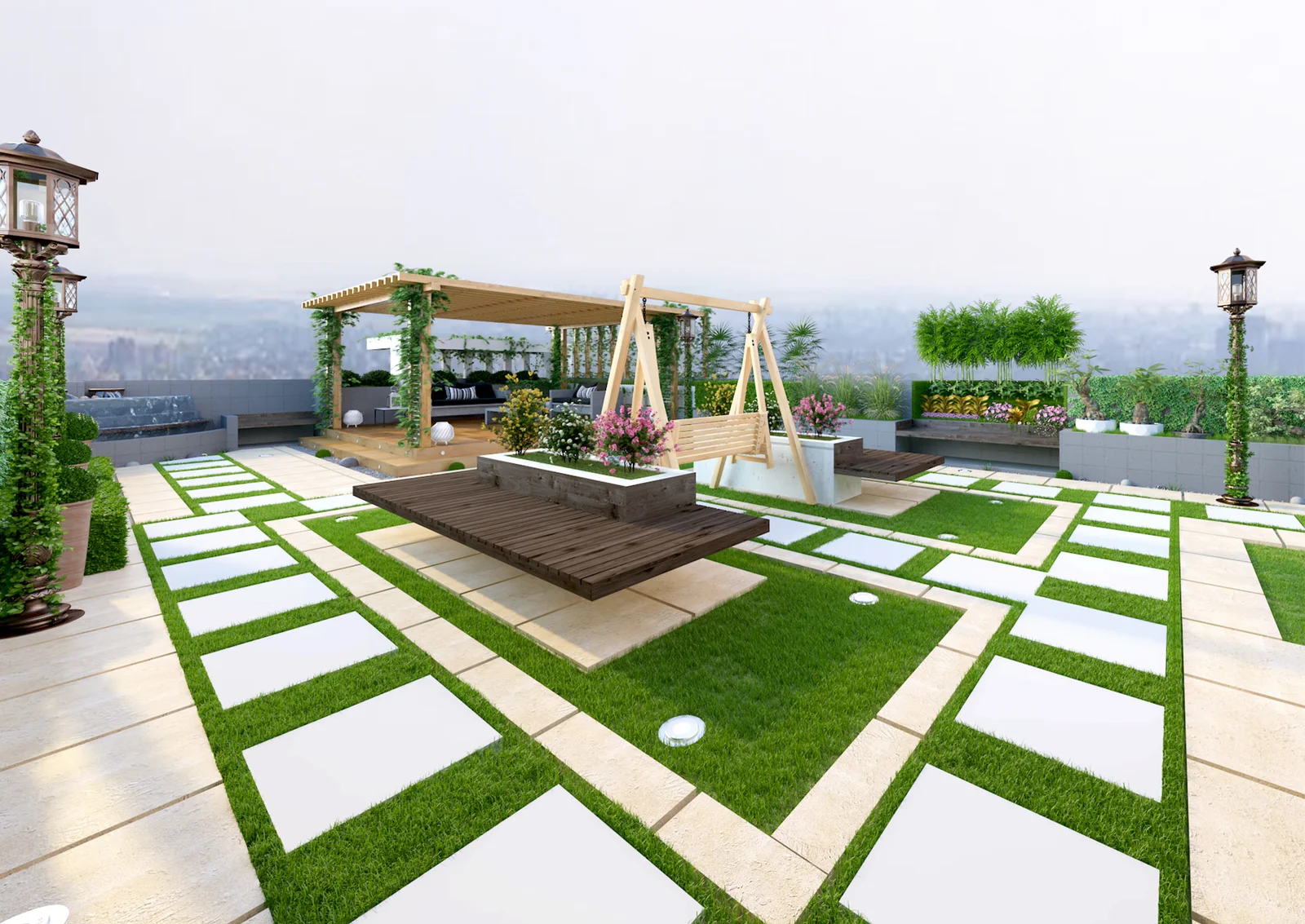
Your rooftop sits empty. Every square foot of that concrete slab bakes under the Dhaka sun, adding heat to your home and offering nothing in return. What if you could transform it into a green, functional outdoor space where your family actually wants to spend time?
Research published in Scientific Reports (2024) found that rooftop gardens can reduce internal room temperatures by 4 to 11°C compared to fully exposed roof configurations. In a city where summer temperatures regularly hit 38-40°C, that is not a small detail. It is a genuine quality-of-life upgrade.
This guide covers everything you need to know about rooftop garden design in Dhaka: structural safety, waterproofing, drainage, plant selection, furniture, lighting, irrigation, and realistic budgets. By the end, you’ll have a clear picture of what your rooftop project involves and how to get it right.
Key Takeaways
- Rooftop gardens can lower indoor temperatures by 4-11°C, reducing cooling costs significantly (Scientific Reports, 2024).
- Most rooftops support 98-195 kg per square meter of live load, but a structural assessment is non-negotiable before adding any weight.
- LECA (lightweight expanded clay aggregate) weighs just 250-400 kg/m³ versus 1,200-1,600 kg/m³ for standard garden soil, making it the smart choice for weight-restricted Dhaka rooftops.
- Waterproofing failure is the single biggest risk. A quality membrane lasts 20-30 years when properly installed.
- A mid-range rooftop garden in Dhaka typically costs BDT 1,500-4,000 per square foot, depending on materials and complexity.
- Not every rooftop in Dhaka can be converted. A structural engineer must assess your slab before any work begins.
Why Is Rooftop Garden Design in Dhaka Growing So Fast?
Dhaka is one of the densest cities in the world. Ground-level green space is scarce and expensive. For homeowners on the top floor, or those with independent houses, the rooftop is often the only outdoor space available. It’s understandable that more families are asking how to make it work.
The benefits go beyond temperature control. A 2024 umbrella review and meta-analysis published in Systematic Reviews (Springer Nature) confirmed that regular gardening activity significantly improves mental well-being, reduces anxiety, and enhances quality of life. A classic field experiment, widely cited in horticulture literature, found that gardening reduced salivary cortisol levels more effectively than reading during a stress-recovery period.
For Dhaka families, a rooftop garden can also produce food. Tomatoes, chillies, lemon, and herbs like Tulsi thrive in container gardens. The space can double as a kitchen garden and a relaxation zone, creating real functional value. For more on how natural green elements affect indoor comfort, read our guide on natural home cooling tips for Bangladesh.
Our landscape design team has designed rooftop gardens across Dhaka, from compact spaces in Mogbazar to larger installations in Gulshan. Each project starts with the same foundation: safety first, beauty second.
Our observation: In our experience across 500+ client projects in Dhaka, the homeowners who are happiest with their rooftops are the ones who treated waterproofing as the centrepiece of the budget, not an afterthought. Getting the foundation right is what determines whether the garden lasts 3 years or 30.
What Structural Assessment Does Your Rooftop Need?
Before a single pot touches your rooftop, you need to understand the load capacity. Standard residential rooftops in Bangladesh are typically rated to support a live load of 98-195 kg per square meter (International Building Code, IBC 2024). Older buildings, particularly those constructed before 2000, often fall in the range of 75-100 kg/m², and some may be lower still. This varies significantly based on your building’s age, construction type, and original design intent.
We completed a rooftop garden project in Bashundhara R/A where the existing slab could only support 150 kg/m². Standard raised planters filled with garden soil would have exceeded that limit quickly. We switched to LECA (lightweight expanded clay aggregate) in raised planters instead of soil, bringing the total distributed load to under 120 kg/m² while still achieving a lush, layered planting scheme. That project is now in its third year and performing exactly as designed.
What does a structural assessment cover?
- Dead load review: The existing weight of the roof structure itself.
- Live load capacity: How much additional weight the roof can safely carry.
- Point load analysis: Whether specific areas (like a corner planter or a pergola post) will concentrate weight in a way the structure cannot handle.
- Waterproofing integrity: The condition of any existing waterproofing layer.
A qualified structural engineer in Dhaka typically charges BDT 5,000-20,000 for a rooftop assessment, depending on the size and complexity. This is not an expense to skip. It is the foundation of everything else.
The honest reality: Not every Dhaka rooftop can support a garden. Older buildings, buildings with existing structural damage, and slabs that were never designed for rooftop use may not be convertible without major reinforcement work. A structural engineer will tell you plainly whether your rooftop qualifies. That clarity is worth far more than the assessment fee.
Once you know your load limits, you can design around them intelligently. LECA weighs just 250-400 kg/m³ compared to standard garden soil at 1,200-1,600 kg/m³. Raised deck systems and distributed planting arrangements can all help you stay safely within structural tolerances.
How Does Waterproofing Work for Rooftop Gardens in Dhaka?
Dhaka receives approximately 1,854 mm of annual rainfall, with nearly 80% falling during the monsoon season between May and September (Climate of Dhaka, Bangladesh Meteorological Department data). A rooftop garden without proper waterproofing is a guaranteed leak waiting to happen.
There are three main waterproofing membrane types used in rooftop garden construction:
Modified Bitumen Membranes are the most common choice in Bangladesh. They’re affordable, readily available, and perform well when properly installed. A quality modified bitumen membrane lasts 15-20 years with appropriate maintenance.
EPDM (Synthetic Rubber) Membranes offer superior durability. EPDM roofs last 20-25 years on average, with properly maintained systems lasting up to 30 years (First American Roofing, 2025). EPDM handles Dhaka’s temperature swings and UV exposure well.
TPO and PVC Membranes are the premium options. TPO membranes can last 20-30 years and offer excellent UV reflectivity, which reduces roof surface temperatures further. These are less common in Bangladesh but are increasingly available through specialist suppliers.
For a rooftop garden specifically, the waterproofing must be rated for “wet area, constant moisture” conditions. A standard rooftop waterproof coating designed for dry conditions will fail quickly under planters and irrigation water.
Above the waterproofing membrane, you must install a root barrier layer. We specify HDPE (high-density polyethylene) root barrier membrane at 0.5-1mm thickness. Without it, plant roots will penetrate and damage the waterproofing membrane over time, causing leaks that are difficult and expensive to trace. This layer sits between the membrane and the drainage aggregate.
The drainage layer itself should be a minimum 100mm depth of clean gravel or a purpose-made drainage mat. This prevents waterlogging in the growing medium above and protects the membrane from standing water pressure.
The installation process matters as much as the product. Ask for a 10-year installation warranty from your waterproofing contractor, and ensure the membrane wraps up the parapet walls by at least 150mm.
Our landscape design service coordinates waterproofing specification with your structural assessment, ensuring the two work together from day one. You can also see how we handle similar technical challenges in our Dhanmondi 6A common space project.
Which Plants Grow Best in Dhaka Rooftop Gardens?
Dhaka’s climate is both an asset and a challenge for rooftop gardening. Temperatures between 35-40°C in summer, combined with humidity above 80% and intense monsoon rainfall, will quickly stress plants that aren’t suited to the conditions. The good news is that many beautiful and productive plants thrive here.
Flowering and Ornamental Plants:
- Bougainvillea is almost indestructible in Dhaka. It loves heat, tolerates drought between waterings, and produces spectacular colour. Train it up a trellis or pergola for a dramatic vertical element.
- Hibiscus (Hibiscus rosa-sinensis) produces large, bold flowers and handles humidity well. Multiple colour varieties are available locally.
- Jasmine (Jasminum sambac, locally called Beli phul) works beautifully on railings or low trellises, adding fragrance and soft white flowers.
- Money Plant (Pothos) is one of the easiest plants for container gardens. It tolerates partial shade and occasional neglect.
Kitchen Garden Plants:
In a Gulshan 2 project, a client wanted a rooftop kitchen garden for fresh herbs and vegetables. We installed a drip irrigation system running at 2-4 litres per hour per emitter on a timer, which is essential in Dhaka’s summer when daily hand watering becomes impractical. The kitchen garden now produces coriander (Dhania), mint, chilli, and tomatoes year-round with very little daily effort from the family.
- Lemon grows well in large containers (40-50 litre pots) and produces fruit year-round with regular feeding.
- Chilli and Tomato are reliable performers from October to March, when temperatures are cooler and more stable.
- Tulsi (Holy Basil) is extremely low-maintenance and grows prolifically in Dhaka’s heat.
- Aloe Vera is both decorative and practical. It needs almost no attention once established.
Practical planting tip: During the monsoon, switch to plants that can handle waterlogging. Elevate pots on feet or drainage trays to prevent root rot when Dhaka receives its heaviest daily rainfalls.
A mix of ornamental plants and edible species gives your rooftop garden year-round interest. You get visual beauty in the cooler months and green foliage through the summer. Our design team curates planting schemes suited to your specific rooftop orientation, shade patterns, and personal preferences. See our completed projects for inspiration.
What Are the Best Materials for Rooftop Garden Flooring and Furniture?
Material selection for a Dhaka rooftop garden must account for four harsh realities: intense sun, monsoon rain, high humidity, and restricted load capacity. Not every material that looks good at a showroom will last five years on your rooftop. Our full guide on choosing outdoor flooring materials for Bangladesh rooftops and terraces covers this decision in depth.
Flooring Options:
Porcelain tiles are the most popular choice in Dhaka. They’re durable, widely available, and relatively affordable. For rooftop use, specify tiles with a minimum R11 slip-resistance rating for wet surfaces, or a DCOF value of 0.60 or greater (ANSI A137.1 standard). Lighter-coloured tiles also absorb significantly less heat than dark ones.
Composite decking (WPC, wood-plastic composite) is gaining popularity in premium Dhaka homes. Composite decking typically lasts 25-30 years with minimal maintenance (Trex, 2024). It doesn’t rot, warp, or require annual sealing, making it well-suited to Dhaka’s monsoon conditions. It’s heavier than some alternatives, so verify your load budget first.
Raised deck tile systems (interlocking tiles on adjustable pedestals) offer an elegant solution for managing drainage while creating a level, comfortable surface. The gap between tiles allows monsoon water to drain rapidly.
Furniture:
Avoid untreated wood or standard steel for outdoor furniture in Dhaka. Both will deteriorate rapidly in the humidity and monsoon rain. Good choices include:
- Powder-coated aluminium (lightweight, rust-proof, long-lasting)
- High-density polyethylene (HDPE) resin furniture
- Teak or marine-grade hardwood with proper sealing (higher cost but beautiful)
Folding or stackable furniture is practical for rooftops where monsoon storage is limited. You want pieces that can be moved quickly when a storm arrives.
How Should You Plan Irrigation and Lighting for a Rooftop Garden?
Irrigation and lighting are often treated as finishing touches, but they should be planned from the start. Getting these systems wrong means disruption later when you’re cutting through finished surfaces to run pipes or cables.
Irrigation Planning:
A gravity-fed drip irrigation system running at 2-4 litres per hour per emitter is the most reliable solution for Dhaka rooftops. This flow rate keeps the growing medium consistently moist without waterlogging roots, and the gravity-fed design removes dependence on pump reliability or consistent electricity supply.
A practical setup combines:
- A rooftop water storage tank (if you don’t already have one) dedicated to garden irrigation.
- Manual drip lines or soaker hoses connected by gravity from an elevated tank.
- Self-watering planters for smaller balcony-style areas within the rooftop.
During the monsoon season (June-October), many plants need little supplemental watering. The challenge shifts to drainage: ensuring planters drain freely and the rooftop surface doesn’t pond water.
Lighting:
Solar-powered LED garden lights are the most practical option for Dhaka rooftop gardens. They require no electrical connection, which simplifies installation and removes the safety risk of running mains electricity across a wet outdoor surface. Modern solar garden lights perform well with just a few hours of direct sun per day.
For a more designed lighting effect, low-voltage LED systems (12V DC) wired to a transformer inside the building are an option. These offer more creative flexibility: pathway lights, uplights for plants, and string lights for social spaces.
Power should be planned by a qualified electrician, with all outdoor fittings rated IP65 or higher for weather resistance.
From our projects: We’ve found that the most-used rooftop gardens in Dhaka are the ones designed for evening and night use. A well-lit rooftop becomes a genuine family living space after sunset, when the heat breaks and a breeze picks up. Lighting is what separates a garden you visit occasionally from one you use every day.
What Does a Rooftop Garden Cost in Dhaka?
Cost is the question everyone asks, and it deserves an honest answer. Rooftop garden costs in Dhaka vary widely based on size, materials, scope of waterproofing work, and finish level. The table below gives realistic budget ranges.
| Item | Budget Range (BDT per sq ft) | Notes |
|---|---|---|
| Structural assessment | BDT 5,000-20,000 (total) | One-time cost, size-dependent |
| Waterproofing membrane | BDT 80-250 per sq ft | Modified bitumen to EPDM |
| HDPE root barrier | BDT 20-40 per sq ft | Essential, not optional |
| Drainage layer (100mm gravel) | BDT 30-60 per sq ft | Aggregate or drainage mat |
| Growing medium (LECA blend) | BDT 40-80 per sq ft | Lightweight vs standard soil |
| Flooring (porcelain tile) | BDT 150-400 per sq ft | Material + labour |
| Flooring (composite decking) | BDT 300-700 per sq ft | Premium option |
| Planting (ornamental mix) | BDT 50-200 per sq ft | Varies by plant selection |
| Drip irrigation system | BDT 30-80 per sq ft | Timer-controlled gravity-fed |
| Lighting (solar LED) | BDT 20-60 per sq ft | Pathway and accent lights |
| Furniture | BDT 50,000-300,000+ (total) | Wide range by quality |
Estimated total project costs:
- Basic rooftop garden (waterproofing + simple planting + basic tile): BDT 800-1,500 per sq ft
- Mid-range rooftop garden (quality waterproofing + composite decking or premium tile + curated planting + lighting): BDT 1,500-3,000 per sq ft
- Premium rooftop garden (bespoke design + premium materials + pergola + full irrigation + designer furniture): BDT 3,000-6,000+ per sq ft
For a 500 sq ft rooftop, a well-executed mid-range project would typically fall in the range of BDT 7.5 lakh to 15 lakh, including professional design and project management.
What You Need to Know About Building Management Approval
This is a topic many design guides avoid. In Dhaka’s apartment buildings, rooftop modification rights are frequently restricted by building management committees. Before spending money on a structural assessment or design, confirm the following:
- Does your building management allow rooftop modifications by individual flat owners?
- Is there a shared rooftop policy? Some buildings restrict access entirely.
- If the rooftop is common property, you may need written approval from fellow flat owners or the management association before any work can begin.
We’ve worked with clients in Uttara and Banani who had detailed design plans ready, only to discover their building management did not permit individual rooftop installations. Raising this question first, before any design spend, saves significant frustration. This is an honest limitation that applies to many Dhaka apartment buildings, and it’s one every prospective rooftop garden owner must resolve early.
Steps to Get Started With Your Rooftop Garden in Dhaka
Getting started doesn’t require committing to the full project immediately. Here’s a sensible sequence:
Step 1: Confirm building management approval. Before any technical work, verify that your building management permits rooftop modifications. If approval is needed, begin that process first.
Step 2: Structural assessment. Commission a structural engineer to assess your rooftop’s load capacity. This is the first decision-gate. If the load capacity is very limited, it shapes every subsequent choice.
Step 3: Waterproofing inspection. Have your existing rooftop waterproofing assessed. If it’s failing or absent, waterproofing must happen before any garden installation.
Step 4: Brief your designer. Share your vision, budget range, and how you want to use the space. A kitchen garden? A relaxation zone? A social space for entertaining? The use case drives the design.
Step 5: Design development. Your designer develops a layout, plant palette, material specification, and lighting plan. Review and refine until it reflects your vision.
Step 6: Phased implementation. You don’t need to do everything at once. Many homeowners complete waterproofing and base flooring in phase one, then add planting and furniture in phase two as budget allows.
Step 7: Seasonal planting. Plant cool-season edibles (tomato, chilli, herbs) in October-November. Install ornamental plants that handle heat before the monsoon arrives in May-June.
Our team at DIT Studio guides clients through every step. We’ve completed projects across Dhaka, from Bashundhara R/A to Mogbazar, and we understand how Dhaka’s climate and building stock shapes every design decision. For a broader look at how good design improves everyday life in a Dhaka home, read our guide on functional home design in Bangladesh.
Frequently Asked Questions
How much weight can a Dhaka rooftop handle for a garden?
Most modern residential rooftops support a live load of 98-195 kg per square meter, based on international building standards. Older buildings built before 2000 may be rated at only 75-100 kg/m². A structural engineer must verify your specific building before you add soil, planters, or structural elements. LECA (lightweight expanded clay aggregate) growing media weigh just 250-400 kg/m³, compared to 1,200-1,600 kg/m³ for standard garden soil, which makes them the preferred choice for weight-restricted rooftops.
Do I need a permit to build a rooftop garden in Dhaka?
For basic gardening, planting, and lightweight structures, formal permits are typically not required. However, if you plan to add a permanent pergola, structural posts, or substantial built elements, you should check with RAJUK (Rajdhani Unnayan Kartripakkha) and your building management. Always confirm with a professional before starting structural work.
What plants are easiest to maintain on a Dhaka rooftop?
Bougainvillea, Money Plant (Pothos), Aloe Vera, and Tulsi (Ocimum tenuiflorum) are among the most resilient options for Dhaka’s climate. They tolerate heat, occasional waterlogging during monsoon, and don’t need daily attention. For kitchen gardens, chilli and Tulsi are the most reliable starter plants year-round.
How long does rooftop waterproofing last in Bangladesh?
A properly installed EPDM or TPO waterproofing membrane lasts 20-30 years (First American Roofing, 2025). Modified bitumen, the most common option in Bangladesh, lasts 15-20 years with basic maintenance. Annual inspection of seams and parapet junctions helps catch problems early, before leaks reach the rooms below.
Can I add a rooftop garden to an older apartment building in Dhaka?
Possibly, but with extra care. Older Dhaka buildings often have lower structural load tolerances of 75-100 kg/m² and inadequate existing waterproofing. A structural assessment is especially important for buildings more than 15-20 years old. If structural capacity is limited, focus on very lightweight solutions: small pots, vertical planters on walls, and LECA-filled raised systems that distribute weight broadly.
Ready to Transform Your Rooftop?
Your rooftop isn’t wasted space. With the right design, it becomes one of the most valuable parts of your home: cooler, greener, and genuinely livable. The key is getting the structural and waterproofing foundation right, then building a planting and materials scheme that’s honest about Dhaka’s climate.
As an interior design company in Bangladesh with deep expertise in outdoor spaces, DIT Studio has crafted rooftop gardens for homeowners across Dhaka who wanted more from their rooftops. We start every project with a thorough assessment of your space, your goals, and your budget. Then we design something that works beautifully for years, not just months. Explore why homeowners across Dhaka choose DIT Studio for their most important design decisions.
Ready to get started? Contact our design team for a consultation. We’ll walk you through the possibilities and help you build something worth coming home to.
Written by the DIT Studio design team — Bangladesh’s specialist home interior firm since 2011. Our landscape and outdoor space work includes rooftop gardens, balcony designs, and terrace conversions across Dhaka’s most sought-after residential areas.