
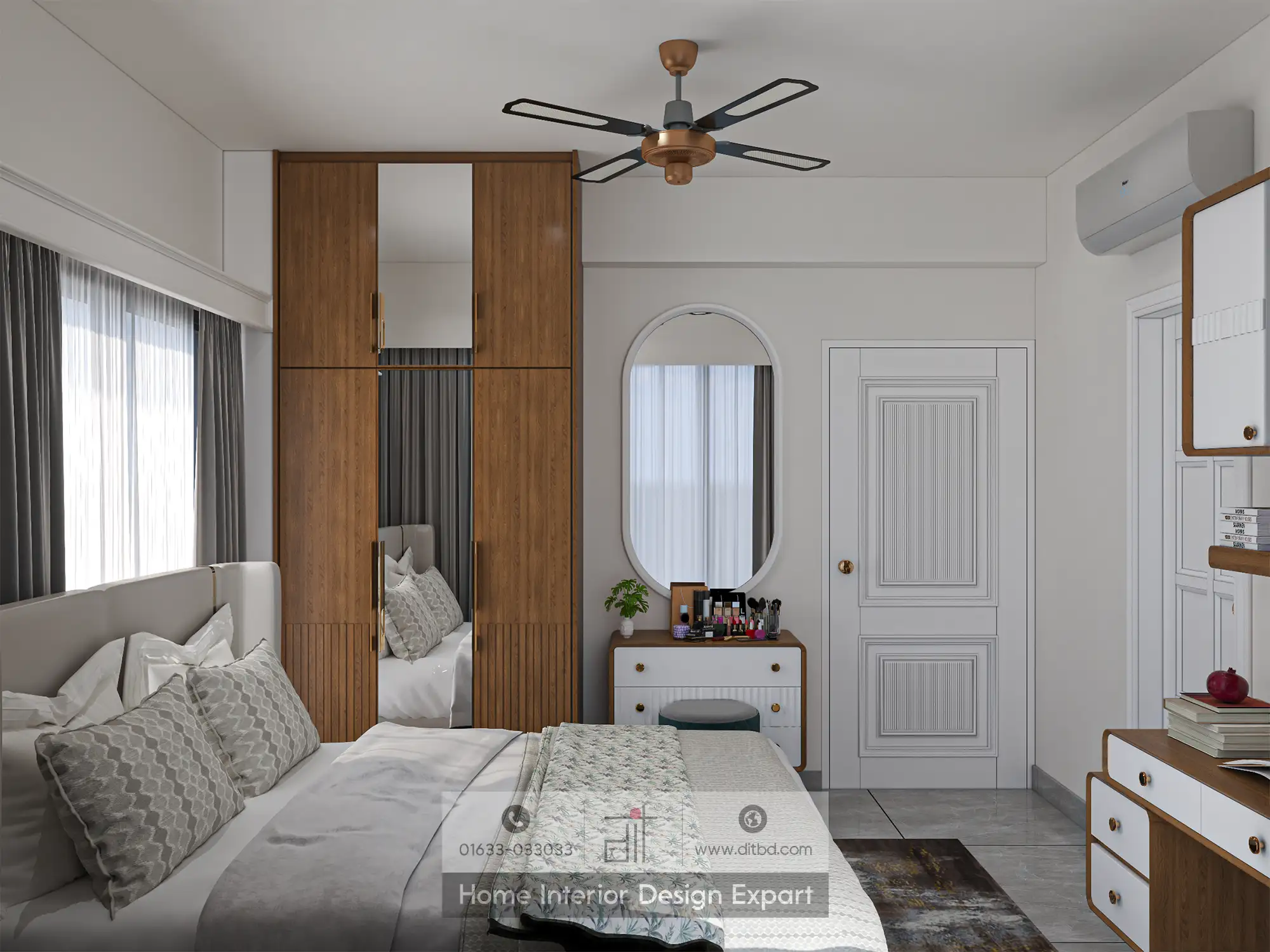
Walk into any furniture workshop in Dhaka and you’ll encounter a wall of material samples: HPL sheets, acrylic panels, veneer swatches, MDF boards, particle board cores. It’s a lot to take in if you’re not a furniture professional.
But choosing the right material for your custom furniture isn’t just an aesthetic decision. In Bangladesh, it’s a practical one. Dhaka’s tropical climate, with monsoon humidity regularly exceeding 80% from June through October, has a significant effect on how furniture performs over time. The wrong material in the wrong application can mean swelling doors, peeling surfaces, and furniture that needs replacing within five years.
This guide breaks down the most common materials used in custom furniture in Bangladesh, with honest assessments of where each one excels and where it falls short. We’ve been specifying materials for Dhaka’s conditions since 2011, and some of what we’ve seen fail in the field has shaped every recommendation below.
Key Takeaways
- Engineered wood expands and contracts approximately 50% less than solid wood in high-moisture environments, making it the more stable base material for Dhaka’s climate (Sustainable Lumber Co., 2024).
- Bangladesh’s furniture market reached US$1.82 billion in 2024 and is projected to grow at 4.15% CAGR through 2029, driven by growing demand for quality interior finishes (Statista, 2024).
- Standard MDF can shrink and expand at five times the rate of solid wood under fluctuating humidity conditions, making moisture-resistant variants essential for Bangladesh (EWPAA Particle Board and MDF Facts).
Why Material Choice Matters More in Bangladesh
Bangladesh sits in a humid subtropical zone. Dhaka averages 80-90% relative humidity during the monsoon season, and even in drier months, indoor humidity levels rarely drop below 50-60%.
Wood-based materials respond to humidity by absorbing moisture from the air and releasing it when conditions dry out. This cycle of expansion and contraction is invisible day-to-day but cumulative over years. Poorly selected materials swell, warp, delaminate, and lose structural integrity.
The good news is that the right materials, specified correctly, perform excellently in Bangladesh’s climate. The key is knowing which materials those are and understanding the difference between standard and moisture-resistant grades.
Early in our work, we encountered a project in Aftabnagar where the client had used a local furniture maker who specified standard particle board throughout a full bedroom wardrobe. Within two monsoon seasons, the base panels had swollen, the doors wouldn’t close properly, and the HPL surface had begun to delaminate at the bottom edges where moisture had entered through the board’s cut face. The finish itself was fine. The substrate had failed. That’s one of the most common and expensive mistakes we see, and it’s entirely avoidable with correct specification from the start.
When clients visit DIT Studio, material selection is always one of our first conversations. The custom furniture we design is built to last in Dhaka’s specific conditions, not simply imported designs specified for temperate climates. Let’s walk through your options.
Engineered Wood: The Smart Base Material
Engineered wood is an umbrella term for sheet materials manufactured from wood fibres, chips, or layers bonded together with resin and adhesive. The most common types used in Dhaka’s furniture industry are particle board, MDF (Medium Density Fibreboard), and HDF (High Density Fibreboard).
Engineered wood products expand and contract approximately 50% less than solid wood in high-moisture environments due to their cross-directional construction (Sustainable Lumber Co., 2024). This makes them more dimensionally stable than solid timber for flat applications like cabinet carcasses, wardrobe panels, and shelving.
However, not all engineered wood is equal. Standard grades absorb moisture readily. Moisture-resistant (MR) grades use water-resistant resin binders and are the correct specification for any furniture application in Bangladesh. For structural carcasses in full-height wardrobes, panels should be a minimum 18mm thickness. Thinner panels flex under load across spans of 2.5m or more, causing doors to misalign and shelves to sag over time.
Particle Board
Particle board is made from compressed wood chips and sawdust. It’s the most affordable engineered wood option and widely available in Bangladesh.
Standard particle board is vulnerable to moisture. When it gets wet, it can swell irreversibly and lose structural strength. MR particle board uses phenol-formaldehyde resin to improve moisture resistance, though it still should not be used in direct-water-contact applications.
One reliable way to confirm MR grade in the field: MR board has a green dye added to the core during manufacturing. When you see a cross-section of the board at a cut edge, MR board shows a distinctive green tint through the core. Standard board does not. This is a quick visual check you can ask any fabricator to demonstrate.
Use for: Cabinet carcasses, shelf interiors, wardrobe bodies (always specify MR grade).
Avoid for: Surfaces near kitchen sinks, outdoor-adjacent areas, or bathroom furniture.
MDF and HDF
MDF (Medium Density Fibreboard) is denser and smoother than particle board, with a more uniform surface that takes paint and veneer very well. Standard MDF has a density of 640-700 kg/m³. Moisture-resistant MDF runs at 700-750 kg/m³ and uses melamine-urea-formaldehyde resin binders that hold their structure even in sustained high humidity. That density difference is why MR board costs more, and why it earns the premium in Dhaka’s conditions.
HDF (High Density Fibreboard) is denser still, used for applications requiring extra strength. Standard MDF shrinks and expands at five times the rate of solid wood under fluctuating humidity (EWPAA). Moisture-resistant MDF uses similar resin treatment to MR particle board. For painted or veneered furniture in Dhaka, moisture-resistant MDF is the recommended base.
Use for: Painted door panels, routed decorative surfaces, painted cabinets (MR grade).
Avoid for: Any standard-grade application in humid rooms.
HPL (High Pressure Laminate): The Best Surface Finish for Bangladesh
If there’s one material recommendation we make to nearly every client in Dhaka, it’s to specify HPL for surface finishes wherever possible.
HPL is manufactured by pressing multiple layers of resin-impregnated paper under high pressure and heat, creating a hard, non-porous surface sheet. Standard HPL has a 0.7mm decorative resin layer bonded to a 16-18mm substrate. Panel faces are water and moisture resistant, and HPL maintains its form and integrity even in humid environments, unlike natural wood which can warp or rot (Composite Panel Association).
HPL’s performance properties for Bangladesh’s conditions include:
- Moisture resistance: Non-porous surface repels moisture and stains effectively
- Scratch resistance: The hard resin surface resists daily wear better than painted finishes
- Temperature stability: Handles the heat and humidity fluctuations of Bangladesh’s seasons without delaminating
- Easy maintenance: Wipes clean without special products
- Wide aesthetic range: Available in wood-grain effects, solid colours, and textured finishes
HPL is available in two primary formats. Standard HPL sheets are bonded to a substrate (the MR board carcass). Compact HPL is a thicker, self-supporting panel used for applications like countertops or high-wear surfaces where extra rigidity is needed.
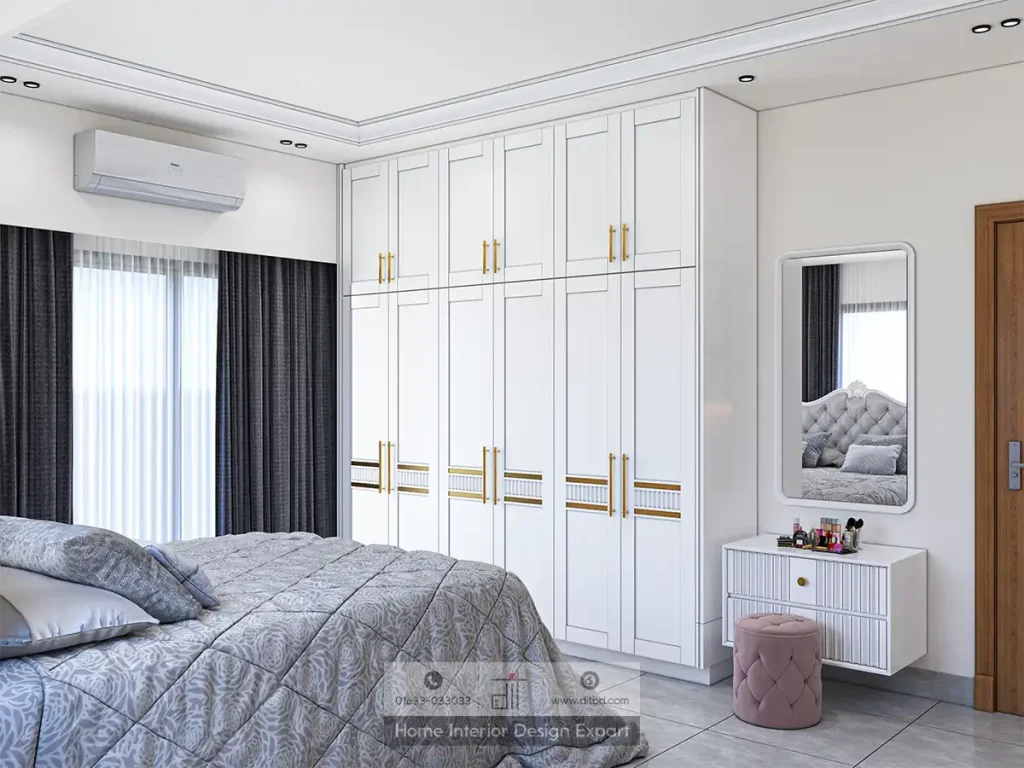
For wardrobes, bedroom furniture, kitchen cabinets, and living room units in Dhaka, HPL over MR board is our standard specification at DIT Studio. You can see this combination in our luxury closet in Gulshan 2 and modern closet in Basila projects.
Acrylic Finish: Premium Aesthetics with Strong Humidity Performance
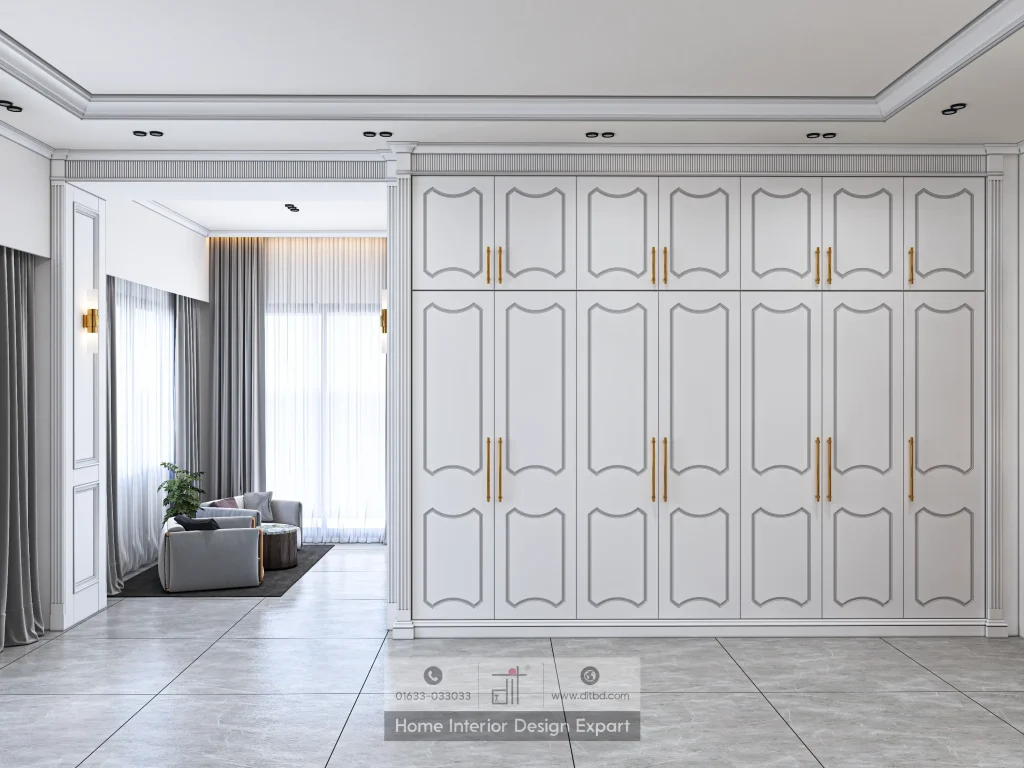
Acrylic finish panels are a step up from HPL in terms of visual impact. The high-gloss surface creates a reflective appearance that photographs well and looks genuinely premium in a bedroom or kitchen.
Like HPL, acrylic is non-porous and handles Dhaka’s humidity well. Its reflective surface makes rooms feel brighter and larger, which is a genuine benefit in compact Dhaka apartments.
The trade-offs are cost and fingerprints. Acrylic costs more than HPL, sometimes 30-50% more for the same panel area. And the high-gloss surface shows fingerprints clearly, requiring more frequent wiping to maintain its appearance in daily use. This is an honest trade-off we raise with every client who requests it. HPL is the more practical finish. Acrylic is the more impressive one.
For clients who want the most visually striking finish for a master bedroom wardrobe or a kitchen that will feature in their home’s aesthetics, acrylic is often the right choice despite the premium.
Best for: Master bedroom wardrobes, kitchen cabinet fronts, statement furniture pieces.
Not ideal for: Children’s rooms or high-traffic areas where fingerprint smudging would be a constant annoyance.
Our luxury closet design projects in Uttara Sector 5 frequently use acrylic for the door fronts paired with HPL carcasses, balancing visual impact with practical durability.
Veneer: Natural Wood Beauty at a Lower Price Point
Veneer is a thin slice of real wood, typically 0.5-3mm thick, bonded to an engineered wood base. It gives the appearance and texture of solid timber at a fraction of the weight and cost.
Quality wood veneer over a stable MR board base performs reasonably well in Bangladesh’s climate, provided the veneer is properly sealed on all edges and surfaces. Unprotected veneer edges can lift when moisture penetrates. A quality lacquer or UV-cured coating provides adequate protection for most indoor applications.
Veneer options available in Dhaka include teak, walnut, oak, and various tropical hardwoods. Burma teak veneer is popular for its natural oils that provide additional moisture resistance.
PVC veneer is a synthetic alternative that performs better than natural veneer in high-moisture applications. It’s more affordable, doesn’t require sealing, and is available in a wide range of wood-effect finishes. For budget-conscious projects where the warmth of a wood-look finish is wanted without the cost of natural veneer or HPL, PVC veneer is a practical choice.
Use veneer for: Feature walls, statement furniture pieces, premium wardrobes where natural texture is desired.
Consider PVC veneer for: Budget-friendly projects needing a wood-effect finish with good moisture tolerance.
Solid Wood: Beautiful but Context-Dependent
Solid wood furniture is the gold standard for heirloom-quality pieces. A well-made solid teak dining table or a hand-carved solid wood bed frame will outlast everything else discussed in this guide if properly maintained.
But “properly maintained” is the critical phrase. Solid wood expands and contracts with humidity changes more than any engineered wood alternative. In Bangladesh’s climate, this means seasonal movement that can cause joints to crack, doors to stick or warp, and finishes to check if the wood isn’t allowed to adjust.
The best solid wood species for Bangladesh’s climate are naturally oily, dense tropical hardwoods. Burma teak is the benchmark: its natural silica and oil content provides excellent resistance to insects, moisture, and rot. Premium Burmese teak costs BDT 10,000-15,000 per cubic foot for high-grade planks in Bangladesh, making it a significant investment.
Mahogany and local garjan are more affordable solid wood options with reasonable performance in humid conditions. Imported pine and engineered-look woods like rubberwood are better suited for temperate climates and can struggle with Bangladesh’s monsoon conditions if not properly finished.
What about marine ply? When a project calls for structural wood that will be exposed to higher moisture levels, marine-grade plywood is a far better specification than standard plywood. Marine ply uses BWP (Boiling Water Proof) grade adhesive throughout, making it genuinely waterproof rather than just water-resistant. In kitchen base units or areas near bathrooms, marine ply for the structural frame is worth the additional cost.
Is solid wood worth the premium for your project? For a dining table or statement bedroom piece that you want to pass to the next generation, yes. For wardrobe carcasses and kitchen cabinets, engineered wood with HPL is the more practical and cost-effective choice.
Material Comparison Table
| Material | Cost Level | Humidity Resistance | Best Application | Avoid For |
|---|---|---|---|---|
| Standard MDF | Low | Poor | Painted interiors (dry rooms) | Kitchens, bathrooms, monsoon-exposed spaces |
| MR Particle Board | Low-Medium | Good | Wardrobe carcasses, cabinet bodies | Direct water contact |
| MR MDF | Medium | Good | Painted or veneered door panels | Direct water contact |
| HPL finish | Medium | Excellent | Wardrobe fronts, kitchen cabinets, all surfaces | – |
| Acrylic finish | High | Excellent | Bedroom wardrobes, premium kitchens | High-traffic children’s areas |
| Natural veneer | Medium-High | Moderate (when sealed) | Feature furniture, statement pieces | Wet areas without extra sealing |
| PVC veneer | Low-Medium | Good | Budget wood-look furniture | Premium aesthetic applications |
| Marine ply | Medium-High | Excellent | Structural frames in wet-adjacent areas | Pure aesthetic applications |
| Solid teak | Very High | Very Good | Statement pieces, dining tables | Large flat panels (warping risk) |
| Other solid wood | Medium-High | Variable | Selected feature pieces | High-humidity exposure without treatment |
Common Mistakes to Avoid
Specifying standard MDF for all applications. Many budget furniture makers in Dhaka use standard MDF throughout because it’s cheaper. In dry rooms it performs adequately, but it will swell and fail in kitchens, bathrooms, or rooms that see significant humidity exposure during monsoon season. Always ask for MR grade and confirm it in writing before work begins.
Choosing the finish before the base material. The finish (HPL, acrylic, veneer) gets most of the attention, but the base material determines the structural integrity. A beautiful HPL finish over a poor-quality particle board substrate will fail when the board swells and the HPL delaminates at the edges.
Not sealing veneer edges. Natural wood veneer is vulnerable at cut edges where moisture can penetrate and cause lifting. Any quality fabricator should seal all veneer edges during assembly. Ask to confirm this is included in the specification.
Ignoring the difference between particle board grades. There’s a significant performance gap between standard particle board and MR particle board. Both look identical until they’re exposed to moisture. Confirm the grade you’re getting before work begins, and look for the green core tint at cut edges as visual confirmation.
Selecting materials based on photos alone. Instagram and design websites are full of beautiful solid oak and white-painted MDF kitchens designed for European climates. Those specifications don’t translate directly to Bangladesh. Always consult with a local expert who understands how these materials perform in Dhaka’s specific conditions.
Our team at DIT Studio addresses all of these issues as part of our custom furniture design process. We specify materials for Bangladesh’s climate, not templates borrowed from another market. You can read more about how we approach quality in our why choose DIT Studio page.
FAQ
Is HPL the same as laminate?
HPL (High Pressure Laminate) and standard laminate are related but different. HPL is manufactured at higher pressure, making it denser and more durable than low-pressure laminate (LPL). For furniture in Bangladesh, HPL is the correct specification. LPL is sometimes used as a cheaper alternative but it’s less resistant to impact, heat, and moisture.
How can I tell if a furniture maker is using MR board or standard board?
Ask directly and request the board manufacturer’s specification sheet. Reputable suppliers in Bangladesh stock boards from manufacturers like Hatil, or imported boards with MR certification. MR board has a green dye added to the core to allow visual identification after cutting. If you can see a cross-section of the board, MR board will show a green tint through the core.
What’s the best material for kitchen cabinets in a Dhaka apartment?
MR particle board or MR MDF for the carcass, HPL or acrylic for all surface finishes. Kitchen environments see the most moisture, heat, and steam of any room in a Dhaka apartment, making moisture-resistant base materials and non-porous surface finishes essential. Our modular kitchen design service uses this specification as standard.
Does solid wood furniture require special care in Bangladesh’s climate?
Yes. Solid wood furniture in Bangladesh benefits from being kept in air-conditioned rooms where humidity is more controlled. During monsoon season, maintaining indoor humidity below 65% significantly reduces wood movement. Applying quality furniture wax or oil annually helps maintain the finish and provides some barrier against moisture absorption. Teak requires less maintenance than other species due to its natural oils.
How much more does HPL cost compared to standard laminate?
HPL typically costs 20-40% more than standard laminate for the same panel area. For a typical wardrobe or kitchen project, this difference in material cost is often offset by the significantly longer service life of HPL versus standard laminate, which can begin to delaminate within 3-5 years in Dhaka’s humidity conditions.
Make the Right Material Choice From the Start
Material decisions made at the beginning of a furniture project are difficult and expensive to reverse later. A wardrobe built on the wrong base material will show problems within a few monsoon seasons. One built correctly will serve your family for decades.
As a specialist interior designer in Bangladesh, DIT Studio has been specifying materials for Bangladesh’s climate since 2011. Our team understands which combinations perform, which ones fail, and how to balance aesthetics with genuine long-term durability in Dhaka’s specific conditions.
For more context on how these material choices affect real projects, read our guide on complete flat interior design in Dhaka and our overview of common interior design myths in Bangladesh homes that covers several material misconceptions we encounter regularly.
If you’re planning a custom furniture project and want advice on materials before committing to a design, we’d welcome the conversation. Browse our luxury master bedroom design in Gulshan 2 for real examples of these materials in finished interiors, or contact our team to schedule a consultation. We’re happy to walk you through the options specific to your project, your space, and your budget.
Written by the DIT Studio design team — Bangladesh’s specialist home interior firm since 2011, with 500+ completed residential projects. Our custom furniture work includes wardrobes, storage systems, TV units, and bespoke cabinetry across hundreds of Dhaka homes.