
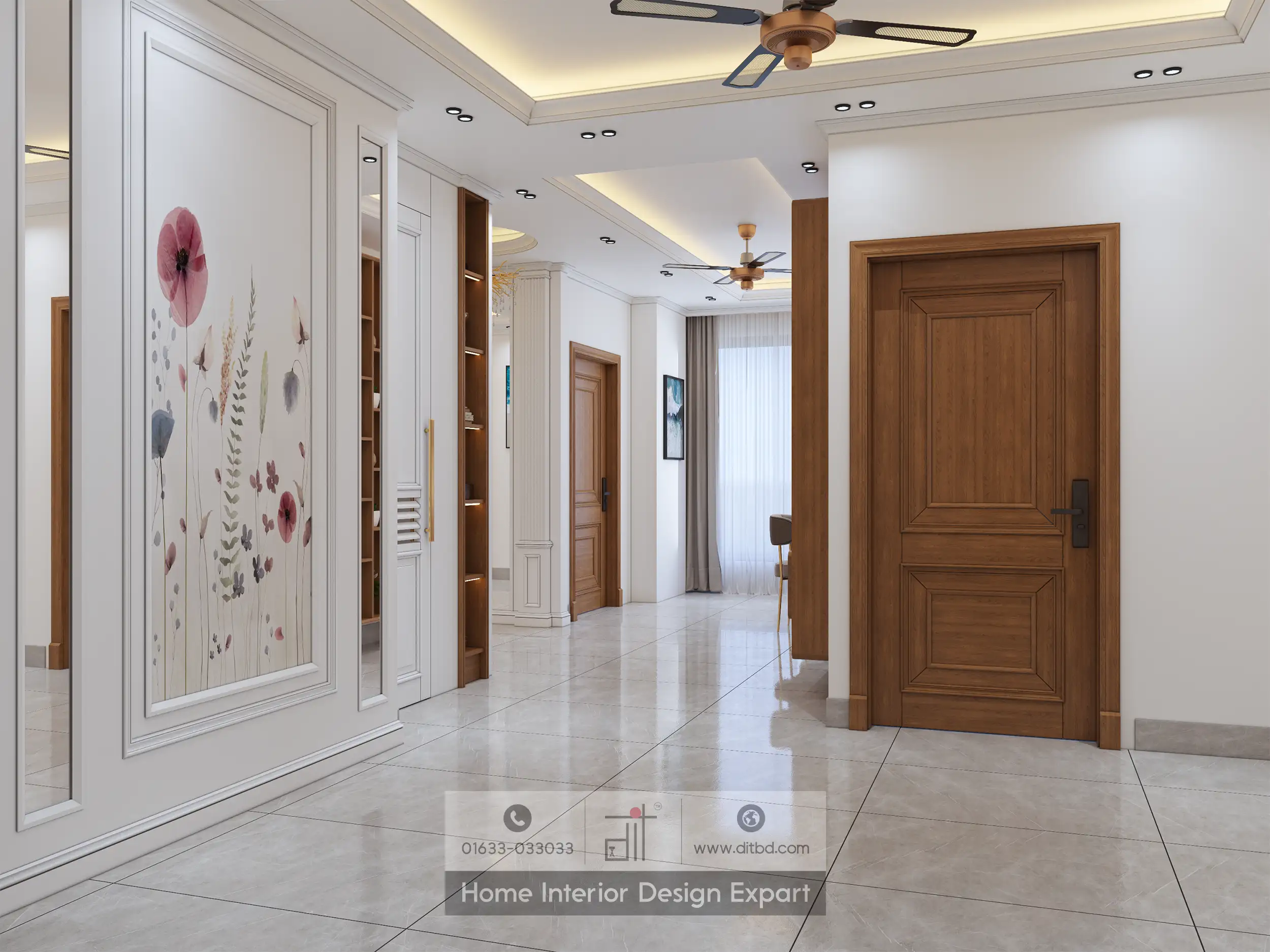
Narrow corridors are among the most neglected spaces in Dhaka apartments. They’re walked through dozens of times each day, but rarely thought about, rarely designed, and rarely loved. The corridor connecting your entrance foyer to your bedrooms is often long, thin, dark, and entirely without character. That’s a significant missed opportunity. Done well, a hallway isn’t wasted space. It’s a curated journey through your home, one that tells guests something about your taste before they reach the living room. This guide covers the hallway design ideas we’ve refined through years of common space design projects in Dhaka’s apartments.
Key Takeaways
- Placing large mirrors along at least 50% of wall length can effectively double a corridor’s perceived width (Rocky Mountain College of Art and Design)
- 94% of design experts say thoughtfully designed storage is the number one priority for home buyers and renovators (Fixr.com, 2025 Home Remodeling Report)
- Over 42% of homeowners now prioritise organised living spaces, driving demand for built-in corridor storage (Global Growth Insights, 2024)
- LED lighting uses up to 80% less electricity than incandescent bulbs, making recessed corridor lighting both affordable and practical in Dhaka (U.S. Energy Information Administration, 2024)
Why Hallway Design Matters More Than You Think
Before we get into specific ideas, it’s worth understanding why the corridor deserves your attention. In Bangladeshi homes, the hallway is the connective tissue of the house. It links the entrance to the bedroom, the living room to the children’s room, the kitchen to the common areas. Every member of the household passes through it dozens of times daily.
The Bangladesh interior design market has grown four-fold over the past decade, according to The Business Standard, and now sits at approximately Tk 20,000 crore. This growth reflects a real shift in how Dhaka homeowners think about their interiors. Functional rooms are now the baseline. What people want is spaces that feel complete, cohesive, and worth spending time in. The corridor connects all those spaces, and when it’s designed thoughtfully, the whole home feels more considered.
We’ve worked on dozens of narrow corridors in Dhanmondi apartments over the years. The ones that transform best are the ones where we treated the corridor as a gallery, not just a passage. In many of our most acclaimed projects, like this luxury common space design in Dhanmondi 6A, the corridor became one of the most praised parts of the home. If you’re thinking about this alongside a broader flat redesign, our guide to complete flat interior design in Dhaka covers how hallway choices connect to the rest of the home.
What stops most people from investing in corridor design? The perception that it’s too narrow to bother with. Constraint is not the enemy of good design. It’s the condition that makes design necessary.
Hallway Design Idea 1: Accent Wall Panelling
The fastest way to give a hallway character is to treat one wall as a design surface. Accent wall panelling, whether fluted timber profiles, raised geometric MDF panels, or smooth board-and-batten, transforms a plain plaster surface into an architectural feature without requiring structural changes.
According to the 2024 home design trend reports from PortSide Builders and other industry analysts, textured wall treatments are among the top residential design choices for 2024 and beyond. This makes practical sense in corridors: you can’t fit large furniture in a narrow space, so the walls carry the visual weight of the design.
For Dhaka’s humid climate, we recommend moisture-resistant MDF panels finished with a water-based paint or PVC laminate. Natural timber panels look beautiful but require sealing and maintenance in Bangladesh’s monsoon conditions. WPC (wood-plastic composite) boards offer an excellent middle ground: they look like timber and perform like a moisture-resistant material. This is an honest tradeoff worth naming: WPC costs somewhat more than untreated timber upfront, but we’ve seen natural wood corridor panels delaminate within two monsoon seasons in poorly-ventilated Dhaka buildings. The extra cost is worth it.
Panel proportions matter in a narrow corridor. Vertical fluting or vertical board profiles draw the eye upward, making the ceiling feel higher. Horizontal banding has the opposite effect, widening the visual field but lowering the apparent ceiling. In most Dhaka corridor layouts, vertical profiles are the stronger choice.
A popular treatment we use: panel the lower half of the corridor wall in a mid-tone painted MDF, add a picture rail or chair-rail moulding at approximately 900–1000mm height, and leave the upper portion in a lighter shade of the same colour. This two-tone approach adds depth without making the space feel heavy.
Before and after: One client’s Mirpur apartment had a 1.2-metre-wide corridor running 8 metres from the entrance to the master bedroom. It was off-white throughout, with a single bare bulb. After adding fluted white-oak veneer panels on one side, recessed lighting above, and dark-painted plaster on the opposite wall, the corridor became the most photographed part of their home.
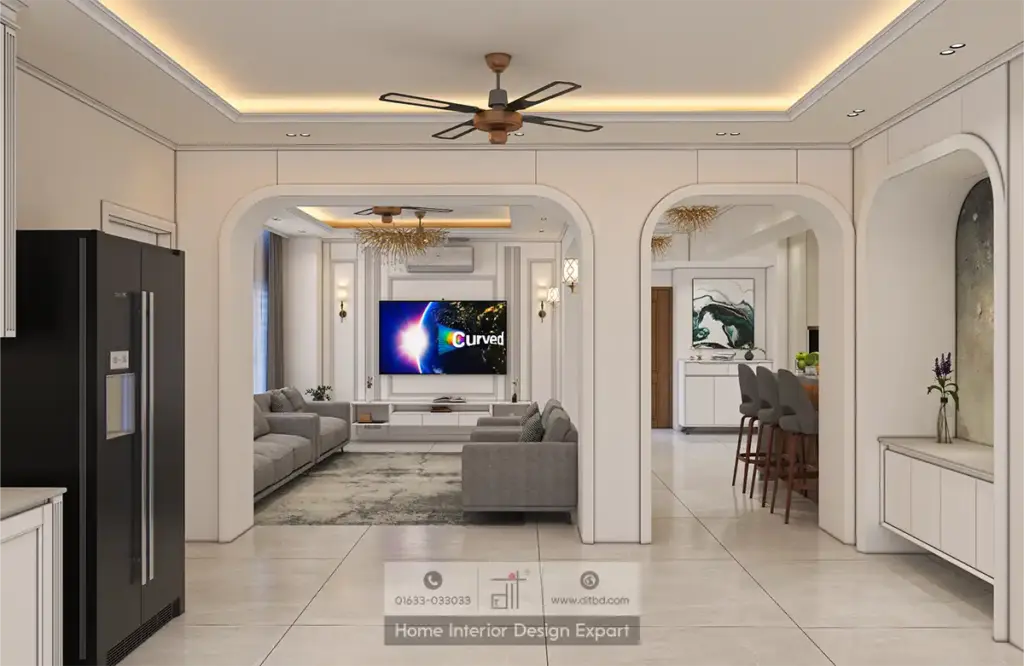
Hallway Design Idea 2: Recessed Lighting for Depth and Drama
Lighting changes a corridor faster than almost any other intervention. Most narrow hallways in Dhaka apartments rely on a single flush-mounted ceiling light, which produces flat, shadow-free illumination. It’s functional but completely uninteresting.
According to research by the U.S. Energy Information Administration (2024), 63% of homes now use LED bulbs as their primary indoor light source, up from just 4% in 2011. LEDs use up to 80% less electricity than traditional incandescent bulbs, which is a meaningful saving in Dhaka where household electricity costs are a real consideration. They also last significantly longer, which reduces maintenance in hard-to-reach ceiling fixtures.
For hallways, we layer lighting across multiple planes. Recessed downlights in a line along the ceiling, spaced every 150–200 cm, create even illumination without visual clutter. These replace the single bulb and immediately make the corridor feel more finished. Specify warm white, 2700K to 3000K, for an inviting atmosphere rather than the cold brightness of daylight-range bulbs. Anything further apart than 200 cm leaves visible dark patches between pools of light, which makes a long corridor feel even longer.
Cove lighting is a refinement that adds significant drama. A continuous LED strip concealed behind a dropped ceiling soffit or a cove detail runs the length of the corridor and washes the ceiling with indirect light. The effect is warmth and apparent height simultaneously. Paired with wall-panel texture that catches the indirect light and creates shadow play, this is the combination that makes corridors look genuinely designed.
Wall sconces are a third option, particularly suited to corridors with a slight width allowance. Slim, minimal sconces mounted at consistent intervals on one wall create a rhythm that makes a long corridor feel deliberate rather than accidental.
During Dhaka’s frequent power outages, battery-backed emergency lighting integrated into the corridor circuit ensures basic safety and navigation. We typically specify at least two battery-backed LED downlights per corridor as a standard inclusion. Our broader article on lighting tips for Bangladeshi home interiors explains the layering principles in more detail. See how lighting design integrates with our broader common area design approach in Gulshan 2.
Hallway Design Idea 3: Mirror Panels for Perceived Width
A narrow corridor can feel uncomfortably tight. The psychological experience of width is driven almost entirely by what you see, which means mirrors are one of the most powerful and cost-effective tools in corridor design.
Research published by the Rocky Mountain College of Art and Design confirms that placing large mirrors along a wall can effectively double a room’s perceived size. In a corridor context, this works by creating an apparent second corridor running parallel, which makes the brain read the space as far wider than it is.
The key is scale. A small decorative mirror hung on a corridor wall looks timid and doesn’t produce the spatial expansion effect. What works is a mirror panel that spans at least 50% of the wall’s length, and ideally reaches from floor to ceiling. A 600mm-wide panel is the minimum where you start to see the widening effect; anything smaller reads as decoration rather than spatial intervention. Floor-to-ceiling height is the most effective format, but a panel from 200mm above the floor to 200mm below the ceiling achieves most of the same result.
In Dhaka apartments, we often combine mirror panels with adjacent panel moulding on the opposite wall. One side of the corridor is mirrored; the other is panelled in a complementary material. The mirror reflects the panelling and the lighting, creating layered depth that makes a 1-metre-wide corridor feel like 2 metres.
The orientation of the mirror also matters. Never position a large mirror directly opposite a bedroom door. Aside from cultural sensitivities common in many Bangladeshi households, it can feel startling in low-light conditions. Position mirrors to reflect lighting fixtures or panelling, not doorways.
Frosted or tinted mirrors are an option for clients who want the spatial benefit without the full reflectivity. A smoke-tinted mirror, in particular, adds warmth and a sophisticated, gallery-like quality to corridor walls. We used this approach in the common area design in Aftabnagar, where the client wanted openness without the full mirror effect.
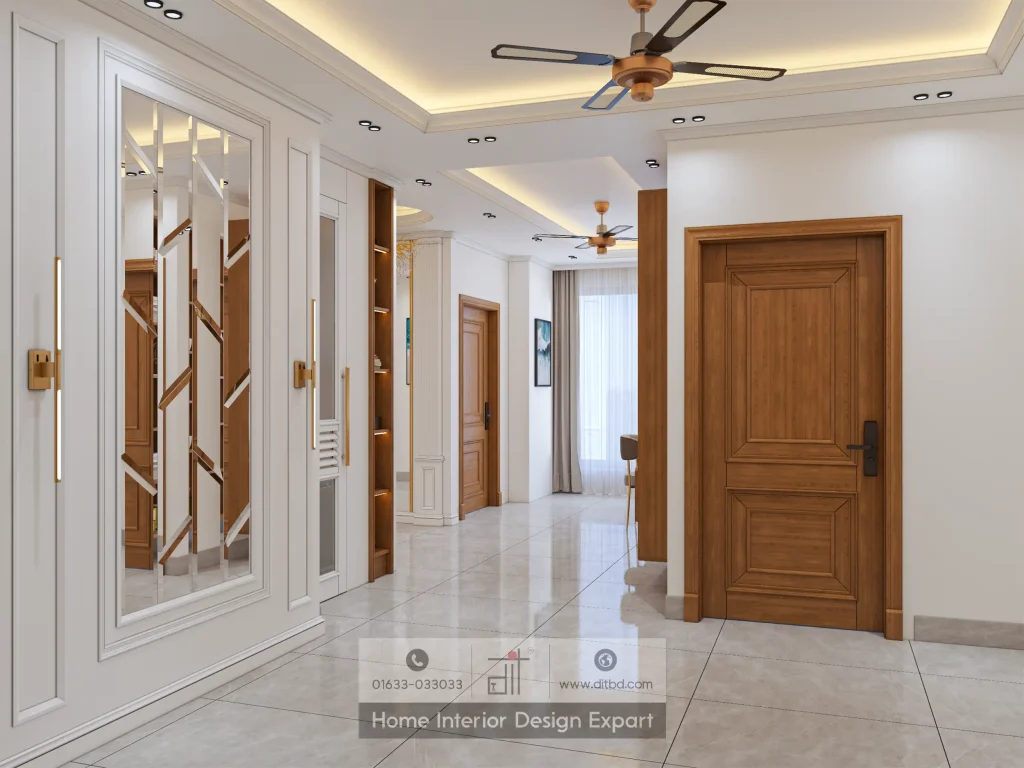
Hallway Design Idea 4: Built-In Storage Niches and Cabinets
A corridor wall is storage space you haven’t used yet. In Dhaka apartments, where internal room sizes are already compressed, the hallway can absorb storage needs that would otherwise crowd the bedrooms.
According to Fixr.com‘s 2025 Home Remodeling Statistics report, 94% of design experts surveyed say thoughtfully designed storage is the top priority for home buyers and renovators. The Global Growth Insights home storage market report (2024) adds that 42% of homeowners now actively prioritise organised living spaces, with demand for built-in solutions growing steadily across Asia.
Built-in corridor storage takes two main forms. The first is a full-height cabinet integrated flush with the wall. These are built so the doors sit exactly in plane with the surrounding plaster, creating a seamless surface that doesn’t interrupt the corridor’s visual flow. Inside, they hold linen, seasonal items, vacuum cleaners, luggage, or whatever the household needs to store out of sight.
The practical width question matters here. A corridor needs a minimum of 900mm of usable walkway width for comfortable movement, regardless of what’s built in. If your corridor is 1,100mm wide, a built-in cabinet with 200mm of depth is feasible. If the corridor is 1,050mm, recessed niches of 100–150mm depth are the better route: they add display space without cutting into passage width. We always measure under load conditions too, checking whether the corridor narrows at doorframes or structural columns before committing to a cabinet depth.
The second form is the open display niche. Recessed into the wall between structural studs, these niches provide display space for artwork, books, small plants, or framed photographs. They add visual interest without adding projection into the walkway.
A combination of both approaches works especially well in longer corridors: a closed storage unit at one end, open niches along the middle section, and perhaps a small console or wall-mounted shelf at the far end. This creates rhythm and breaks the monotony of a long, plain passage.
We build corridor storage as custom furniture designed precisely for each home, ensuring every millimetre of width and height is used efficiently. See an example of how this comes together in our common area design in Dhanmondi 10A.
Hallway Design Idea 5: Art, Colour, and Personal Expression
A hallway doesn’t have to be neutral. In fact, some of the most memorable corridors in homes we’ve designed have been the boldest in terms of colour and artwork. The corridor is a transitional space, which means it tolerates a higher level of visual intensity than a room where you spend extended time.
A single wall of deep colour, rich navy, forest green, terracotta, or even black, can be spectacular in a corridor. Because the space is narrow and moving through it is quick, the dark colour creates atmosphere without the oppressive effect it might have in a bedroom. Pair it with recessed ceiling lighting and the contrast between the lit ceiling and the saturated wall creates a cinematic quality.
Artwork works exceptionally well in hallways because the linear arrangement of a corridor naturally creates a gallery-like context. A sequence of prints, photographs, or paintings at consistent eye height along one wall, spaced evenly at 50–80 cm intervals, creates a visual rhythm that makes walking the corridor an experience rather than a transit.
In Bangladeshi homes, family photography is often displayed prominently, and a corridor gallery arrangement is both practical and emotionally meaningful. A hallway filled with well-framed photographs at consistent hanging heights feels intentional and personal in a way that a random arrangement on a bedroom wall does not.
Flooring in the corridor can also carry design weight. Geometric or patterned tiles in a hallway create a runner effect that draws the eye forward and makes the corridor feel longer and more considered. Popular choices in Dhaka include encaustic cement tiles in geometric patterns and porcelain tiles with stone-look finishes. Keep the grout colour close to the tile colour to preserve visual continuity. Natural stone tiles look extraordinary in a corridor but require sealing every one to two years in Dhaka’s climate. Porcelain is the lower-maintenance alternative that delivers a comparable visual result.
See how art and colour integrate with structural design in our luxury common space design in Dhanmondi 6A. For inspiration on how personal expression through colour choices works across different home types, our guide to timeless vs. trendy interior design in Bangladeshi homes is worth a read.
Common Mistakes in Narrow Hallway Design
Filling the corridor with freestanding furniture. A corridor is not a room. Freestanding pieces like side tables, tall bookcases, or decorative stands belong in rooms that can accommodate them without restricting movement. In a hallway, everything must be wall-mounted or built-in.
Using too many competing materials. Flooring, walls, ceiling, and any built-in elements should work together. A marble floor, patterned wallpaper, wooden panels, and a different ceiling treatment will make a narrow corridor feel chaotic. Choose a dominant material and support it with one or two complementary finishes.
Ignoring the ceiling. Most people design corridors from the floor up and stop at eye level. The ceiling is an underutilised surface. A painted ceiling slightly lighter than the walls appears higher. A cove lighting detail along the ceiling edge softens the transition between wall and ceiling. Even a thoughtful choice of ceiling colour changes the feel of the space.
Overhead lighting only. A single central light leaves the corridor walls in shadow and creates an institutional feel. Layer your lighting: recessed downlights for general illumination, wall-adjacent downlights or sconces to wash texture across panelled walls, and accent lighting for niches or artwork.
Leaving the corridor outside the overall design scheme. The hallway connects every room in your home. If its palette, materials, and style have no relationship to the rooms it connects, the home feels fragmented. Your corridor should feel like part of the same conversation as your living room design and bedroom.
FAQ: Hallway Design in Bangladeshi Homes
How wide does a hallway need to be for built-in storage?
The minimum comfortable corridor width for circulation is 900mm. For built-in cabinets to work without restricting movement, you ideally need 1,050–1,200mm of total width, allowing for 150–300mm cabinet depth and 900mm of clear passage. In tighter corridors, recessed niches of 100–150mm depth are achievable without reducing passage width. Our custom furniture team can design solutions for corridors as narrow as 850mm.
What colour should I paint a narrow dark corridor?
It depends on your goal. If you want to maximise apparent width and brightness, choose light neutrals, off-white, pale grey, or warm cream, and pair them with warm-white recessed lighting. If you want atmosphere over apparent size, a deep single-colour treatment on the walls with well-considered lighting can create a dramatic, gallery-like quality. Avoid mid-tones, which achieve neither effect particularly well.
Can I add storage to a corridor without construction work?
Open display niches require wall work unless you’re using shallow wall-mounted shelves. Floating shelves at consistent heights can be installed without structural changes and add useful display or storage space. However, for the most effective use of corridor space, built-in cabinetry is worth the construction investment. According to Fixr.com (2025), 94% of design experts consider built-in storage the top home improvement priority.
How many lights do I need in a corridor?
Recessed downlights should be spaced every 150–200 cm for even illumination without dark patches between fixtures. A 6-metre corridor typically needs four to five fixtures in a straight line. If you add wall sconces, you can reduce the ceiling fixtures and gain warmth and dimensionality. Always specify LED fixtures, ideally warm white at 2700–3000K, for consistent, flattering light. Battery-backed options are worth including for Dhaka power outage conditions.
How do I connect hallway design to the rest of the home?
Choose one or two materials that appear in both the corridor and the adjacent rooms, whether a flooring material, a paint colour, or a hardware finish. The hallway doesn’t need to match rooms exactly; it needs to feel related. A warm-wood floor that continues from the living room into the corridor, for example, creates immediate visual continuity. Explore our full services to see how we approach whole-home design coherence, or read our guide to space maximisation tips for Bangladeshi homes for practical ideas that apply across every room.
Turn Your Corridor Into a Design Feature
A narrow corridor doesn’t have to be a problem. With the right combination of accent wall panelling, recessed lighting, mirror panels, built-in storage, and personal expression through art and colour, it becomes one of the most distinctive and memorable parts of your home.
Every hallway we’ve designed at DIT Studio — a trusted interior designer in Bangladesh since 2011 — has started from the same premise: there is no space too small to deserve good design. From corridors in compact Mirpur apartments to long gallery hallways in Gulshan residences, the approach is the same. Measure carefully, think strategically, and craft something that connects every room in the home rather than merely separating them.
We’ve been designing common spaces across Dhaka since 2011, with over 500 completed residential projects and a portfolio that demonstrates what thoughtful design can do for even the most challenging corridors. Contact DIT Studio to start your hallway transformation.
Written by the DIT Studio design team — Bangladesh’s specialist home interior firm since 2011, with 500+ completed residential projects across Dhaka. Our work spans compact apartment interiors to large floor-through homes in Gulshan and Dhanmondi.