
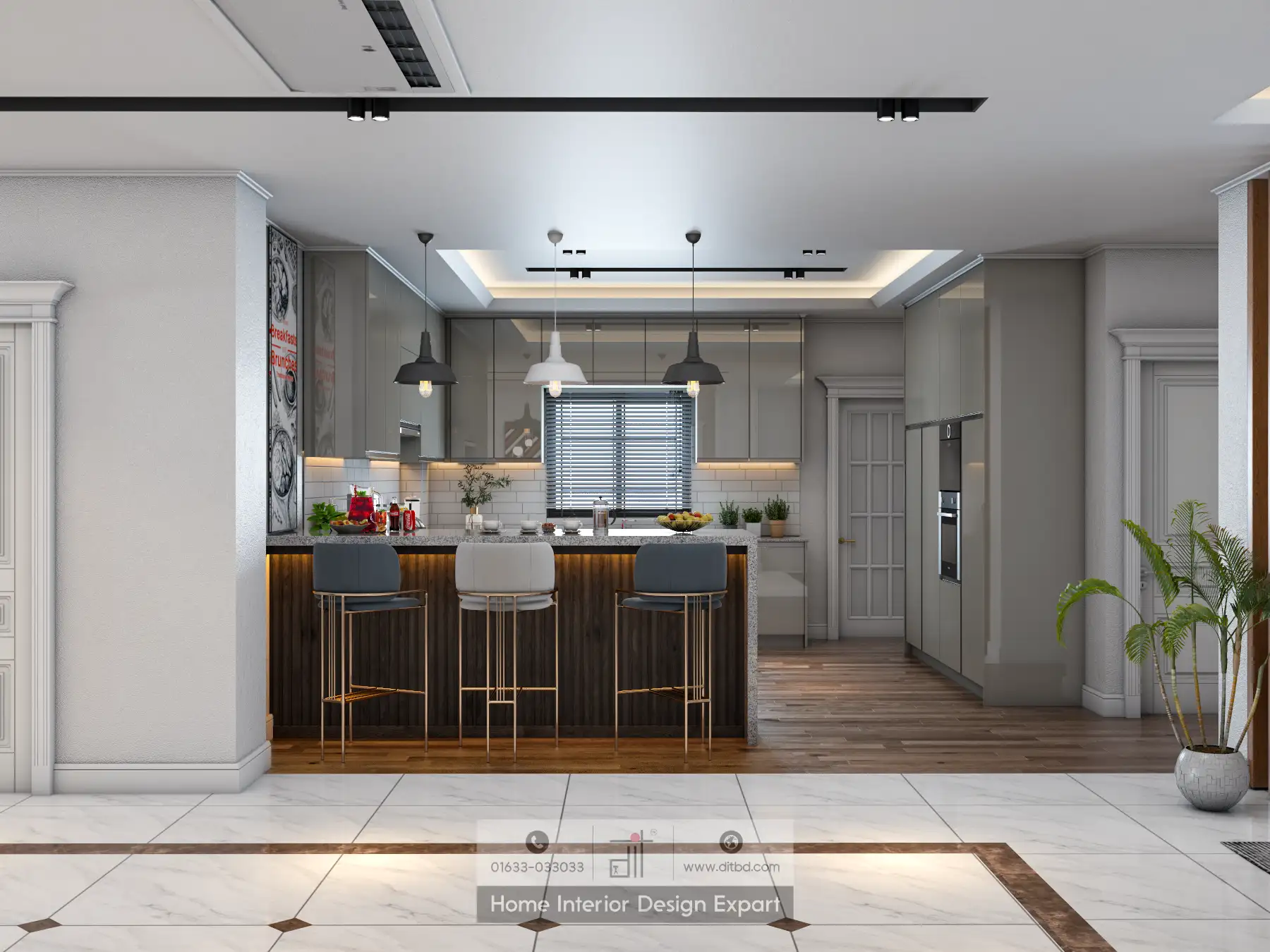
The smell of biryani fills the house. For most Bangladeshi families, that’s a wonderful thing. Until it’s your living room sofa absorbing it at 2 PM on a Tuesday, and guests are arriving at 6.
Cooking odour is the single biggest concern we hear from Dhaka homeowners considering an open kitchen. It’s also the most solvable. A 2024 study published in the Journal of Building Engineering found that properly installed extracting (ducted) ventilation significantly outperforms recirculating systems at removing cooking odours, smoke, and moisture from the air.
Our clients always ask about the smell first. And we always start with the same answer: the ventilation is the design. Get that right, and the open kitchen becomes practical. Get it wrong, and no amount of beautiful cabinetry will save you.
This guide explains exactly why odours spread in an open kitchen, and precisely what you need to do about it, from chimney selection to installation to the mistakes that undo good planning.
Key Takeaways
- Ducted (extracting) kitchen hoods significantly outperform ductless (recirculating) models for odour, smoke, and moisture removal in open kitchens (Journal of Building Engineering, 2024)
- A standard 4-burner gas hob produces 40,000–60,000 BTU, requiring a minimum of 400–600 CFM at the hob; an open layout adds further demand, making 600–900 CFM the practical target (Proline Range Hoods)
- Charcoal filters in ductless hoods need replacement every 3–4 months for heavy Bangladeshi cooking, not 6 months as generic guides state
- Ductless recirculating hoods are inadequate for biryani, fish frying, or daily heavy cooking in an open kitchen
- Each 90-degree elbow in your duct run reduces effective CFM by 10–15%; keep runs short and straight
Why Do Cooking Odours Spread So Easily in an Open Kitchen?
Physics explains the problem clearly. A 2024 study in Indoor Air measured particulate matter (PM2.5) and volatile organic compound (VOC) emissions from various cooking methods in a controlled research kitchen. It found that cooking generates substantial quantities of both, at levels capable of causing adverse health effects with prolonged exposure. These particles and compounds are airborne the moment you start cooking. They travel in thermal plumes rising from the hot cooking surface and in the general air movement within the space.
In a closed kitchen, the walls contain the plume. The airborne particles bounce around the kitchen, settle on surfaces, and concentrate near the ceiling. The smell stays in one room. In an open kitchen, there are no walls to intercept the plume. The same airborne particles travel freely into the dining and living areas, settling on upholstery, curtains, and every soft surface in the space.
Bangladeshi cooking creates a particularly intense odour challenge. Fish, mustard oil, turmeric, dried spices, and high-heat frying all produce strong aromatic compounds. These compounds are not water-soluble, so they bind to fabrics and surfaces and linger for hours without active removal.
The solution is not to close the kitchen. The solution is to capture the plume at its source before it has the chance to spread.
Understanding CFM: The Number That Determines Success or Failure
Before choosing a chimney or exhaust system, you need to understand CFM. CFM stands for cubic feet per minute, and it measures how much air a hood can move. According to ventilation specialists at Proline Range Hoods, a range hood should exchange the air in the kitchen at least 15 times per hour to maintain clean indoor air quality.
The most relevant calculation for Bangladeshi cooking is BTU-based. The general industry rule is 1 CFM per 100 BTU of your stove’s total output. A standard four-burner gas hob in a Dhaka home typically produces 40,000–60,000 BTU total, which means you need 400–600 CFM minimum just for the stove’s output. Add the open-plan factor, where there’s no wall to help contain the initial plume, and you need to increase that figure further.
For context, a 6-inch duct handles up to 400 CFM effectively. An 8-inch duct is required for 400–700 CFM, and a 10-inch duct for 700–900+ CFM. Size your duct to match your chimney’s rated output, not a size smaller.
Also worth noting: every 90-degree elbow in your duct run reduces effective CFM by 10–15%. A chimney rated at 700 CFM with three bends in the duct may be delivering closer to 490 CFM at the exhaust point. Keep your duct run as short and straight as possible, or account for bends by specifying a higher-rated chimney.
Our recommendation for open kitchens in Bangladesh: A ducted chimney rated at 600–900 CFM. This accounts for your stove’s BTU output, the open layout, and the intensity of Bangladeshi cooking. A 600 CFM unit is adequate for moderate cooking intensity (one to two heavy cooking sessions per day). A 900 CFM unit is the right choice for households that fry fish, cook shutki, or prepare full biryani regularly.
We designed an open kitchen in a Maona Gazipur apartment where the client cooked fish daily. We specified a 900 CFM ducted chimney with an 8-inch duct run straight through the exterior wall. The client reported zero odour issues in the dining area after six months of use. You can see that project at modern open kitchen design in Maona Gazipur.
In our project experience, clients who install a 400 CFM chimney because it was cheaper often come back within six months asking us to upgrade it. The marginal cost of buying a 600–900 CFM unit from the start is far smaller than the cost of a second installation. Buy right the first time.
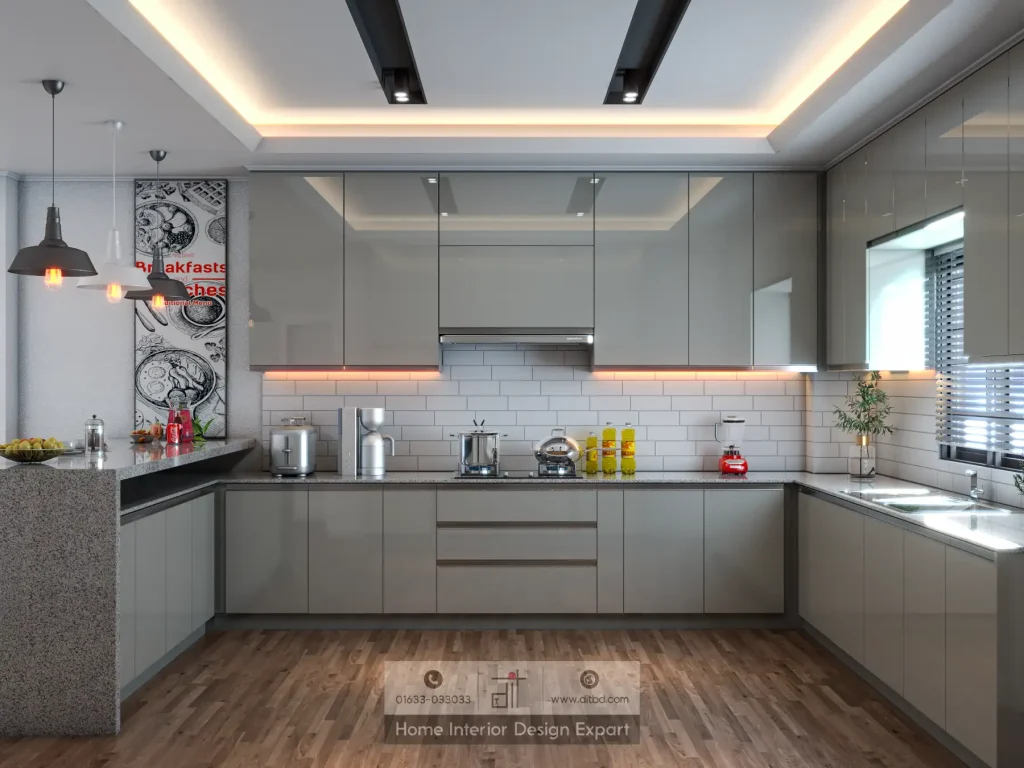
Ducted vs Ductless Chimney: The Most Important Decision You’ll Make
This is not a close call for open kitchens in Bangladesh. A 2024 study published in the journal Building and Environment compared VOC exposure levels in kitchens with ducted (extracting) hoods versus ductless (recirculating) hoods during cooking. The results were unambiguous: recirculating kitchen hoods led to significantly higher occupant exposure to VOCs during and after cooking compared to extracting ventilation.
How ducted chimneys work: The fan draws air from above the cooking surface, pulls it through a grease filter, and pushes it through a duct that exits the building through an exterior wall or the roof. The contaminated air is gone. It does not come back into the home.
How ductless chimneys work: The fan draws air from above the cooking surface, passes it through a grease filter and a charcoal filter, and returns the filtered air back into the room. The filters capture some particles and some odour compounds, but not all. More importantly, moisture and heat return to the room with the recirculated air. Charcoal filters also saturate over time.
Here’s the honest reality on filter replacement: charcoal filters in ductless hoods need replacing every 3–4 months if you’re cooking full Bangladeshi meals regularly, not every 6 months as generic chimney manuals typically state. The aromatic compounds in fish, mustard oil, and dried spices saturate activated carbon faster than lighter Western cooking. Most homeowners don’t replace filters on this schedule, which means the ductless system becomes progressively less effective within months of installation.
To be direct: ductless recirculating hoods are nearly useless for biryani or fish frying. They’re acceptable for reheating and light cooking. For an open kitchen in a Bangladeshi home, they will not solve your odour problem, regardless of how well the marketing describes them.
The practical challenge with ducted systems in Dhaka apartments is duct routing. You need a clear path from the chimney to the outside of the building. This is typically through an exterior kitchen wall or through the ceiling to the roof. In most Dhaka apartments, the kitchen sits adjacent to an external wall or a service shaft, making duct routing straightforward. Our team assesses duct routing as part of every open kitchen design project.
Ranked Solutions: From Most to Least Effective
Here are your options ranked by effectiveness for managing cooking odours in an open kitchen in Bangladesh.
Rank 1: High-CFM Ducted Chimney (Most Effective)
A ducted chimney rated 600–900 CFM, installed directly above the hob and ducted externally, is the gold standard. It captures the cooking plume at the source and removes it from the building entirely. This is the solution we specify in every open kitchen project we design.
Cost: BDT 35,000–90,000 for the unit, plus BDT 10,000–25,000 for ducting and installation.
Effectiveness: Removes 85–95% of cooking odours, grease, and moisture when properly sized and installed.
A note on brands: premium ducted chimney systems from manufacturers like Elica, Faber, and Hindware cost 3–5 times more than budget options, but they perform dramatically better for heavy Bangladeshi cooking. The motor quality, grease filter construction, and duct seal engineering all differ significantly at this price gap. We specify premium brands on all our open kitchen projects and the performance difference is not subtle.
Rank 2: High-CFM Ducted Chimney Plus Kitchen Zoning
A properly sized ducted chimney combined with smart kitchen zoning, placing the hob along an external wall, positioning the hob away from the main living area, and using a breakfast bar or low partition as a partial buffer, achieves near-complete odour management. This combination is our preferred specification for open kitchens used for full Bangladeshi cooking.
Cost: Add BDT 15,000–50,000 for partition or zoning elements above the chimney cost.
Rank 3: Mechanical Ventilation with Heat Recovery (MVHR)
MVHR systems are more common in European residential construction but are now available in Bangladesh. They continuously extract stale air from the kitchen (and other wet rooms) and supply fresh, filtered air to living spaces, with a heat exchanger recovering warmth from the extracted air. They work as a whole-home background ventilation system, supplementing (not replacing) the chimney.
Cost: BDT 1,50,000–4,00,000 for system supply and installation. Suitable for premium apartments.
Effectiveness: Maintains excellent background air quality and reduces residual odour between cooking sessions.
Rank 4: Ductless Chimney with Regular Filter Maintenance (Least Effective)
Where external ducting is genuinely impossible, a high-quality ductless chimney with diligent filter maintenance (charcoal filter replacement every 3–4 months for heavy cooking) is better than nothing. It will not fully control odours from heavy Bangladeshi cooking. It will reduce smoke and capture some grease. Supplement with a window fan or air purifier with a HEPA and activated carbon filter.
Cost: BDT 15,000–50,000 for the unit. BDT 2,000–5,000 per filter replacement.
Effectiveness: 30–50% odour reduction. Inadequate for daily heavy cooking in an open kitchen.
How to Choose the Right Chimney Hood for Your Kitchen
Use this guide to select the correct chimney specification for your Dhaka home.
| Kitchen Type | Cooking Frequency | Recommended CFM | Duct Size | Hood Type |
|---|---|---|---|---|
| Open kitchen, light Bangladeshi cooking | 1 session/day | 600 CFM | 6–8 inch | Ducted |
| Open kitchen, daily full cooking (biryani, fish curry) | 2+ sessions/day | 750–900 CFM | 8 inch | Ducted |
| Open kitchen, includes shutki or very strong aromas | Daily | 900 CFM | 8–10 inch | Ducted + air purifier |
| Closed kitchen, standard cooking | 1–2 sessions/day | 400–600 CFM | 6 inch | Ducted preferred |
| Closed kitchen, no external duct possible | Any | 600 CFM ductless | N/A | Ductless with 3–4 month filter change |
Hood width: Match your chimney width to your hob width, or go wider. A 90 cm chimney over a 60 cm hob is standard. A 90 cm chimney over a 90 cm hob covers the full cooking surface.
Mounting height: Install the chimney 65–75 cm above the hob surface for gas stoves. Too high reduces capture efficiency. Too low creates a burn risk.
Noise level: Measured in sones or decibels. Higher CFM units are louder. Look for models with multi-speed fans so you can run at lower, quieter speeds for light cooking and maximum speed for heavy frying.
Our completed kitchen projects, including the modern kitchen design in Dhanmondi 5 and the modular kitchen in Dhanmondi 10A, include ducted chimney specifications matched precisely to each client’s cooking habits and kitchen layout.
Installation Tips and Common Mistakes
Even the right chimney fails if it’s poorly installed. These are the most common mistakes we see in Dhaka kitchen projects.
Mistake 1: Undersized duct diameter. The duct carrying extracted air away from the chimney must be sized to match the fan’s output. Using a 4-inch duct on a 900 CFM fan creates back-pressure that reduces the effective extraction rate dramatically. For 400 CFM chimneys, use a minimum 6-inch (150 mm) diameter duct. For 400–700 CFM, use 8-inch (200 mm). For 700–900+ CFM, use 10-inch (250 mm).
Mistake 2: Excessive duct length and bends. Every bend in the duct reduces airflow. A 90-degree elbow reduces effective CFM by approximately 10–15%. Keep duct runs as short and straight as possible. If bends are unavoidable, use swept bends rather than sharp elbows, and add 10% CFM to your chimney specification to compensate.
Mistake 3: No makeup air provision. A powerful chimney that extracts a large volume of air creates negative pressure in the kitchen. Without a fresh air inlet, the fan works against this negative pressure and becomes less effective. For chimneys above 400 CFM, ensure there’s a window that can be opened slightly or an air inlet vent to allow makeup air into the kitchen.
Mistake 4: Installing a ductless chimney in an open kitchen. As covered above, this is inadequate for Bangladeshi cooking. Don’t let a contractor or supplier persuade you otherwise. Ductless chimneys are specifically not recommended for high-intensity cooking with strong aromatic ingredients.
Mistake 5: Ignoring the hob’s position. Your chimney must sit directly above the hob, centred, within the recommended 65–75 cm height range. If the hob is positioned far from an external wall, the duct run becomes long and complex. Where possible, position the hob on or near an external wall to minimise duct length and maximise extraction efficiency.
Based on our project reviews across open kitchen installations in Dhaka, undersized duct diameter and excessive duct bends account for approximately 60% of chimney performance complaints from clients. The chimney unit itself is rarely the problem. The installation is.
Additional Strategies to Complement Your Chimney
A great chimney handles 80–90% of your odour problem. These strategies address the remaining 10–20%.
Air purifier with activated carbon filter: An air purifier placed in the open-plan living area filters residual odour molecules that escape the chimney’s capture zone. Look for units with both HEPA (particle capture) and activated carbon (odour absorption) filters. Change the carbon filter every 3–6 months.
Cross-ventilation: Open a window in the living area opposite the kitchen when cooking. This creates a gentle cross-ventilation path that draws fresh air through the space and helps carry residual odour toward the chimney or out through the open window.
Cooktop habits: Use the chimney’s maximum speed setting when frying, not just when smoke is visible. The grease aerosol from high-heat oil cooking is invisible but heavily aromatic. Turn the chimney on before you start cooking and leave it running for 5–10 minutes after you finish.
Splashback design: A full-height splashback behind and around the hob reduces the surface area where grease and odour compounds can settle in the kitchen itself. Easy-clean surfaces like glass, tile, or high-pressure laminate are preferable to textured or porous materials near the cooking zone.
For a complete open kitchen solution that integrates ventilation, layout, and aesthetics into one cohesive design, explore our open kitchen design service or browse our project portfolio, including the open kitchen in Maona Gazipur.
For broader context on how ventilation fits into the full picture of a Dhaka home interior, our guides on interior design challenges in Bangladesh and natural home cooling tips for Bangladesh are worth reading alongside this article.
Frequently Asked Questions
What CFM chimney do I need for cooking biryani in an open kitchen?
For biryani and similar high-heat, aromatic cooking in an open kitchen, we recommend a ducted chimney rated at a minimum of 750–900 CFM. A standard 4-burner gas hob produces 40,000–60,000 BTU, requiring 400–600 CFM at the stove level. An open layout means cooking smells can travel further before capture, so you need headroom above the BTU-based minimum. A higher-rated ducted chimney with a short, straight duct run gives you the best results (Proline Range Hoods).
Can I use a ductless chimney in my open kitchen in Dhaka?
We don’t recommend it for daily Bangladeshi cooking. Research published in the journal Building and Environment (2024) found that recirculating ventilation leads to significantly higher cooking VOC exposure than extracting (ducted) systems. Ductless chimneys return filtered air to the room, which means grease, moisture, and odour compounds remain in the space. For an open kitchen, this is inadequate, particularly if you cook fish, shutki, or biryani regularly.
How often do I need to clean my kitchen chimney in Bangladesh?
The grease filter (metal mesh or baffle) should be cleaned every 2–4 weeks if you cook daily Bangladeshi meals. Soak it in hot water and dish soap or run it through a dishwasher. For ducted chimneys, the charcoal filter (if fitted as a supplementary filter) needs replacement every 3–4 months for heavy Bangladeshi cooking. Generic chimney manuals often say 6 months, but that figure applies to lighter Western cooking habits. A poorly maintained chimney loses extraction efficiency quickly.
Is a 600 CFM chimney enough for a large open kitchen?
For a large open kitchen (above 150 sq ft) used for heavy Bangladeshi cooking, 600 CFM is the minimum. We’d typically specify 750–900 CFM for larger spaces to ensure the kitchen air exchanges at the recommended rate of 15 times per hour. Also account for duct bends: each 90-degree elbow reduces effective CFM by 10–15%, so a 600 CFM chimney with two bends may be delivering closer to 420 CFM at the exhaust point. Size up if your duct run has multiple bends.
Will my open kitchen always smell if I cook fish or shutki?
Not if your ventilation is properly designed. With a 900 CFM ducted chimney, proper duct sizing, and good cooktop habits (starting the chimney before cooking, running it on maximum during frying), the smell should be managed effectively within the kitchen zone. Some residual aroma will always be present during cooking in any layout. The goal is to prevent it from persisting and settling into fabrics and furniture. We’ve achieved this outcome consistently across our open kitchen projects in Dhaka.
Is an open kitchen just not suitable for some Dhaka apartments?
Yes, honestly. If your apartment has no viable duct path to an external wall, if the hob must sit in the centre of the floor plan, or if your household cooks shutki and dried fish daily, an open kitchen may genuinely not be the right choice. We tell clients this when it’s true. The best design outcome is one that works for how you actually live, not one that looks good in photos but creates daily frustration.
Conclusion
Cooking odour in an open kitchen is a design problem, and like all design problems, it has clear solutions. The answer starts with a ducted chimney rated at 600–900 CFM, with a properly sized duct run matched to the chimney’s output. It continues with smart kitchen zoning that places the cooking surface as far as practical from the main living area. And it’s supported by good habits: running the chimney at full power during heavy cooking, maintaining clean filters on the right schedule, and allowing cross-ventilation.
Don’t let odour concerns stop you from having the open kitchen you want. Solve the ventilation first, and the rest of the design follows naturally.
At DIT Studio, a leading interior design company in Bangladesh, we design open kitchens where ventilation is built into the plan from day one, not treated as an afterthought. We’ve solved this challenge for clients cooking everything from Sunday biryani to daily shutki bhorta, and we’ll solve it for you too.
Also see our guide to choosing the right interior designer in Bangladesh if you’re in the early stages of planning your kitchen transformation.
Contact DIT Studio to discuss your open kitchen project, or visit our open kitchen design service page to learn more about what we can craft for your home.
Written by the DIT Studio design team — Bangladesh’s specialist home interior firm since 2011. We’ve designed both open and enclosed kitchens across hundreds of Dhaka homes, navigating the practical realities of Bangladeshi cooking culture and apartment layouts.