
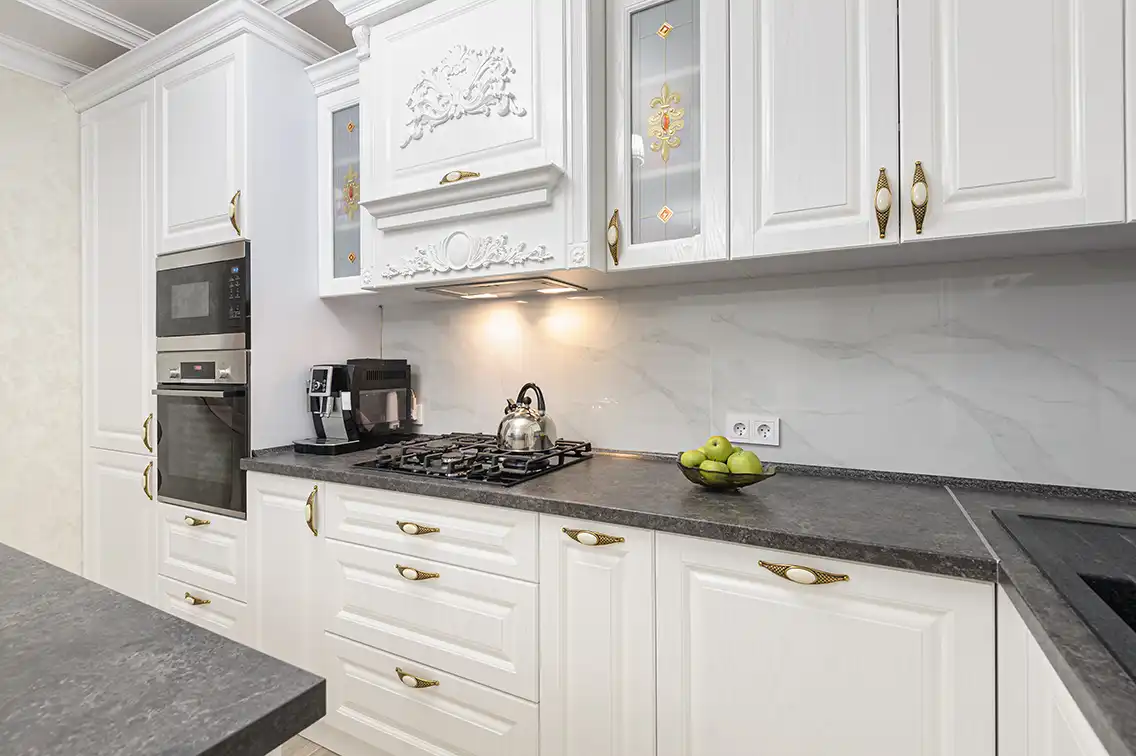
Choosing between a traditional enclosed kitchen and an open kitchen is one of the biggest decisions you’ll make in a home renovation. For Dhaka homeowners, this choice carries real weight. Bangladeshi cooking generates some of the most aromatic, oil-heavy fumes in the world, and research published in Scientific Reports found that cooking oil fume exposure increases lung cancer risk by up to 98% in non-smoking women (meta-analysis of 23 studies, PubMed, 2017). What you cook every day should directly shape how your kitchen is designed.
In our experience designing kitchens across Dhaka, the traditional enclosed layout is still the right choice for most families who cook Bangladeshi meals daily. The smell containment alone justifies it. We’ve seen open kitchens in Dhaka become a source of real frustration for clients who cook fish or mustard-oil dishes regularly. The living room absorbs the smell, the sofa absorbs the grease, and within months the homeowner wishes they had a door they could close.
This guide compares both layouts honestly, covering ventilation, oil management, cooking comfort, social dynamics, and long-term cost.
Key Takeaways
- Cooking fumes during heavy frying can raise indoor PM2.5 levels to 20-50 times WHO’s safe 24-hour guideline of 15 µg/m³ (WHO Air Quality Guidelines, 2021)
- An enclosed kitchen with a proper exhaust hood reduces PM2.5 in adjacent living areas by up to 79% compared to open layouts (PMC, 2021)
- The Asia-Pacific kitchen design market is growing at 6.2% CAGR through 2032, driven by rising demand for functional, health-conscious kitchen spaces (DataIntelo, 2024)
Why Ventilation Is the Most Important Factor for Bangladeshi Kitchens
Anyone who has cooked a proper Bangladeshi meal knows how quickly oil vapor and spice smoke fill a room. Mustard oil tempering, deep-frying hilsa, or preparing a full curry spread produces far more airborne grease than Western cooking styles.
Research from the Lawrence Berkeley National Laboratory found that cooking generates fine particulate matter (PM2.5) at concentrations frequently reaching 100 to 250 µg/m³, levels 20 to 50 times higher than WHO’s 24-hour guideline of 15 µg/m³. In an open kitchen plan, those particles travel freely into the living room and dining area. In a well-ventilated traditional enclosed kitchen, closing the door during cooking can keep PM2.5 levels in adjacent rooms up to 90% lower than in the kitchen itself (PMC study on cooking emissions mitigation, Scientific Reports, 2024).
This single fact is why most experienced Dhaka families remain committed to the traditional enclosed layout. For a broader look at how kitchen layout decisions affect daily life in Dhaka homes, our guide on open kitchen design for Bangladeshi homes covers the trade-offs in detail.
Traditional Enclosed Kitchen: Strengths and Limitations
The traditional kitchen has dominated Bangladesh’s residential architecture since urbanisation began in the 1980s. It exists for good reason.
What it does well:
A door that closes is the simplest and most effective form of cooking fume containment. You cook freely, and your living room doesn’t absorb the smell of tarka or fish fry. Storage can line all four walls, giving you dedicated space for your large kadai, pressure cookers, multiple dal pots, and a serious spice collection. Our traditional kitchen design service is built around exactly these functional priorities.
You can see how we’ve applied these principles in real Dhaka homes, including our modern kitchen project in Moghbazar and our kitchen renovation in Dhanmondi.
Where it falls short:
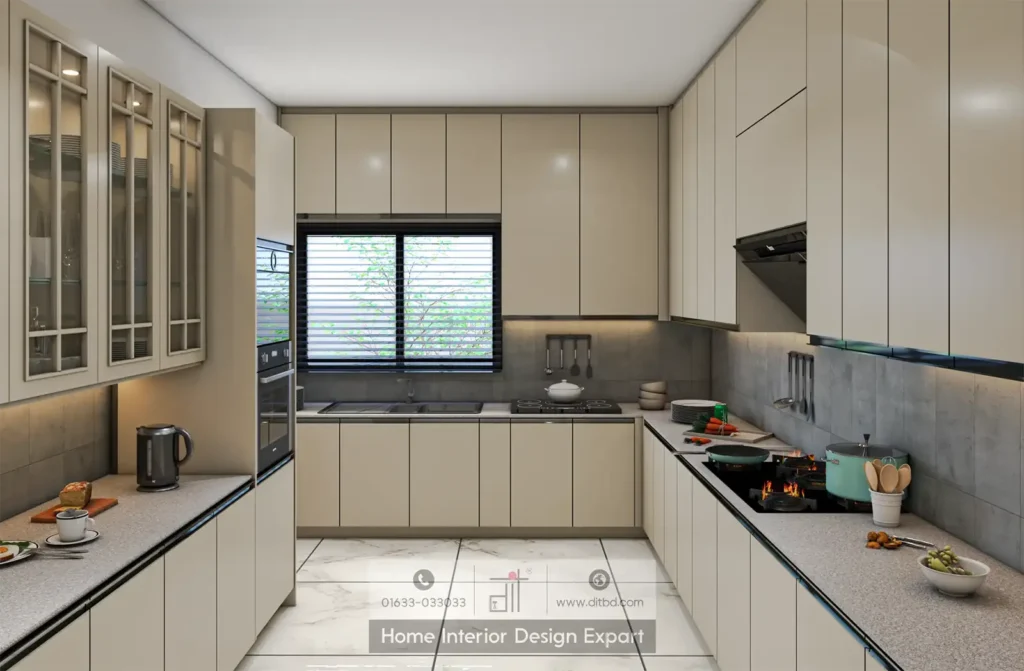
A poorly planned traditional kitchen can feel cramped, dark, and isolated. When you’re cooking alone, you’re cut off from family conversation. If natural light and cross-ventilation are not designed in from the start, heat builds up quickly. A small window and a weak exhaust fan aren’t enough for a Bangladeshi kitchen in a Dhaka summer.
The good news is that a well-designed traditional kitchen doesn’t have to feel this way. With thoughtful lighting, an efficient layout, and proper ventilation, it can feel just as modern and comfortable as any open-plan space.
Open Kitchen Design: The Real Picture for Heavy Cooking
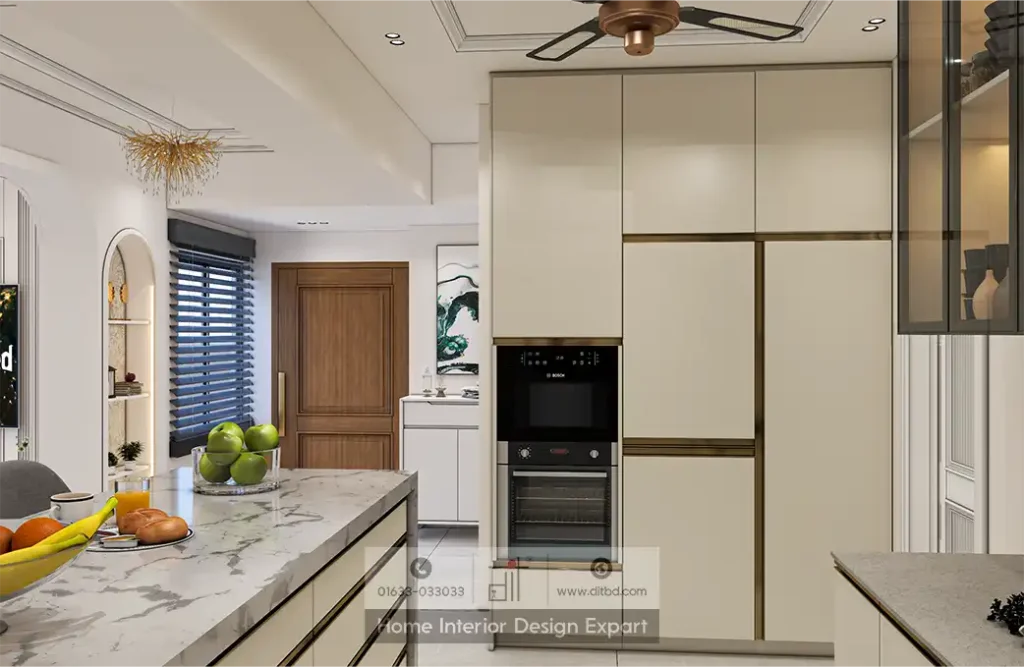
Open kitchens look spectacular in magazines and Instagram feeds. They create a sense of spaciousness, allow social cooking, and flood the space with visual continuity. For many Dhaka homeowners who cook lightly or infrequently, an open kitchen design is a genuinely good option.
But here’s the honest reality: heavy Bangladeshi cooking and open kitchen plans are a difficult combination without serious investment in ventilation.
Research published in Scientific Reports (2024) found that automated ventilation interventions in one-bedroom apartments could reduce cooking-generated PM2.5, but manual range hoods need to be running at high capacity throughout the cooking session. A standard recirculating hood, the kind commonly installed in Dhaka apartments, does not exhaust air outside. It filters and recirculates, meaning cooking particles still enter the open living space.
An open kitchen also means every oil splatter on your stovetop becomes a visual concern from the dining table. Maintenance demands increase significantly.
Does this mean open kitchens are wrong for Dhaka? No. But they require a higher-specification ventilation system, disciplined surface maintenance, and a cooking style that’s lighter than the traditional daily Bangladeshi spread.
Side-by-Side Comparison
| Factor | Traditional Enclosed Kitchen | Open Kitchen |
|---|---|---|
| Fume containment | Excellent (door + hood) | Poor without premium exhaust |
| Oil splash management | Confined to kitchen walls | Spreads to living/dining area |
| Daily cooking comfort | High (no social performance) | Moderate (always visible) |
| Storage capacity | Excellent (all four walls usable) | Reduced (no solid wall on open side) |
| Natural light | Depends on window placement | Typically better |
| Social interaction | Limited during cooking | High |
| Apartment cleaning effort | Lower overall | Higher (grease spreads further) |
| Suitable for heavy frying | Yes | Requires major ventilation upgrade |
| Suitable for light cooking | Yes | Yes |
| Typical fit-out cost in Dhaka | BDT 3,00,000 to 8,00,000 | BDT 4,50,000 to 12,00,000 (with proper ventilation) |
Oil and Grease Management: A Practical Comparison
This is where the comparison becomes very specific to Bangladesh. Mustard oil heated to its smoking point, fish marinated in turmeric and then fried, or dal tadka with ghee: each of these produces grease particles that settle on every nearby surface.
In an enclosed kitchen, your walls, tiles, and cabinets absorb that grease. You clean the kitchen. In an open kitchen, those same particles land on your sofa fabric, curtains, bookshelf, and television. The IARC (International Agency for Research on Cancer) classifies high-temperature frying emissions as possibly carcinogenic (Group 2A). Spreading those emissions across your living space compounds the exposure for family members who aren’t even cooking.
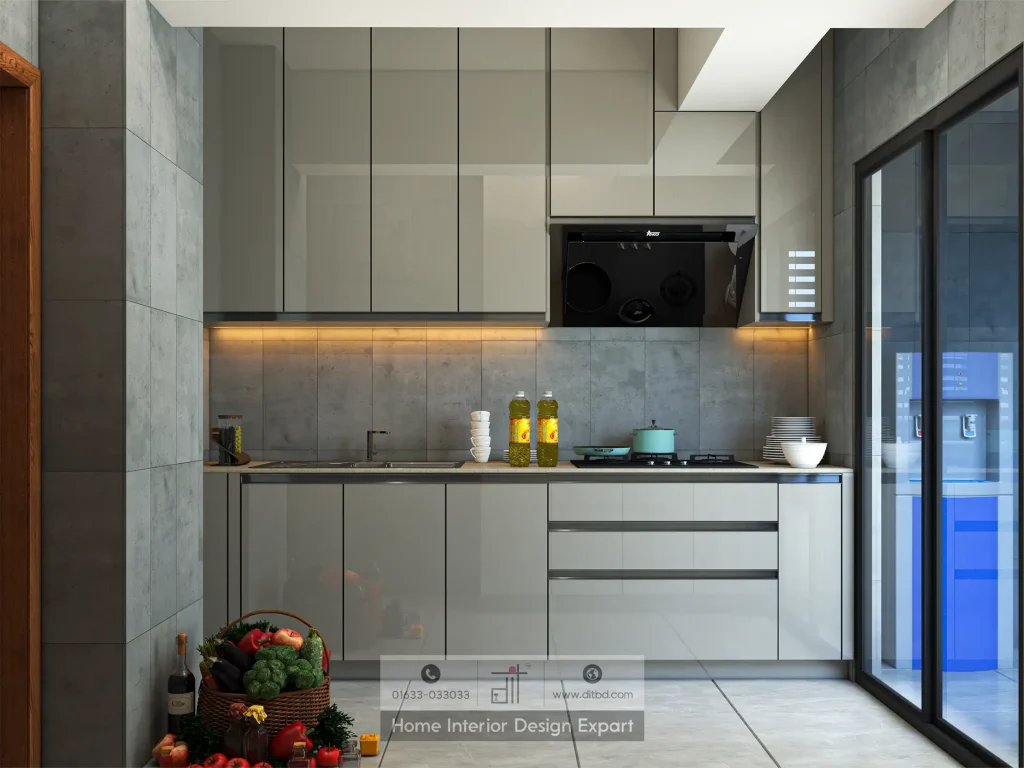
The traditional kitchen designs we craft always include proper exhaust placement, easy-to-clean tile selections, and grease-resistant finishes on cabinet surfaces. Our work in Bashundhara R/A and Tolarbag, Mirpur demonstrates how a traditional kitchen can be both beautiful and genuinely functional for daily heavy cooking.
Who Should Choose a Traditional Enclosed Kitchen?
A traditional enclosed kitchen is the right choice if you:
- Cook full Bangladeshi meals daily, including frying, heavy tempering, and slow-simmered curries
- Live in a family where multiple people cook simultaneously
- Have children or elderly family members sensitive to smoke and strong aromas
- Want maximum wall storage for large cookware
- Prefer a lower long-term maintenance commitment
If you’re weighing this decision as part of a broader flat redesign, it’s worth reading our guide on flat interior design in Dhaka, which covers how kitchen layout choices affect the rest of your living space.
Who Should Choose an Open Kitchen?
An open kitchen may suit you if you:
- Cook lightly and primarily use modern appliances like air fryers and induction hobs
- Have a genuinely large living space where some dispersal of cooking air isn’t problematic
- Are willing to invest in a professional-grade exhaust system with external ducting
- Prioritise visual flow and entertaining over daily heavy cooking practicality
If you’re drawn to the aesthetics of an open plan but cook Bangladeshi meals daily, consider a semi-open kitchen with a glass partition or a pocket door. This gives you the visual openness when you want it and containment when you need it. Talk to our team about custom kitchen design options that balance both worlds. For a full breakdown of how modular and traditional kitchens compare in terms of cost and function, our article on modular kitchen vs traditional kitchen is a useful next read.
FAQ
Is an open kitchen a bad idea for Bangladeshi cooking?
Not automatically, but it requires a premium exhaust system with external ducting. Without it, cooking fumes from daily Bangladeshi meals will settle on furniture, soft furnishings, and walls throughout the living space. Research shows enclosed rooms during cooking can keep adjacent area PM2.5 levels 90% lower (PMC, 2024).
How much does a traditional kitchen cost in Dhaka?
A professionally designed traditional enclosed kitchen in Dhaka typically costs between BDT 3,00,000 and 8,00,000, depending on materials, cabinet quality, and countertop choice. An open kitchen with proper ventilation generally costs more due to higher exhaust system requirements.
Can I convert my traditional kitchen to a semi-open layout?
Yes. A glass partition with a sliding or pocket door is a popular solution. You get visual openness when cooking light meals and full containment during heavy frying sessions. Our custom design team can advise on structural feasibility for your specific flat.
What’s the best exhaust setup for a Bangladeshi kitchen?
A ducted range hood that exhausts air outside the building is significantly more effective than recirculating hoods. A 2021 PMC study found that range hood use reduced kitchen PM2.5 by 81 µg/m³ (37%) and living area PM2.5 by 294 µg/m³ (79%). For a traditional kitchen, position the hood directly above the hob at 60 to 75 cm height.
Does DIT Studio design both traditional and open kitchens?
Absolutely. We design traditional enclosed kitchens, open kitchen layouts, and hybrid solutions. Our recommendation always starts with understanding how you actually cook and how you live, not with what looks good in a photograph.
Conclusion
For most Dhaka households who cook full Bangladeshi meals daily, a well-designed traditional enclosed kitchen remains the more practical, health-conscious, and cost-effective choice. It contains fumes, supports heavy storage needs, and doesn’t ask your family to live with the grease and aroma of daily cooking drifting through the living room.
That said, the best kitchen isn’t about choosing a category. It’s about understanding your cooking habits, your family’s lifestyle, and your flat’s layout, then designing around those realities. That’s precisely what we’ve been doing at DIT Studio — a specialist in interior design in Bangladesh — since 2011, across 500+ homes in Dhaka.
Ready to design a kitchen that works as hard as you do? Contact our team for a free consultation, and let’s build something that fits your life.
Written by the DIT Studio design team — Bangladesh’s specialist home interior firm since 2011. Traditional enclosed kitchens are the most common kitchen type we design across Dhaka, and we’ve refined our approach across hundreds of projects spanning compact flats to premium full-floor renovations.