
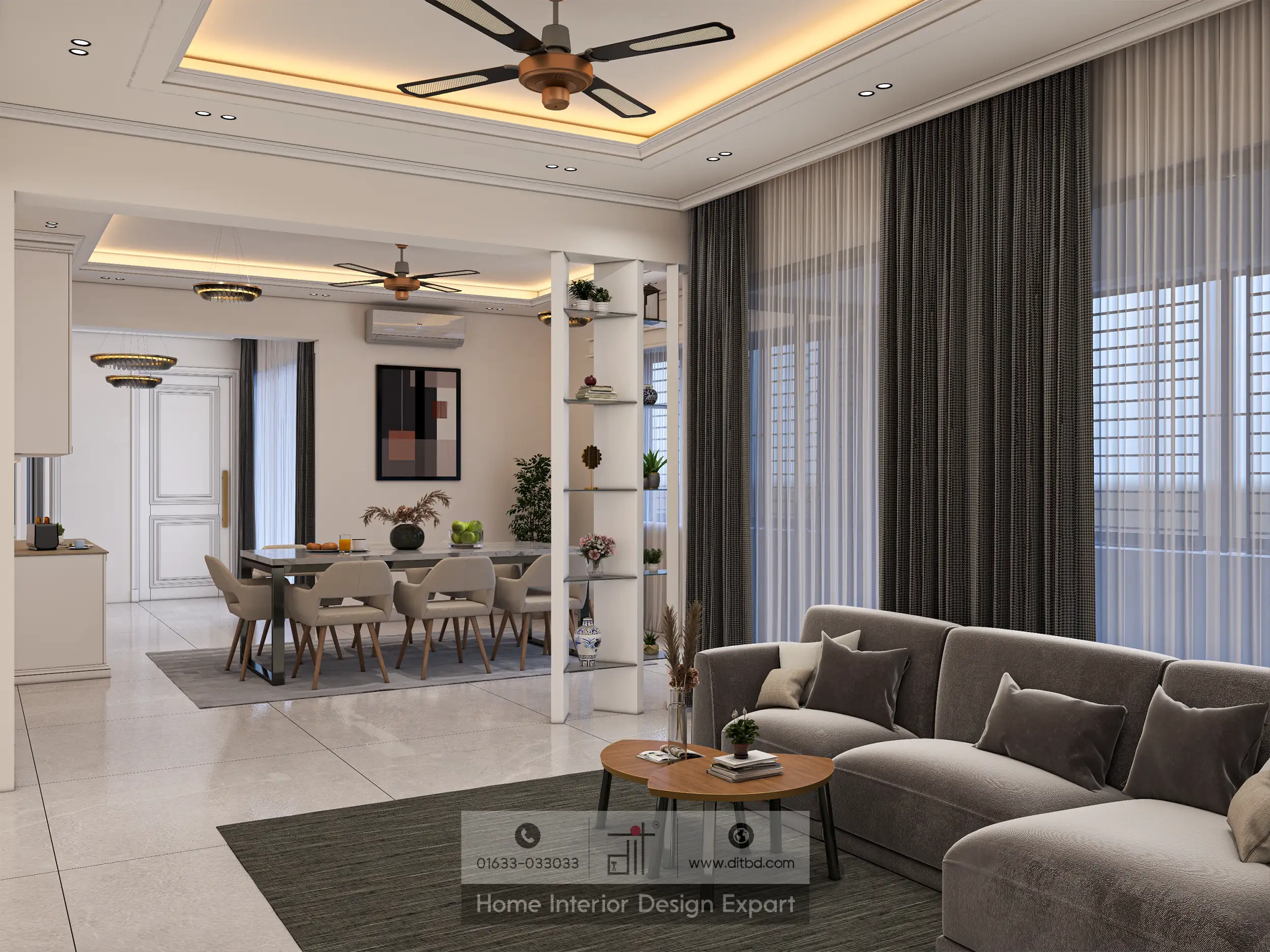
Most Dhaka apartments weren’t built with dining room interior design in mind. The kitchen is compact, the living area does double duty, and the space meant for a dining table is often whatever’s left over. If you’ve ever tried to seat four people comfortably and still have room to pull out a chair, you know how quickly the maths stops working. Yet a dining space that functions well and looks considered is absolutely achievable in a small flat. You just need a different approach to layout, furniture, and materials. This guide walks you through the steps we use in our own dining space design projects across Dhaka.
Key Takeaways
- A minimum dining room of 8×8 ft (2.4×2.4 m) comfortably seats four people with 900mm of clearance on all sides (NKBA guidelines)
- The global small space furniture market was valued at USD 23.4 billion in 2023, growing at 5.25% CAGR (Future Market Insights, 2023)
- In 2023, there was a 13% increase in people choosing to downsize or move into smaller urban spaces (Home Accents Today, 2023)
- Round tables seat the same number of people as rectangular ones while occupying up to 25% less visual footprint in a small room
Step 1: Measure Your Space and Set Your Non-Negotiables
Before any furniture goes into a small dining space, the first thing we do is measure everything twice and decide what the room must achieve. This sounds obvious, but most people skip directly to browsing furniture. Then they buy a table that’s 10 centimetres too wide and wonder why the room feels impossible.
According to the National Kitchen and Bath Association (NKBA), the recommended minimum for a four-person dining room is 8 feet by 8 feet (approximately 2.4×2.4 metres). This provides a table, four seats, and 900mm of clear circulation space on all sides for comfortable passage behind seated diners. The American Institute of Architects (AIA) sets the same benchmark. In tighter spaces where 900mm isn’t achievable, 760mm is the minimum we’d consider functional, but it requires slim-profile seating and a round or oval table to avoid collision points.
In Dhaka, middle-income apartments typically run between 600 and 1,400 sq ft. That means your dining zone, whether it’s a dedicated room or a section of the living area, is probably working with somewhere between 60 and 120 sq ft. That’s workable. But it requires precision.
We worked on a Banani flat last year where the combined living-dining space was just under 200 sq ft. The client had been using a 6-seater rectangular table pushed against one wall. There was 400mm of clearance on the open side, and getting in and out required everyone to stand in sequence. We replaced it with a 120cm round table on a pedestal base and a custom banquette along one wall. The result seated five people with 900mm of clearance on all sides, and the room felt twice as large.
Write down your non-negotiables before you start. How many people must the table seat on a normal evening? Does it need to expand for guests during Eid or family gatherings? Is this purely a dining space or does it double as a workspace? Every decision should be filtered through these answers.
Common mistake to avoid: Many Dhaka homeowners default to a standard 6-seater rectangular table because it “feels right” for a family home. In a compact room, this is the single biggest layout error. It leaves no circulation space and makes daily meals feel like an obstacle course.
Step 2: Choose the Right Table Shape for Your Room
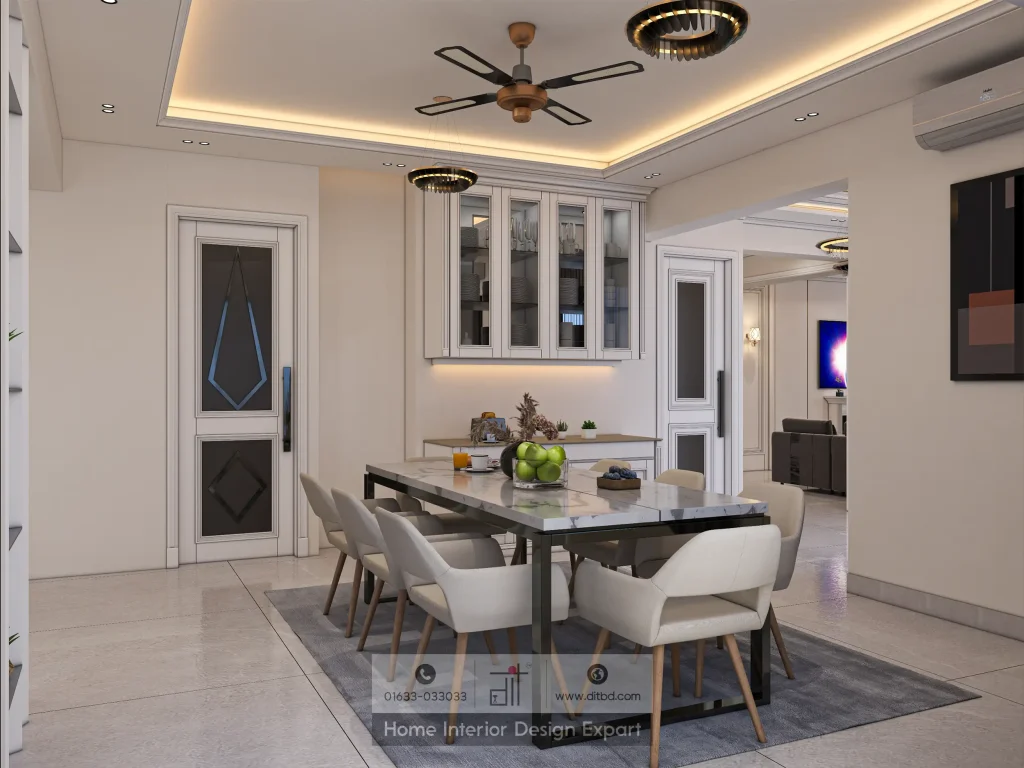
Table shape is one of the most important and least discussed decisions in dining room interior design. The shape you choose determines how many people you can seat, how easily people can move around the table, and how spacious the room feels overall.
In 2023, there was a 13% increase in people across Asia choosing to downsize or move into smaller urban spaces, according to Home Accents Today. With that shift came a major trend toward round and oval dining tables, which fit tighter spaces far more efficiently than their rectangular counterparts.
Round tables have no corners, which means no one gets the awkward corner seat. They allow conversation across the full table because everyone is equidistant from everyone else. A 36-inch (91cm) round table seats two to three people comfortably. At 48 inches (122cm), it fits four people with ease, often within a space that would struggle to hold an equivalent rectangular table.
Oval tables are another strong option for small Dhaka dining rooms. They provide the visual softness of a round table while extending length to seat more diners. They work well in rooms that are longer than they are wide, which describes many corridor-style Dhaka flat layouts.
For families that need flexibility, an extendable rectangular table with folding leaves is the practical middle ground. On ordinary days, it sits at its minimum width. When guests arrive, you pull it out. Custom furniture design lets us build these to exact room dimensions, so the extended length doesn’t crash into the kitchen doorway. It’s worth knowing the honest tradeoff here: custom extending tables cost noticeably more than flat-pack equivalents, but they’re built to your room’s actual measurements and perform far better in the long run.
Common mistake to avoid: Choosing a table shape based on aesthetics alone, without checking circulation clearance. Always mark your proposed table footprint on the floor with tape before ordering.
Step 3: Plan Seating That Doesn’t Eat the Room
Once you’ve settled on a table, the chairs matter enormously. Oversized upholstered chairs can add 30–40 cm to each side of the table, which is often the difference between a room that breathes and one that suffocates.
In compact dining rooms, we recommend three seating strategies. The first is slim-profile chairs, typically with open backs and tapered legs, which take up less visual and physical space than padded armchairs. The second is stackable or foldable chairs for guest capacity, which store flat against a wall or inside a built-in cabinet when not in use. The third, and often the most space-efficient, is a built-in banquette bench along one or two walls.
A banquette bench, built against the wall, eliminates the need to pull chairs back to sit down. It can be sized to any room dimension, includes storage beneath the seat, and often seats more people per linear metre than individual chairs. The global home storage and organisation market reported that modular and multi-purpose designs now account for 41% of consumer demand, and a seating banquette is exactly this kind of product: it serves at least two functions at once.
See how we’ve used integrated seating in our luxury dining space design in Gulshan 2, where a custom banquette created a generous seating arrangement in a room that initially seemed too tight for six people.
Common mistake to avoid: Choosing armchairs for a tight dining table. The arms of adjacent chairs collide, making it impossible to sit or stand comfortably. Armless chairs or a bench are almost always better in compact spaces.
Step 4: Use Light, Colour, and Materials to Open the Space
The physical dimensions of your dining room don’t change. What changes is how you perceive those dimensions, and that’s almost entirely down to light, colour, and the materials you choose.
The principle here is straightforward. Light colours reflect more light and make walls feel further away. Dark colours absorb light and make walls feel closer. This doesn’t mean dark rooms are always bad. A deep, warm dining room can feel intimate and considered rather than cramped. The difference is in how intentionally the choices are made.
In Dhaka’s context, natural light availability varies widely by floor level and building orientation. On lower floors in dense neighbourhoods, a dining room may receive very little direct daylight. In these cases, we recommend pale walls, high-sheen tile or polished marble flooring, and a dining table in a light wood or white finish. These surfaces collectively bounce available light around the room and make it feel airier. For a practical breakdown of how colour choices affect perceived space in Bangladeshi homes, our guide to choosing home colours covers the principles in plain language.
According to the U.S. Energy Information Administration (2024), 63% of homes now use LED lighting as their primary indoor source. In Dhaka’s premium residential market, LED pendant lighting over the dining table has become standard. A single pendant hung low over the table, approximately 70–80 cm above the table surface, pools warm light directly onto the dining area and creates a defined zone within a larger open-plan space.
Glass-top tables are another material choice worth considering. They reflect light upward, let the floor show through, and reduce the visual mass of the table. Paired with metal legs in gold, black, or chrome, they look contemporary and work across a range of room styles. One honest note: glass tops require daily wiping in a family home and show fingerprints readily. Porcelain or sintered stone table tops give a similar lightness with considerably lower maintenance, and we’ve started recommending them more often in Dhaka’s humid climate.
Our dining space design in Wari demonstrates how thoughtful material selection, specifically a combination of ceramic tile flooring, light walls, and a glass-and-wood table, transformed a modest dining area into something that feels considered and spacious.
Common mistake to avoid: Installing bright, cool-white overhead lighting in the dining room. It removes warmth and ambience. Use a pendant with warm white LEDs (2700–3000K) and add a dimmer for full control.
Step 5: Integrate Storage Into the Dining Area Design
Storage in a dining room is often an afterthought. But in a Dhaka flat where every room has to work hard, the dining area can carry useful storage without compromising its visual appeal.
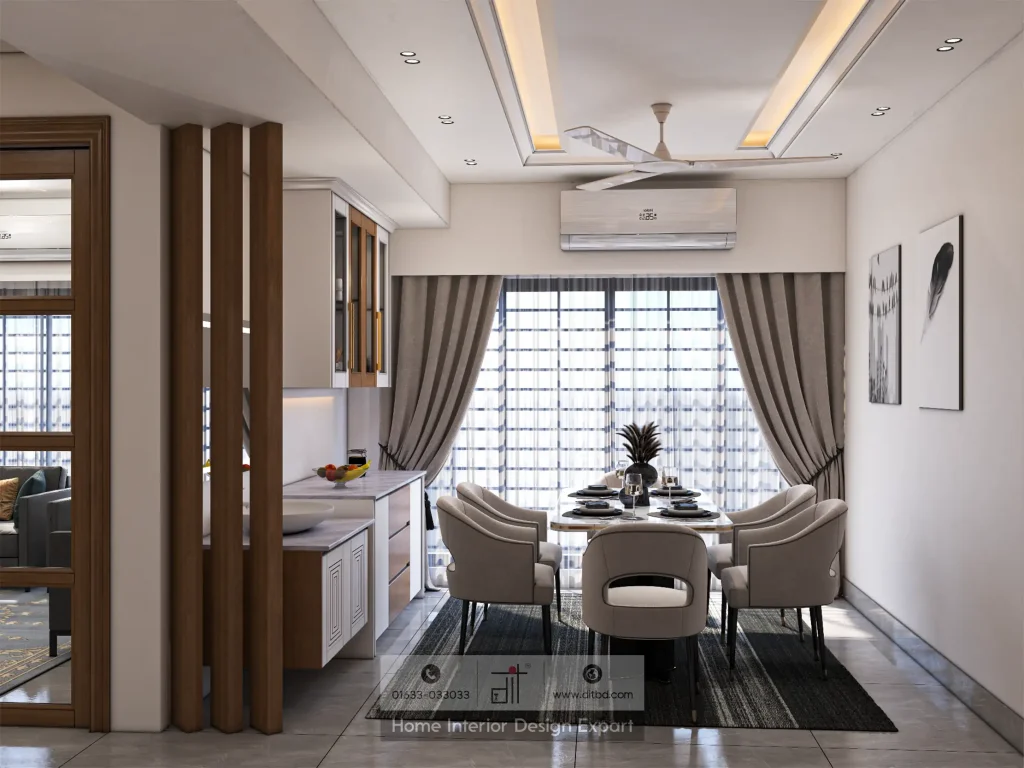
A sideboard or buffet unit along one wall does multiple jobs. It stores crockery, table linen, extra cutlery, and perhaps serving dishes. Its top surface provides buffet space during gatherings, a place for a decorative mirror or artwork, and sometimes a drinks station. In apartments without a separate dining room, a slim sideboard also visually defines the eating zone from the living area.
Built-in cabinetry is the most space-efficient version of this. We design dining-area cabinetry as a continuous floor-to-ceiling unit that integrates closed storage at the bottom, open display shelves above, and sometimes conceals a small bar or appliance storage behind flat doors. This approach keeps the room visually organised without sacrificing floor area. The Bangladesh interior design market, valued at approximately Tk 20,000 crore according to The Business Standard, shows clear demand for exactly this kind of custom, space-optimised work.
At DIT Studio, we design these units as part of our custom furniture service, built to the exact millimetre of your dining room wall. This is a meaningful advantage over off-the-shelf furniture, which almost never fits perfectly in a Dhaka flat’s non-standard room dimensions. The tradeoff is cost and lead time: custom built-ins take four to six weeks and cost more than furniture from a showroom. But they fit, they last, and they don’t leave gaps at the wall that accumulate dust.
Common mistake to avoid: Skipping dining room storage entirely and ending up with crockery in kitchen cabinets and linen in a bedroom closet. Give the dining area its own storage and the whole flat becomes more organised.
Step 6: Define the Dining Zone in an Open-Plan Space
In many Dhaka flats, the dining area is not a separate room at all. It shares an open plan with the living room, the kitchen, or both. This creates a challenge: how do you make the dining space feel intentional and distinct without building a wall?
The answer is zone definition through design. You use a combination of ceiling treatment, flooring change, lighting, and furniture arrangement to signal where one area ends and another begins.
A dropped ceiling section or a ceiling rose above the dining table creates visual height variation that anchors the dining zone. A change in flooring material, say, ceramic tile in the dining area and timber-look vinyl in the living room, draws a clear boundary without a physical divider. A pendant light centred over the table reinforces the zone boundary from above.
Rugs are another underused zoning tool. A dining rug defines the eating area, grounds the furniture, and adds warmth to tiled floors. The rug should be large enough that chair legs stay on it even when pulled out, so a minimum of 200×300 cm for a standard four-person table. Our broader guide on space-saving interior design ideas for small flats in Dhaka covers zone definition across the whole apartment, which is worth reading if you’re dealing with a fully open-plan layout.
Our luxury common space design in Gulshan 2 addressed exactly this challenge: a combined living-dining area that needed to function as two distinct spaces. Through careful zone definition, the result feels like two generous rooms rather than one crowded one. You can also see a different approach to the same challenge in our modern dining space design in Moghbazar, where a flooring change alone created the necessary separation.
Common mistake to avoid: Pushing the dining table against a wall to “save space.” This approach actually makes the room feel smaller because it interrupts circulation and forces diners to squeeze in. Keep the table centred in its zone where possible.
FAQ: Dining Room Design in Small Dhaka Flats
What is the minimum size for a dining room in a Dhaka apartment?
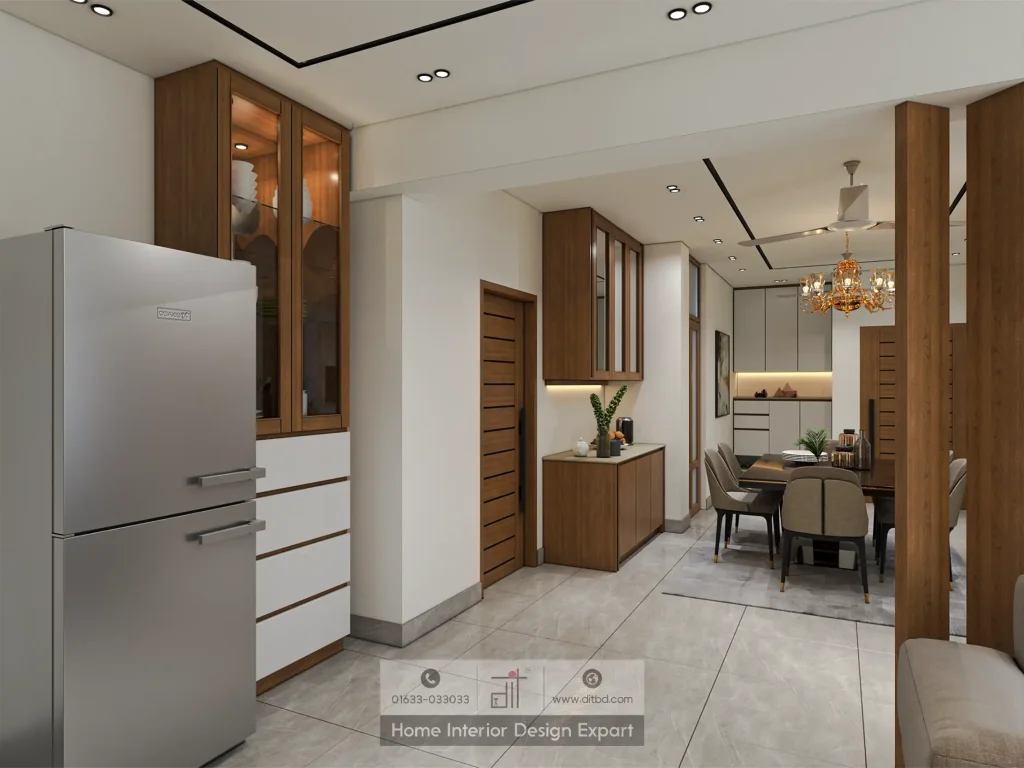
According to NKBA guidelines, a functional four-person dining room requires a minimum of 8×8 feet (2.4×2.4 metres) with 900mm of clearance on all sides. In tighter spaces, 760mm is the practical minimum with the right table shape and slim seating. In Dhaka flats, many dining zones work within 60–90 sq ft using a round or extending table. Our common space design team regularly works with layouts in this range.
Is a round or rectangular table better for a small dining room?
Round tables are almost always the better choice for compact spaces. They eliminate corner seats, allow easier movement, and seat the same number as an equivalent rectangular table in less floor area. A 48-inch round table seats four comfortably. If you need to accommodate more guests occasionally, an oval extendable table offers the best of both shapes.
How can I make a combined living-dining room feel bigger in a Dhaka flat?
Use zone definition rather than physical separation: a pendant light over the dining table, a rug under the dining furniture, and a flooring transition between zones. Light colours on walls, mirrors in the living area, and glass or light-wood furniture in the dining zone all contribute. The Bangladesh interior design market’s four-fold growth over the past decade (The Business Standard) reflects exactly this kind of demand for smart small-space solutions. Our smart space solutions guide for small Dhaka flats goes deeper on this if you want practical tactics room by room.
What’s the best lighting for a small dining room?
A single pendant hung 70–80 cm above the table surface provides the most effective dining room lighting. Choose warm white LED (2700–3000K) for a welcoming feel. Add a dimmer. If the room lacks natural light, supplement with wall sconces or under-cabinet strip lighting in an adjoining kitchen. LED fixtures use up to 80% less electricity than incandescent bulbs, which matters in Dhaka where power costs are significant (U.S. Energy Information Administration, 2024).
Can DIT Studio design just the dining area of my flat?
Yes. We take on focused-scope projects as well as full-home renovations. Many clients begin with one room and expand the project from there. Visit our luxury dining space design in Uttara Sector 5 to see a recent example, or contact us to discuss your specific layout and goals.
Start with the Space You Have
A small dining room isn’t a design problem. It’s a design brief. The right table shape, smart seating choices, material selection, and integrated storage can turn even the tightest Dhaka flat dining zone into a space that serves you well every day and impresses guests every time.
We’ve helped hundreds of families across Dhaka create dining spaces that punch well above their square footage. DIT Studio specialises in interior design in Bangladesh, bringing together local expertise and craftsmanship to make even the tightest spaces work beautifully — whether you’re working with a dedicated room or a corner of an open-plan area.
Reach out to DIT Studio to start planning your dining room interior design. We’re based in Dhaka, and we’d love to visit your space, take proper measurements, and show you what’s possible.
Written by the DIT Studio design team — Bangladesh’s specialist home interior firm since 2011, with 500+ completed residential projects across Dhaka. Our work spans compact apartment interiors to large floor-through homes in Gulshan and Dhanmondi.