

The sliding vs. hinged wardrobe doors decision is really an access decision. The door has to work with your bed, the room’s walking route, the wardrobe interior, and the way you get dressed. A front that looks neat in a showroom can be frustrating when its panels hide the drawer you need or its doors leave no comfortable place to stand.
Sliding doors are useful when an outward swing would obstruct the room. Hinged doors can provide direct access to individual compartments when their swing has enough space. Neither system is automatically better quality. The right choice depends on the complete wardrobe, its hardware, and the bedroom around it.
Sliding and hinged doors solve different space problems
A hinged door rotates into the room on a swing arc. Its operating space depends on the door-leaf width, handle, hinge arrangement, and opening angle. Narrower leaves may reduce the projection, but that can change the number of doors and the internal compartment layout.
A sliding door moves along a track, usually overlapping another panel. It avoids the same outward swing but occupies depth within the front assembly and leaves only part of the wardrobe open at a time, depending on the system.
Consider the person using the wardrobe as part of its footprint. Someone must stand in front of the opening, bend toward a lower drawer, reach a hanger, and step back with clothing. A door that moves successfully is only one part of a usable design.
Sliding vs. hinged wardrobe doors: comparison table
| Question | Sliding doors | Hinged doors |
| Do they swing into the room? | Generally no outward door arc | Yes; allow for each leaf and handle |
| Can all compartments open together? | Limited by panel overlap and track layout | Often possible, subject to adjacent doors and fittings |
| What affects usable depth? | Track and front-system depth | Door construction, hinges, and handles |
| What needs routine attention? | Tracks, guides, rollers, stops, and adjustment | Hinges, screws, alignment, and stops |
| How do drawers fit? | Must align with the available clear opening | Must clear hinges and open door leaves |
| What should be checked before purchase? | Hardware compatibility and service access | Swing conflicts and hinge specification |
Do not use the table to assume one system is always cheaper, quieter, or longer-lasting. Those outcomes depend on the specified components, installation, use, and available repair support.
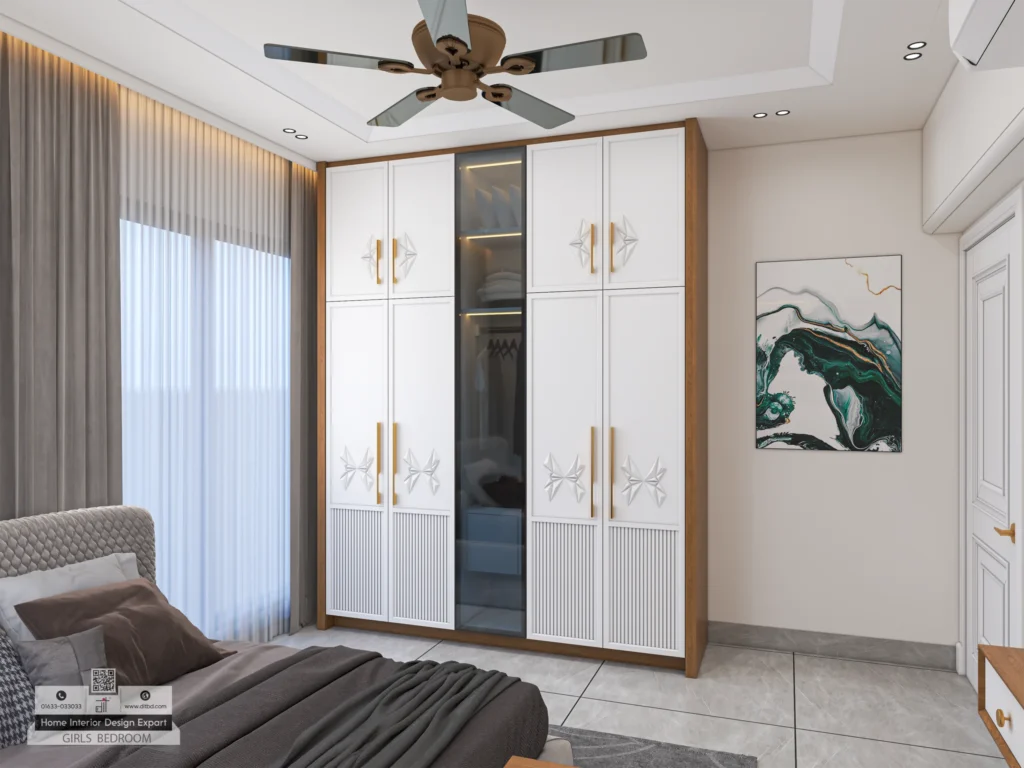
Measure the room space that the doors actually use
Swing clearance versus standing space
Measure from the finished wardrobe front to the nearest bed, chair, or wall. Then mark a hinged door’s actual swing on the floor. Check the arrangement with a person standing where they would normally dress.
For an illustrative example, a 450 mm-wide door opening into a 600 mm gap can leave only about 150 mm between the outer edge of the open leaf and the opposing furniture at the tightest section. The door may technically open, but that does not establish comfortable access. A user might need to stand to one side, and an internal drawer could make the situation worse.
A sliding front removes that particular arc. It does not turn a narrow gap into a full dressing area. Test the standing position and every pull-out accessory separately. These examples are geometric planning checks, not minimum-clearance regulations.
Track depth and usable hanging depth
Ask for the finished external depth and the clear internal depth. They are not interchangeable. Sliding tracks, door profiles, backing, and other parts can reduce the space available inside the cabinet.
Use a hanger and the kinds of clothing you own to test the proposed hanging depth. Make sure garments do not press awkwardly against the closed doors. Avoid solving a tight bedroom by making the wardrobe too shallow to perform its main job.
Where space is limited, compare alternate internal arrangements rather than simply reducing every dimension. Folded storage, side-facing accessories, or a different wardrobe location may deserve consideration, provided they suit the belongings and product system.
Compare access to clothes, shelves, and drawers
Overlapping panels limit the open section
In a common two-panel, two-track arrangement, moving one panel over the other exposes roughly half the frontage, with the exact opening affected by overlap and profiles. Other configurations behave differently. IKEA’s sliding-system guide illustrates that three-track arrangements can create a wider opening than two-track arrangements in its system.
Ask the supplier to show the maximum clear opening, not just the overall wardrobe width. Then align each internal bay with a position that can actually be accessed.
A drawer that sits behind the meeting point of two panels may not pull out unless the opening has been coordinated precisely. The same applies to laundry baskets, trouser pull-outs, and long hanging sections. Approve the inside and outside together.
Hinges and interior fittings need coordination
Hinged doors can make individual wardrobe bays straightforward to access, but the hinge and door leaf may obstruct an internal drawer if the layout is not compatible. Confirm the required opening angle and any filler or spacer detail.
For a shared wardrobe, consider whether two people can open their sections at the same time. Sliding panels may compete for the same track position, while hinged leaves may collide or occupy both standing areas. The better choice depends on how the room is used, not only on the total width of the wardrobe.
Evaluate hardware and installation quality
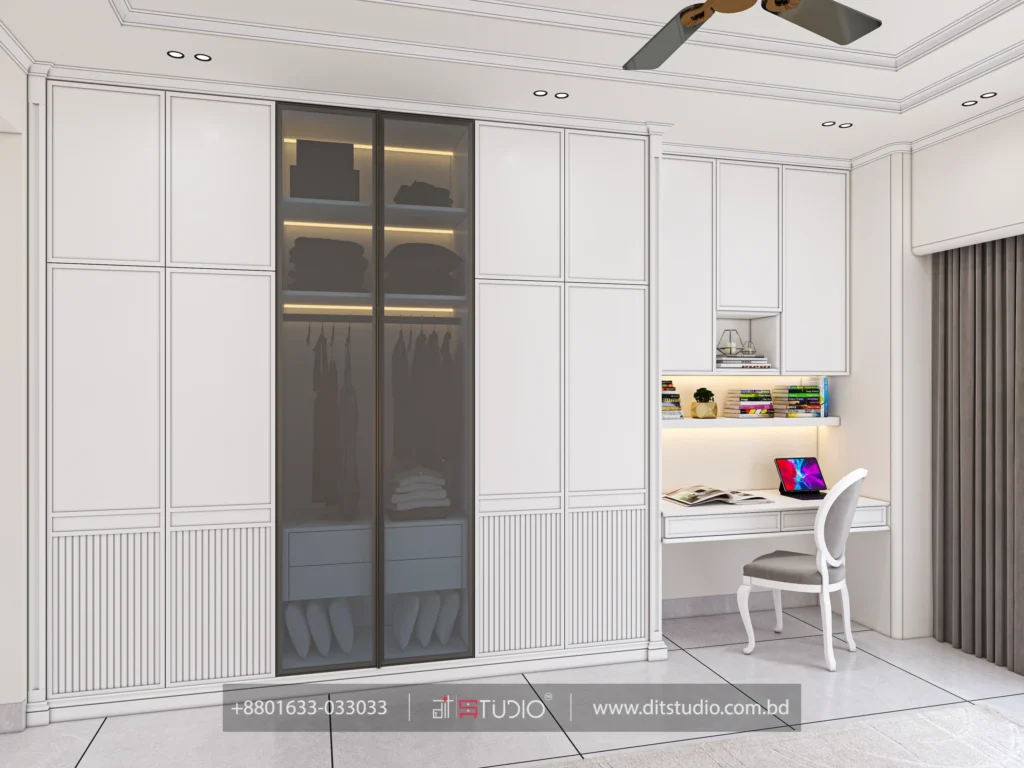
Rollers, rails, hinges, and compatible soft-close
Ask for the manufacturer and model of the hardware, its approved panel dimensions and weight, and its adjustment method. A heavy mirror front should not be fitted to hardware chosen only because it looks similar to the showroom system.
Soft-close is a feature, not proof of overall quality. The mechanism must be compatible with the door weight, travel, and complete system. Test the actual configuration rather than a lighter display door.
For hinged fronts, ask how the number and type of hinges are selected. For sliding fronts, ask how the door is guided, stopped, and retained. Request an explanation of how a panel can be removed for servicing and whether replacement rollers, hinges, or dampers are available.
Level, plumb, and assembly clearance
An uneven opening can complicate door alignment. Measure height at several points and check whether side panels are plumb and supporting surfaces are level. The installer should show how irregularities will be accommodated without forcing the doors to work against a distorted frame.
The space needed to assemble or install a wardrobe can differ from its finished size. Product planning guides such as IKEA’s PAX guidance distinguish installation requirements for particular frame and door configurations. Obtain the equivalent details for the system you are buying.
Clarify whether a sliding system is bottom-running or top-hung, because the load path and supporting construction differ. A top-hung assembly needs suitable structural support; a decorative ceiling panel is not sufficient merely because a track can be screwed to it.
Choose fronts, mirrors, and finishes carefully
Start with the front’s required dimensions and weight, then select compatible materials and hardware. Large doors should not be designed from appearance alone. Ask the maker how the panel construction and finish will be kept stable within the selected system’s requirements.
A mirror can be useful for dressing and can change the perceived view of the room. It does not increase the physical clearance around the bed. Test the reflection from the doorway and sleeping position before covering the entire wardrobe front.
For mirrored doors, ask about the complete safety specification, backing or retention method, edge protection, and hardware compatibility. Do not assume a decorative mirror is safe simply because it is attached to a furniture panel.
Inspect finish samples in the bedroom’s lighting. A strongly reflective surface may show different reflections from those in a showroom. Confirm that edge banding, handles, and profiles are included in the approved sample, not substituted later as minor details.
Consider cleaning, maintenance, and future repairs
Sliding systems need accessible tracks and guides. Check whether the floor track can be vacuumed or wiped easily and whether a recessed detail will collect dirt that is difficult to reach. Keep the supplier’s cleaning instructions rather than improvising lubrication that the mechanism may not require.
Hinged systems need accessible adjustment points and correctly secured fittings. Investigate scraping, loose movement, or a change in door alignment instead of repeatedly forcing the door shut.
For either system, ask what can be replaced independently. A wardrobe with available standard components may be easier to maintain than one dependent on an unidentified fitting. Written repair arrangements are more useful than a general promise that the hardware is premium.
Keep the wardrobe and surrounding wall dry, and investigate any moisture problem rather than relying on the door type to protect clothing. Ventilation provisions, room conditions, and cabinet construction need to be considered separately from whether the fronts slide or swing.
Which door suits four common bedroom situations?
A bed sits close to the wardrobe front
Start by testing sliding doors because an outward swing may be restrictive. Still verify dressing space, track depth, and internal drawer access. Moving the wardrobe or reducing an unnecessarily projecting bed frame may improve the room more than changing doors alone.
A wide, clear dressing area is available
Hinged doors may offer convenient access to separate bays. Confirm that multiple open leaves do not collide with each other, the bedroom door, or nearby furniture. Use the available room to make storage comfortable, not merely to choose wider doors.
Two people use the wardrobe simultaneously
Map which compartments each person uses and how the doors open together. Separate hinged bays might work well, or a carefully planned multi-panel sliding system may be suitable. Test the actual overlap and standing positions before deciding.
The wardrobe may move to another home
Look at the complete furniture construction, not only the doors. Ask whether it can be disassembled and reinstalled, what parts may need replacement, and whether the future opening must be unusually precise. A fitted sliding front across a room recess may be less transferable than a freestanding wardrobe, regardless of its quality.
Questions to ask before approving a wardrobe quote
Request a measured drawing showing the finished external depth, clear internal depth, door positions, and usable opening. Include the internal shelf and drawer arrangement rather than approving a front elevation alone.
Specify the panel material, finish, mirror details if any, hardware model, installation method, and anchoring. CPSC guidance recommends securing relevant furniture against tip-over; make sure responsibility for that work is clear.
Confirm what the written warranty covers, who adjusts doors after installation, and how spare parts are sourced. Ask whether the quote includes delivery, assembly, wall preparation, and removal of packaging. Compare like-for-like specifications rather than deciding from an unexplained price difference.
Frequently asked questions
Are sliding wardrobe doors always more expensive?
No universal price rule is reliable. Door size, panel material, tracks, rollers, finishing, and installation affect the quote. Compare complete specifications and included work.
Do sliding doors give access to only half the wardrobe?
That is approximately true of many two-panel arrangements, but not every system. Track count, panel count, overlap, and travel determine the actual clear opening.
Can hinged doors work in a small bedroom?
Yes, when their swing and the user’s standing area fit the layout. Smaller coordinated leaves or a different wardrobe position may be more practical than assuming sliding doors are essential.
Is soft-close necessary?
It can be useful, but it should not take priority over reliable operation, compatible hardware, and repairability. Test the mechanism with the intended door weight and ask about replacement parts.
Which system is easier to repair?
The one with identifiable components, accessible fixings, and available service support. A simple-looking door is not automatically easy to repair if its hardware is obscure or inaccessible.
Choose usable access over a showroom impression
Measure the room, plan the interiors, and test the doors with a person using the wardrobe. Then compare hardware quality and service support. The sliding vs. hinged wardrobe doors choice becomes much clearer when you focus on the way the storage will operate every day.