

The custom-made vs. ready-made furniture decision is not a contest between good and bad furniture. Both routes can produce a practical, attractive room, and both can disappoint when the dimensions, materials, or buying process are poorly specified. The important question is which route solves your actual problem with the least unnecessary cost and compromise.
For a home in Bangladesh, the decision may involve a compact room, an awkward column, a narrow staircase, a tight move-in schedule, or a need to relocate later. Start with those conditions. Then compare fit, construction, installation, and long-term ownership rather than choosing from a label or a showroom impression.
Understand what each buying route includes
Custom-made furniture is designed or sized for a specific order. It can be built-in or freestanding. A custom sofa, for example, is not necessarily attached to the room, while a fitted wardrobe may be closely tied to one wall and ceiling arrangement.
Ready-made furniture follows an existing design and size. Some pieces are available from stock; others are manufactured after ordering without changing the underlying specification. Confirm the actual delivery arrangement rather than assuming ready-made means immediate delivery.
Modular furniture uses a system of compatible units or components. It may offer more flexibility than one fixed piece without providing completely unrestricted dimensions.
A hybrid approach combines these options. You might choose a fitted wardrobe for an awkward recess and ready-made bedside tables, or a custom shallow TV console with a sofa you have already tested for comfort.
Custom-made vs. ready-made furniture: compare the essentials
| Consideration | Custom-made | Ready-made |
| Fit | Can address particular room dimensions | Must match the available product dimensions |
| Design choices | Can be specified within the maker’s capabilities | Usually limited to available designs and options |
| Inspection before ordering | Drawings and samples may stand in for the finished item | A matching display or stock item may be inspectable |
| Coordination | Requires decisions and approvals during production | Often simpler when the specification is already settled |
| Delivery | Depends on fabrication and installation scope | Depends on stock, manufacture, and delivery arrangements |
| Relocation | Fitted pieces may depend on the original room | Freestanding pieces may be more transferable |
| Quality | Depends on specification and workmanship | Depends on product design and manufacturing quality |
Use the table to identify your priorities. Do not assume custom furniture will last longer simply because it was made to order, or that ready-made furniture is less capable because its size is standardized.
When custom-made furniture earns its extra coordination
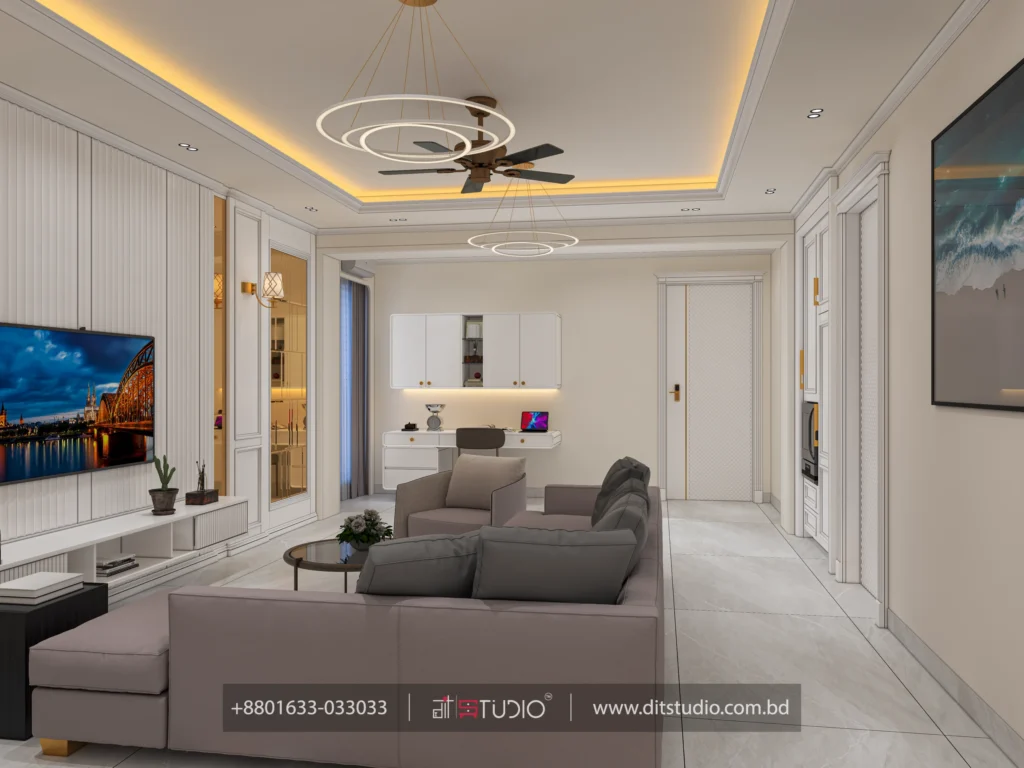
Custom work is most useful when a standard product leaves a meaningful problem unresolved. An irregular recess, sloping ceiling, structural column, or unusually shallow room may justify fitted storage with carefully controlled dimensions.
It can also help when the internal organization matters as much as the exterior. A household storing long garments, specific equipment, or unusually sized documents may benefit from compartments designed around those belongings.
Consider custom work when several functions need to share one carefully measured area. A shallow entry cabinet might combine bag storage with a seating perch. A bedroom unit might integrate a wardrobe and compact work surface without introducing separate pieces into the walkway.
However, custom dimensions should solve a real need. Making a large sofa to exactly fill a wall is not an advantage if it leaves no route beside it. Nor should a fitted cabinet conceal a damp wall, inspection point, or electrical service that needs access.
When ready-made furniture is the more sensible choice
Ready-made furniture is worth prioritizing when an available product already fits the room and performs the required job. Buying a suitable piece can avoid unnecessary design decisions and uncertainty about the final appearance.
It can be particularly useful for furniture that benefits from a physical comfort test, such as a sofa, dining chair, or desk chair. Try the actual seat and ask whether the item being delivered matches the displayed construction and upholstery.
Freestanding pieces can also suit rented homes or households likely to move. Confirm that they can travel through your building and be reassembled where applicable. Portability should be assessed, not assumed from a marketing label.
Check available sizes before commissioning a basic item. A standard table or bedside unit may meet the need well, allowing more of the budget to go toward difficult fitted storage or better-quality seating.
Compare actual construction, not the label
Panel and hardware specifications
Ask what each component is made from: carcass, door front, shelf, back panel, drawer base, and support structure. A statement such as plywood furniture may describe only some parts of the piece.
Plywood itself varies by grade and construction; APA’s guidance describes cross-laminated veneer panels rather than one uniform furniture quality level. The same attention to actual grade and application is needed with MDF, particleboard, solid timber, and mixed-material assemblies.
Hardware deserves equal attention. Identify hinges, drawer runners, connectors, and sliding mechanisms. Ask whether their stated load and operating requirements match the finished furniture, especially where heavy fronts or wide drawers are involved.
Finish quality and visible samples
Inspect edges, corners, joints, drawer interiors, and less visible surfaces. Check whether the approved finish includes all exposed faces and whether the back will remain visible in the intended position.
For custom work, approve a representative sample showing the color, texture, edge treatment, and sheen. For ready-made work, confirm the delivered finish and any natural or manufacturing variation described by the supplier.
Request relevant product information on emissions rather than assuming any material category is automatically emission-free. EPA identifies composite-wood resins among possible formaldehyde sources. Product-specific documentation is more meaningful than a vague statement that furniture is chemical-free.
Calculate the complete installed cost
Normalize the quotation
Compare the same furniture dimensions, internal fittings, board specifications, finish, and hardware. Then include delivery, carrying charges where applicable, assembly, installation, wall fixing, and any making-good work.
For a built-in piece, ask whether the quotation includes site measurement, shop drawings, samples, service coordination, and final adjustments. For ready-made furniture, ask about assembly, packaging removal, missing-parts procedures, and the conditions for returns or exchanges.
Do not assume the lowest headline figure is the lowest completed cost. Equally, a higher price is not proof of better materials. Ask the supplier to identify the specific construction or service differences behind the price.
Compare scope, not only a square-foot rate
A rate is meaningful only when its measurement basis is defined. One quotation may use the visible front area, another may refer to a different surface or cabinet measurement. Depth, internal shelves, drawers, and hardware may be treated as extras.
Ask for an itemized bill of quantities, or BOQ, that describes what is included in each item. Record the quantity, dimensions, material specification, finish, hardware, and installed price on the same comparison sheet.
As a hypothetical comparison, imagine two wardrobe quotations for the same frontage. One includes only a basic hanging rail, while the other includes several drawers, a finished back, upgraded runners, delivery, and installation. Comparing only the total or the square-foot rate hides what you are actually buying.
Use current written quotations rather than generic market-price claims. Furniture costs vary with specification, supplier, site conditions, and scope, so an unsupported nationwide price range can create more confusion than clarity.
Check delivery, installation, and future moves
Measure the complete delivery route: building entrance, lift door, lift interior, stair turns, corridor, and room doorway. Include the diagonal movement needed to turn a large piece. A sofa that fits along the living-room wall may still be impossible to carry around a stair landing.
Ask whether the item arrives assembled, in modules, or flat-packed. Confirm what can be safely disassembled and who is responsible for assembly. Do not assume a large custom piece will be fabricated in sections unless the drawing and quotation say so.
For fitted furniture, establish whether the walls and floor must be ready before measurement and installation. Confirm access to sockets, AC servicing, plumbing, and other maintenance points.
Think ahead to a possible move. A freestanding cabinet may travel well, while a room-height fitted unit may need rebuilding elsewhere. The important issue is the actual construction and disassembly method, not simply whether the order was custom or standard.
Use a written approval and handover process
Before production, approve the overall dimensions, internal layout, materials, hardware, and finish. Keep changes in writing so an altered shelf or drawer does not become a disagreement about an earlier conversation.
Agree on payment milestones tied to clear stages of work. Record the intended delivery or installation date and how changes will be communicated. Review the supplier’s written warranty and after-sales terms, including exclusions and the process for reporting a problem. These are purchasing checks, not a substitute for legal advice in a contract dispute.
For complex custom work, ask whether a sample section or prototype is needed before completing the whole item. This can be particularly useful when a new detail affects comfort, access, or a repeated visual feature.
At handover, open every door and drawer, check alignment, and inspect all accessible surfaces. Test adjustable shelves and moving mechanisms with the supplier present. Verify that tall furniture and applicable televisions are secured appropriately; CPSC’s Anchor It! guidance highlights tip-over prevention.
Keep the approved drawing, material descriptions, finish information, hardware names, warranty, and final invoice. Photograph any agreed correction and record who will complete it. A well-documented purchase is easier to maintain than one supported only by a verbal promise.
Why a hybrid approach often works well
A hybrid approach lets each buying route address the tasks it handles best in your particular home. It avoids paying for customization where a standard item already works and avoids forcing a standard cabinet into an unsuitable gap.
For a small bedroom, consider a fitted wardrobe around the room’s difficult geometry and a ready-made bed with verified outer dimensions. Keep the bedside pieces movable so future changes remain possible.
For a living room, choose the sofa for comfort and fit, then commission a shallow storage unit only if available products would obstruct the walkway. A dining table can be ready-made while a nearby buffet is fitted to a specific recess.
Coordinate the finish palette without demanding an exact match across every piece. Similar proportions, compatible colors, and consistent hardware can create a coherent room even when the furniture comes from different sources.
Prioritize the difficult item first. Measure and settle the largest footprint or most constrained storage unit before buying decorative side pieces. That sequence reduces the chance of having to redesign around something chosen too early.
Frequently asked questions
Is custom-made furniture always more durable?
No. Durability depends on design, materials, joints, hardware, finish, installation, and use. Request a clear specification rather than relying on the fact that the piece was made to order.
Is ready-made furniture better for rented apartments?
It can be, especially when it is freestanding and practical to move. Check delivery, disassembly, and fit in the current room. A standard product that is difficult to relocate may offer little advantage.
How do I compare two furniture quotations fairly?
Put the same dimensions, components, finishes, hardware, and installation scope side by side. Resolve differences in measurement basis and exclusions before comparing the final totals.
Should all my furniture come from one supplier?
Not necessarily. One supplier may simplify coordination, but different sources can work well when dimensions and finishes are managed carefully. Make responsibility for installation and any shared details clear.
What is the biggest mistake in ordering custom furniture?
Approving appearance without approving function. A front-view rendering is not enough; check the interior, moving parts, full dimensions, delivery route, and access to services before production.
Buy the solution to the room, not a category
Choose customization where it resolves a meaningful fit or storage problem, and choose ready-made pieces where they already meet the need. Compare complete specifications and ownership responsibilities. The custom-made vs. ready-made furniture decision should follow the room and household, not a blanket assumption about which label is better.