
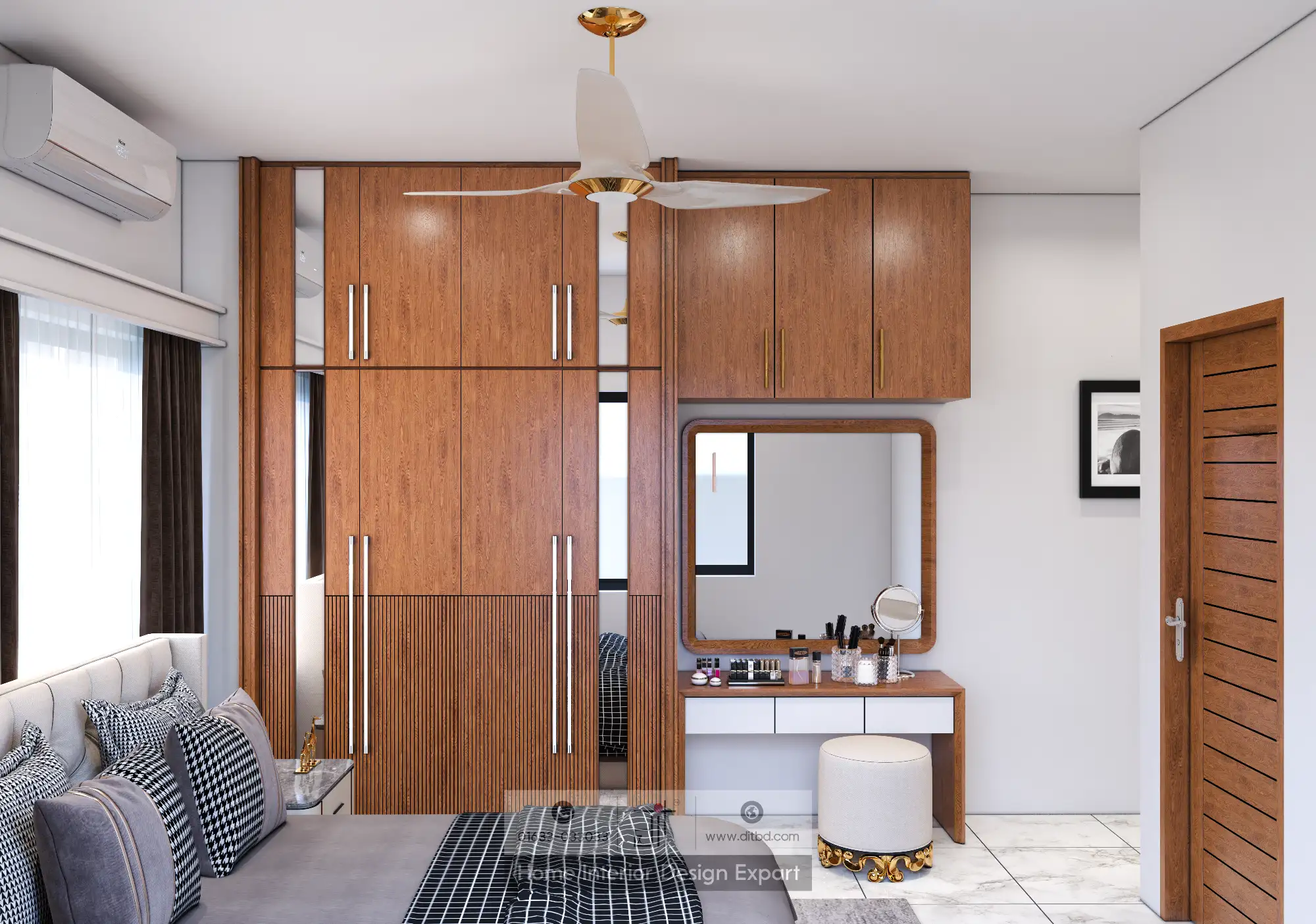
Custom wardrobe design in Bangladesh is not merely a matter of fitting more clothes into less space, it is a considered response to how Bangladeshi families actually dress, entertain, and live across generations under one roof. In a Dhaka apartment where square footage is precious and wardrobes must accommodate everything from everyday cottons to embroidered wedding sarees, a ready-made unit almost never answers the question completely. That gap between what is available and what is genuinely needed is exactly where thoughtful, bespoke storage design begins.
Why Ready-Made Wardrobes Fall Short in Dhaka Apartments
Walk into any furniture showroom in Bashundhara City or Elephant Road and you will find rows of wardrobes built to serve a broadly imagined household. They arrive in standard widths, with a fixed ratio of hanging space to shelving, and they assume a wardrobe that needs to hold, perhaps, a few dozen garments. That assumption breaks down almost immediately in the Bangladeshi context.
The average urban household in Dhaka manages a wardrobe that is genuinely diverse in category. There are the everyday shalwar kameez sets that rotate through the week, the formal suits and dress shirts kept for office or occasions, the collection of sarees that requires careful folding and stacking to preserve embroidery, the prayer garments that need to remain accessible without being crumpled, and the seasonal heavier fabrics stored away during the months of intense heat. Fitting all of this into a 180-centimetre ready-made unit designed for a European market means making compromises at every turn.
Beyond the garment variety, Dhaka apartments themselves present a particular challenge. Floor plans in Gulshan, Banani, Dhanmondi, or Mirpur often feature bedrooms with unusual proportions, alcoves that terminate at odd heights, or walls interrupted by ventilation grilles and structural beams. A ready-made wardrobe cannot occupy that awkward niche beside the window, cannot rise cleanly to a ceiling at a non-standard height, and cannot follow the slight irregularity of a masonry wall built with the natural variance that comes with Bangladeshi construction. Custom wardrobe design in Bangladesh solves these problems by starting from the actual dimensions of the room rather than from a catalogue.
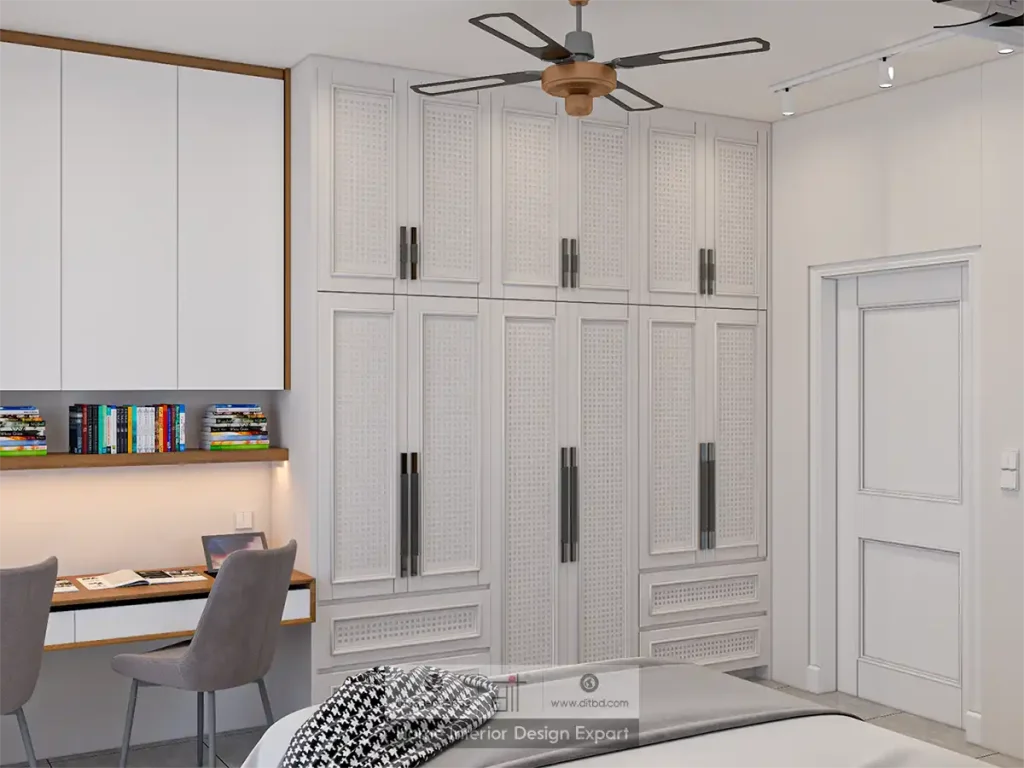
The Bangladeshi Clothing Wardrobe: What You Are Actually Storing
Understanding what goes into a wardrobe is the prerequisite for designing one that works. Over 15+ years and 500+ completed residential projects across Dhaka, we at DIT Studio have catalogued the storage patterns of Bangladeshi families with meticulous attention, and those patterns are quite specific.
Sarees deserve particular mention. A household with even a modest collection might own thirty to sixty sarees, each requiring a folded storage method that prevents permanent creasing of the border. Dedicated saree shelves, wider and shallower than standard shelving, with a smooth surface that does not snag delicate fabrics, are a design decision that simply does not exist in a ready-made unit. Similarly, formal sherwani and panjabi sets benefit from full-length hanging space, which standard three-door wardrobes often sacrifice in favour of a double-hang rail suited to shorter Western garments.
Prayer garments, kept by most Bangladeshi Muslim households, benefit from a small dedicated zone that is clean, accessible, and separate from daily wear. Seasonal storage, especially for heavier fabrics used during the brief cool season, works best in deep pull-out drawers at the base of the wardrobe rather than overhead compartments that require a stool to reach. These are the kinds of functional details that only emerge from sitting with a family and understanding how they move through a week.
Sliding, Hinged, and Walk-In: Choosing the Right Wardrobe Format
The format of a wardrobe determines how it interacts with the room as much as how it functions internally. Each of the three primary formats carries meaningful trade-offs that depend on the specific geometry of the bedroom.
Hinged-door wardrobes are the most familiar format and, in rooms with adequate clearance, the most practical. They allow the entire interior to be visible at once, they are mechanically simple with fewer moving parts to maintain, and they can be fitted with a full-length mirror on the door face to extend the visual depth of the room. The constraint is clearance: a hinged door on a 600-millimetre-deep wardrobe needs roughly the same distance again in front of it to open fully, which in a bedroom measuring 10 by 12 feet can mean the door conflicts with the bed placement.
Sliding-door wardrobes resolve the clearance problem elegantly. They are the preferred format in bedrooms where the wardrobe spans an entire wall, which is increasingly common in Dhaka apartment design as families seek to maximise storage. The trade-off is access: at any moment, only half the interior is reachable because one door is always blocking another section. Good internal organisation compensates for this, grouping items by frequency of use so that the most-reached-for pieces sit behind the most-used panel.
Walk-in wardrobes, while aspirational, are more achievable in Dhaka than many homeowners realise. A dedicated dressing room of even 5 by 7 feet, carved from a spare room or a wide corridor, can accommodate a full perimeter of shelving, hanging rails, and drawers with a central island for jewellery or accessories. For households with two adults managing large collections of formal wear, it is not a luxury but a genuine functional solution.
| Wardrobe Format | Ideal Room Size | Space Needed in Front | Best For |
|---|---|---|---|
| Hinged Door | Medium to large bedrooms | Equal to door width | Full visual access, simple mechanism |
| Sliding Door | Smaller bedrooms or full-wall spans | Minimal clearance needed | Space efficiency, contemporary look |
| Walk-In / Dressing Room | Dedicated space of 35+ sq ft | Internal circulation only | Large garment collections, dual users |
| Reach-In with Curtain | Very compact rooms | None | Budget-conscious, flexible interiors |
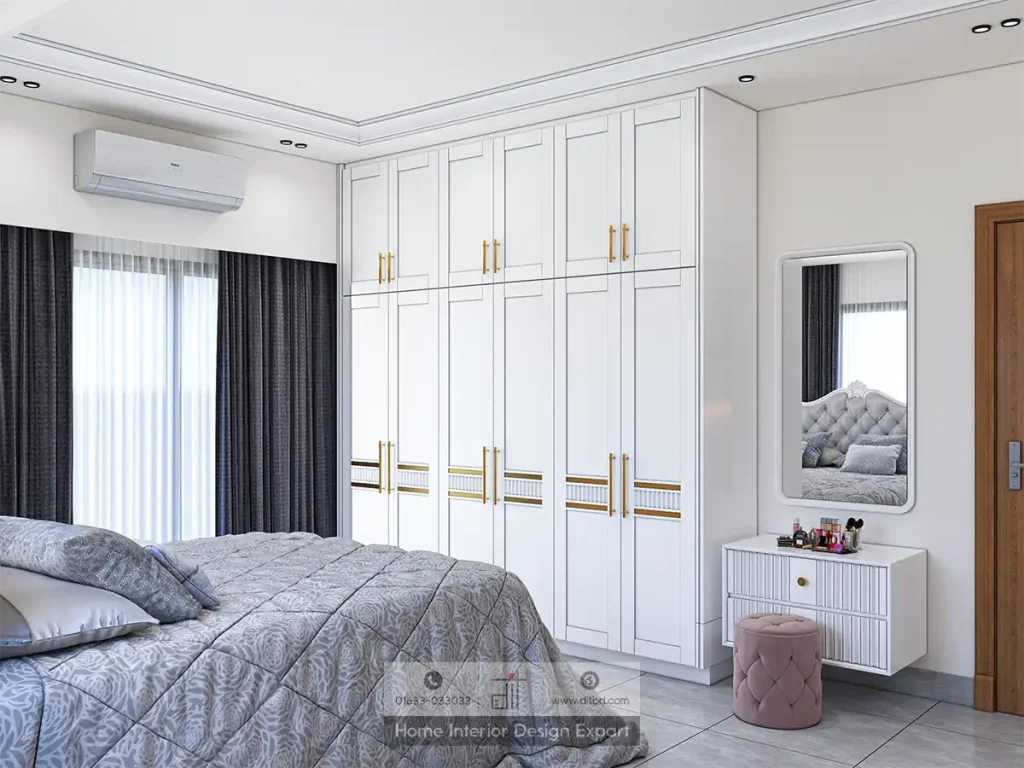
Material Selection for Bangladesh’s Climate
The climate of Bangladesh is not kind to furniture. Dhaka’s monsoon season brings sustained humidity that causes untreated timber to warp, MDF boards to swell at edges, and laminate surfaces to lift away from their substrate if the bonding quality was marginal to begin with. The dust of the dry season is equally relentless, working its way into every gap and joint. Material selection for a custom wardrobe in Bangladesh must account for both conditions with equal seriousness.
Marine-grade plywood is the foundation material of choice for structural components because its cross-ply construction and waterproof bonding resist warping under humidity fluctuations better than standard commercial plywood. For panel faces and door surfaces, high-pressure laminate applied over MDF provides a smooth, cleanable surface that resists the fine dust accumulation that comes with Dhaka’s particular air quality. Melamine-faced boards offer an economical alternative with reasonable performance, provided the edges are properly sealed with PVC tape to prevent moisture ingress at the most vulnerable point.
Hardware selection matters as profoundly as substrate material. Soft-close drawer runners and door hinges with adjustable tension maintain their precision over years of use in humid conditions when they are sourced from quality European or reputable Taiwanese manufacturers. Budget hardware corrodes within a single monsoon cycle and begins to drag, misalign, or seize entirely. We at DIT Studio specify hardware with the same meticulous attention we give to material surfaces, because the feel of a wardrobe in daily use is determined as much by its mechanisms as by its aesthetics.
Internal Fittings That Harmonise with Real Life
The interior architecture of a wardrobe, once the format and materials are decided, is where the design truly becomes personal. A wardrobe that harmonises with how a household operates day-to-day requires a layout that has been thought through against actual habits rather than against a standard template.
Long hanging rails should be positioned at a height appropriate for the specific household. A wardrobe shared between two adults of different heights benefits from adjustable rail brackets. Saree shelves, as mentioned, need to be wider than typical book shelving, roughly 500 to 550 millimetres deep, to accommodate a folded saree without the border hanging over the edge. Shoe racks, tilted slightly to display the footwear and make selection easy, work best near the base of the wardrobe for heavier footwear and at mid-height for the lighter sandals and dress shoes worn more frequently. A dedicated drawer section for undergarments and accessories prevents the common problem of smaller items disappearing into the depths of open shelving.
Mirror integration is a point of both function and spatial perception. A full-height mirror on a sliding panel, or inset into the centre door of a hinged wardrobe, provides a dressing mirror without consuming additional floor space, and in smaller bedrooms it amplifies natural light and makes the room read as larger. Velvet-lined jewellery drawers, pull-out ironing boards, and discreet charging points for small devices are the kinds of finishing details that elevate a wardrobe from adequate to genuinely considered.
Understanding Cost and Value in the Bangladesh Market
The cost of custom wardrobe design in Bangladesh varies considerably depending on format, material grade, hardware quality, and the complexity of internal fittings. A basic reach-in wardrobe in melamine-faced board with standard hardware might begin around thirty to forty thousand taka for a two-metre width. A full-wall sliding-door wardrobe in high-pressure laminate with marine ply carcassing, soft-close mechanisms, and a full internal fitting package for a master bedroom will typically fall between one hundred and fifty thousand and three hundred thousand taka, depending on specific configuration.
The comparison that matters is not between custom and the cheapest available ready-made option. It is between a custom wardrobe with a twenty-year functional lifespan and a ready-made unit that begins to fail at hinges and drawer runners within three to five years of humid Dhaka conditions. Across that time horizon, the cost per year of reliable, well-organised storage shifts the calculation considerably. The DIT Studio approach is to be transparent about this trade-off from the first conversation, so that homeowners can make a genuinely informed decision rather than one based on initial outlay alone.
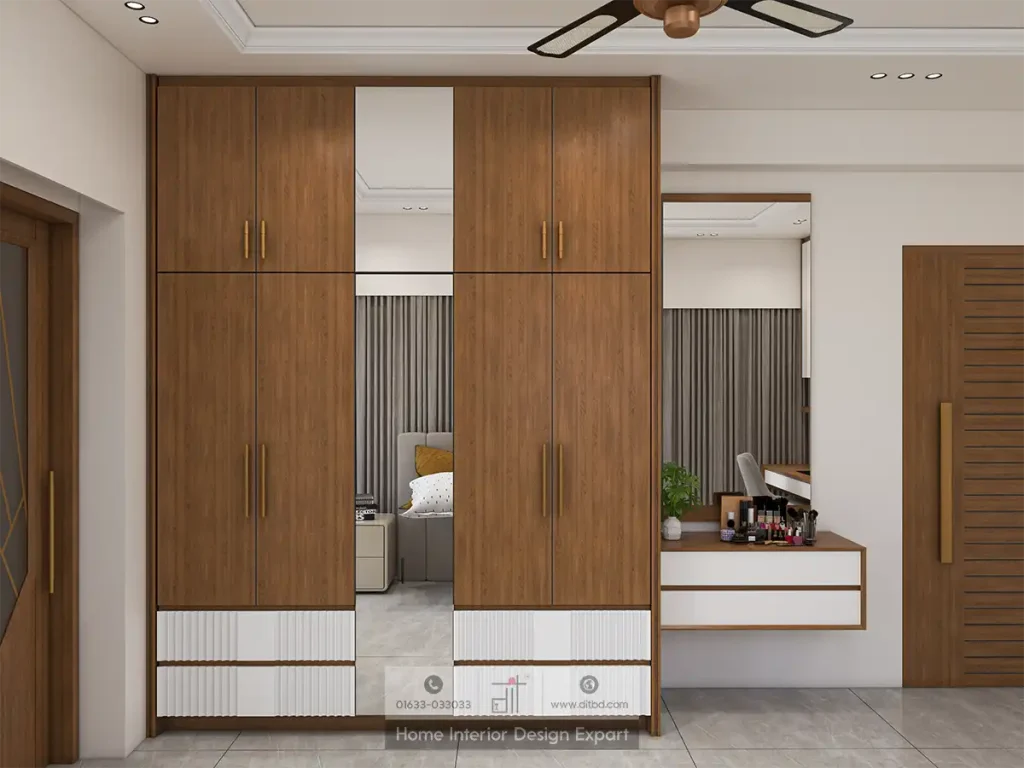
The DIT Studio Process: Measurement to Installation
The process of delivering a custom wardrobe that genuinely works begins before any material is specified or any design is drawn. It begins with understanding the household. We ask about the number of people sharing the wardrobe, the categories of clothing and accessories that need to be stored, the daily routine around dressing, and the aesthetic preferences that will make the wardrobe feel at home in the room. Only after that conversation does measurement begin.
Measurement in a Dhaka apartment is rarely straightforward. Walls are seldom perfectly plumb, ceiling heights vary by a centimetre or two across a span, and existing electrical points or ventilation grilles must be worked around without compromising the storage configuration. Our team measures at multiple heights and cross-references those measurements against the room’s diagonal to identify any rack or lean in the structure. Those measurements become the precise specification from which panels are cut, meaning the finished wardrobe fits the room as though it grew from it rather than being introduced into it.
Design is developed as a collaborative process, with technical drawings shared for client review before production begins. Once materials and fittings are confirmed, fabrication takes place under controlled conditions, and installation is carried out by our own fitters rather than outsourced teams, which ensures the standard of care applied in production carries through to the moment the final door is hung and adjusted.
Find DIT Studio in Dhaka
DIT Studio works with homeowners across Dhaka, from initial consultation through to final installation, and welcomes enquiries from those at any stage of planning a home interior project, whether a single wardrobe or a complete bedroom fit-out. The studio can be reached through the website for consultation bookings, and site visits can be arranged to assess a space before any commitment is made.