

A good kids’ room design for a Dhaka flat starts with safety and floor space, not decoration. In a compact room of around 10 feet square, you need a bed that frees the floor (a loft or bunk where the child’s age allows), a fixed study desk with its own light, storage the child can reach alone, and every tall piece of furniture anchored to the wall. Colour and themes come last, and they’re the cheapest part to change.
Key Takeaways
- Plan in zones: sleep, study, storage and a small floor-play patch. Go vertical to keep the floor free.
- Children under 6 shouldn’t sleep on a top bunk, according to the American Academy of Pediatrics.
- Anchor wardrobes, shelves and TVs to the wall. The US Consumer Product Safety Commission (CPSC) treats this as basic tip-over prevention.
- Check window openings, balcony doors and grills before the furniture arrives.
- Build the shell to last (wardrobe carcass, desk, shelving) and let paint, bedding and accessories change as the child grows.
Start With the Room, Not the Furniture
Most Dhaka flat bedrooms hand children one window, one door and a wall or two that can carry storage. Before choosing anything, measure the room, mark the door swing, the window opening and any beams or AC position, and decide which wall will carry the tall storage. That wall is usually the one opposite the window, so the daylight reaches the desk and the wardrobe doesn’t shade it.
Divide the room into four zones:
- Sleep – in the corner furthest from the door.
- Study – next to the window, where daylight is strongest.
- Storage – along one full wall, from floor to ceiling where possible.
- Play – whatever floor is left, kept clear and soft underfoot.
The same logic runs through our guide to small bedroom layouts for Dhaka flats; a child’s room just adds a desk and more stuff.
Choose the Bed: Single, Bunk or Loft
The bed decides how much floor you keep. The main options compare like this.
| Option | Best for | Floor space freed | Watch out for |
|---|---|---|---|
| Single bed with drawers | Toddlers to early primary school | Low to moderate | Drawers can be heavy for small hands; use soft-close runners |
| Bunk bed | Two siblings sharing | High | Age limit for the top bunk; guardrails; ceiling height |
| Loft bed with desk or storage below | One older child (school age and up) | Highest | Climbing at night; head clearance; ceiling fan position |
| Trundle or pull-out | Sibling sleepovers, guests | Moderate | Mechanism quality; floor must be level |
Bunk bed safety rules worth following
The American Academy of Pediatrics’ guidance on bunk bed safety is specific: do not allow a child younger than 6 to sleep on the top bunk, place the bunk in a corner with walls on two sides, fit a ladder, and install a guardrail with no more than a 3½-inch space between the rail and the side of the bunk. It also says the mattress should fit snugly in the frame and be supported by slats or wires fastened at both ends.
The CPSC’s federal bunk bed standard, summarised in its 2000 announcement, requires guardrails on both sides of any bed whose underside is more than 30 inches off the floor, with openings in the upper bunk small enough that a child’s torso can’t pass through. That 2000 rule has since been updated (the current US rules sit in 16 CFR part 1513 and the ASTM F1427 standard it points to), so check the current rule before relying on any figure.
It’s a US rule, not a Bangladeshi one, so a locally made bunk is only as safe as its design. If you’re commissioning one, ask for the guardrail and opening dimensions in the drawing. Our note on custom-made versus ready-made furniture covers why that’s easier with built-to-order pieces.
Dhaka adds two local checks. First, ceiling fans: a child sitting up on a top bunk or loft can reach a low-hung blade, so the rule is no ceiling-fan blades over a raised bed’s footprint. If the fan can’t be moved, use a wall-mounted fan instead. Second, load-shedding and heat: the top bunk is the hottest spot, so don’t put the bed where it blocks the only airflow.
Make the Study Corner Work
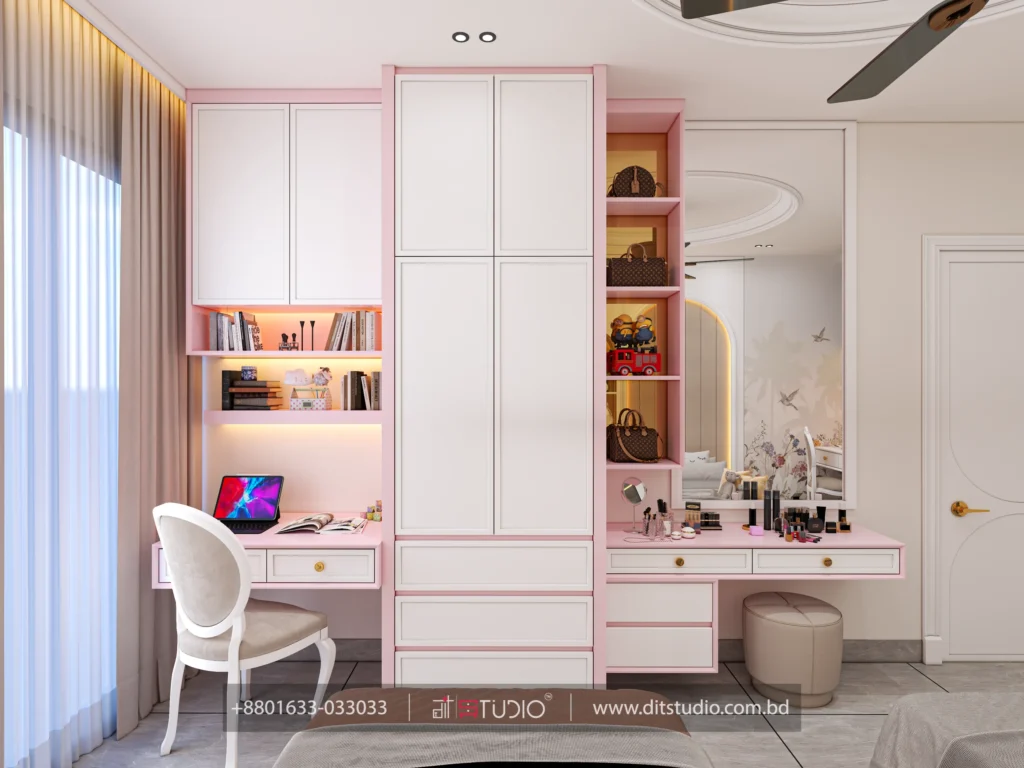
A child who does homework on the bed, at the dining table or on the floor will keep doing it there, so a proper desk is worth the floor space. In a small room, a built-in desk along the window wall, with shelves above, takes less space than a freestanding table plus a bookcase.
General practice for a desk that suits a growing child:
- Adjustable seat height. The child’s feet should rest flat on the floor or a footrest, and the forearms should rest comfortably on the desk. A fixed chair on a fixed desk only fits for a year or two.
- Desk depth for a screen. If a laptop or tablet will live here, leave enough depth to keep the screen well back from the eyes. The American Optometric Association advises keeping a screen 20 to 28 inches from the eyes (its prevention advice gives a wider 16 to 30 inches) and taking regular breaks (the 20-20-20 rule: a 20-second break to view something 20 feet away every 20 minutes).
- Light from the side. Daylight from the window, plus a task lamp on the opposite side of the writing hand, avoids shadows. Don’t rely on one ceiling light.
- Warm, glare-free lamp. Pick a lamp with a diffused shade. The lighting tips for Bangladeshi homes explain layering ceiling, task and night lighting.
- Cable and power planning. Put two or three sockets at desk height on the wall before the carpentry is finished, so there are no extension cords across the floor. Add a socket cover or safety shutters for younger children.
Keep the desk away from the AC’s direct draught and away from the door, so the child isn’t distracted by movement in the hallway.
Storage Children Can Reach Themselves
Kids tidy up when putting things away takes one motion. That means storage sized to their reach, not yours.
| Height zone | What goes there | Why |
|---|---|---|
| Floor to child’s shoulder | Daily clothes, toys, school bag, shoes, books | Child can reach it unassisted |
| Shoulder to adult reach | Seasonal clothes, craft kits, games | Adult-managed |
| Top shelves and loft boxes | Winter bedding, keepsakes, spare linen | Rarely needed |
Practical choices for Dhaka flats:
- Open low shelves and fabric or plastic bins for toys, labelled with pictures for pre-readers.
- Under-bed drawers for out-of-season clothes. In humid months, add silica packs or neem leaves so stored fabric doesn’t smell musty.
- A wardrobe with an adjustable rail. Set the hanging rail low now and raise it later. Our custom wardrobe design guide and sliding versus hinged doors comparison cover the door choice; sliding doors suit narrow rooms and are less likely to swing into a child.
- Moisture-resistant boards. Monsoon humidity swells weak board edges, so it’s worth checking what the carcass is made of. See plywood vs MDF vs particleboard.
Safety Checklist Before Installation
Anchor tall furniture and TVs
The CPSC’s Anchor It! campaign advises anchoring TVs, including those not wall-mounted, and tall furniture to the wall, using inexpensive anti-tip brackets for existing pieces and following the manufacturer’s instructions. A short checklist:
- Fix wardrobes and bookcases to the wall, or to the floor and ceiling where they are built-in.
- Put heavy items on lower shelves.
- Give every drawer unit a stop so children can’t pull several drawers out at once and use them as steps.
- Keep toys and remote controls off the top of furniture, as they tempt kids to climb.
Windows, grills and balcony doors
Children climb whatever’s near a window, so keep beds, desks and chests away from window openings. The New York City health department’s guidance on window guards recommends devices that stop windows opening more than 4½ inches, and says never to leave a child alone in a room with open windows. It reports that window falls have dropped sharply since the city adopted its policy in 1976. A mosquito screen won’t hold a child, so don’t treat it as a barrier.
Many Dhaka flats already have steel grills, but check them anyway: horizontal bars act as a ladder, and wide gaps let a small child squeeze through. Where the bedroom opens onto a balcony, fit a high lock the child can’t reach, and make sure the balcony railing has no footholds. If the room has an AC unit, check that it is securely fixed. Keep planters and chairs away from the railing in homes with young children.
Edges, floors and paint
Specify rounded or bevelled edges on desks, bed frames and shelving at child head height. Choose a floor that is easy to wipe and not slippery in socks; a washable rug with a non-slip backing defines the play area.
On paint, the US EPA warns that products labelled “no VOC” or “low VOC” can still contain toxic volatile chemicals, so the label alone isn’t proof. Its advice for reducing VOC exposure is practical: ventilate well while painting, follow the label, buy only what you need and store leftovers away from children. For a child’s room, ask the supplier for the product’s technical data sheet, choose a water-based finish, paint well before the child moves in and keep the windows open for several days. Our bedroom colour palette guide covers the colour decisions.
Shared Sibling Rooms
Two children in one room need two separate things: a place to sleep and a place that’s theirs.
- Bunk or two single beds along opposite walls, with a shared wardrobe split into two halves.
- Two desks or one long desk with two chairs, if the age gap is small. Different school hours are easier with a lamp each.
- Clear personal zones. A pinboard, shelf and bin per child avoids arguments.
- Different ages, different bedtimes. A small bedside light or a curtain around the bed lets one child sleep while the other reads.
If the age gap is large, the older child may need the desk first, so plan the layout for the older child and let the younger one fit in.
Design a Room That Grows From Toddler to Teen
The approach that lasts is simple: build the big, permanent items neutral and fix the changeable ones lightly.
| Stage | Change | Keep |
|---|---|---|
| Toddler | Low bed, soft floor, no climbable furniture | Wall-anchored storage, window safety |
| Primary school | Add a desk, a reading corner, labelled bins | Same wardrobe with the rail lowered |
| Early teen | Bigger desk, raised hanging rail, pinboard wall | Same wardrobe and bed frame |
| Older teen | Swap bed for a loft or double, add privacy and a shelf for devices | Carcass and desk, repaint |
Choose neutral walls, then add colour with bedding, a pinboard and removable wall stickers. Use furniture that adjusts: desk height, shelf positions, hanging rail. For more on this approach, see our guide to multifunctional furniture for small apartments.
Frequently Asked Questions
What is the best bed for a small kids’ room in Dhaka?
For one school-age child, a loft bed with a desk or wardrobe underneath frees the most floor. For two siblings, a bunk bed works, as long as the child on the top bunk is 6 or older. For toddlers, a low single bed with drawers is safer than anything raised.
At what age can a child sleep on a top bunk?
The American Academy of Pediatrics says children younger than 6 should not sleep on the top bunk. Whatever the age, the bunk needs guardrails, a ladder, a snug mattress and a position in a corner.
How do I stop a wardrobe or bookcase falling on my child?
Fix it to the wall with anti-tip brackets or a built-in fixing, as the CPSC advises, and keep heavy items low. Don’t leave toys or remotes on top that would tempt a child to climb.
Is low-VOC paint enough for a kids’ room?
Not on its own. The EPA notes that “low VOC” labels don’t guarantee a product is free of toxic chemicals. Ask for the technical data sheet, ventilate during and after painting, and let the room air before the child sleeps there.
What Drives the Cost of a Kids’ Room?
Four things set the cost: the board material and finish, the amount of built-in carpentry, the hardware (runners, hinges, locks), and the bed type. Built-in wardrobes and bunk or loft beds are the biggest cost drivers; paint, bedding and accessories are the smallest. Our guide to what affects interior design cost in Bangladesh explains the factors.
Planning Your Child’s Room
If you’re planning a children’s room in a new or existing flat, bring the room measurements, the child’s age, and a list of what must be stored. Our custom bedroom furniture and design service covers bunk, loft and built-in study layouts for Dhaka flats.
About This Guide
Written and reviewed by the DIT Studio design team in Dhaka, an interior design and custom furniture studio that plans and builds residential interiors for flats and duplexes across the city. This guide was researched from the sources listed below; figures were checked against each source on the date of writing, and the guide is reviewed when those sources change. Read more about the studio, see why clients choose us, browse the interior design FAQs or contact the team.