

A good prayer corner (often called a namaz corner or janamaz corner) in a Dhaka flat needs five things. These are a confirmed qibla direction, a quiet and clean spot, a floor that is comfortable and easy to keep clean, somewhere respectful to store the mats and Quran, and easy access to a place for wudu. A full prayer room is nice if you have a spare room, but a well-planned corner of a bedroom, study or living area does the job just as well.
This guide covers design choices only. How a family prays, and what it considers appropriate for its own space, is a personal matter. Treat the ideas below as options, and follow your own practice and your own scholar’s guidance where a question of practice comes up.
Key Takeaways
- Qibla from Dhaka is a little north of due west: a great-circle calculation gives roughly 277 to 278 degrees from true north. Confirm it on site with a compass app or your local mosque before you fix anything to the wall.
- Pick a quiet, clean spot away from the bathroom door, the kitchen and the main walkway.
- Choose a floor and storage that you can keep clean through monsoon humidity and dust.
- Light it softly, give it airflow, and keep the Quran shelf clean and at a comfortable height.
- A guest room or study can double as a prayer corner if the mats and books tuck away neatly.
Why a Dedicated Prayer Corner Is Worth Planning
Bangladesh is a predominantly Muslim country: the 2022 census, as reported by Prothom Alo, put Muslims at about 91 per cent of the population. Yet in many flats the prayer mat ends up rolled behind a sofa or leaning against a wardrobe, and the spot changes every time guests arrive.
A planned corner solves the small daily friction: the mat is always where you expect it, the floor is clean, the Quran has a home, and nobody has to walk across a person praying to reach the kitchen. If you are still working out your layout, the complete flat interior design guide is a good place to decide where each room’s function sits before you start on details.
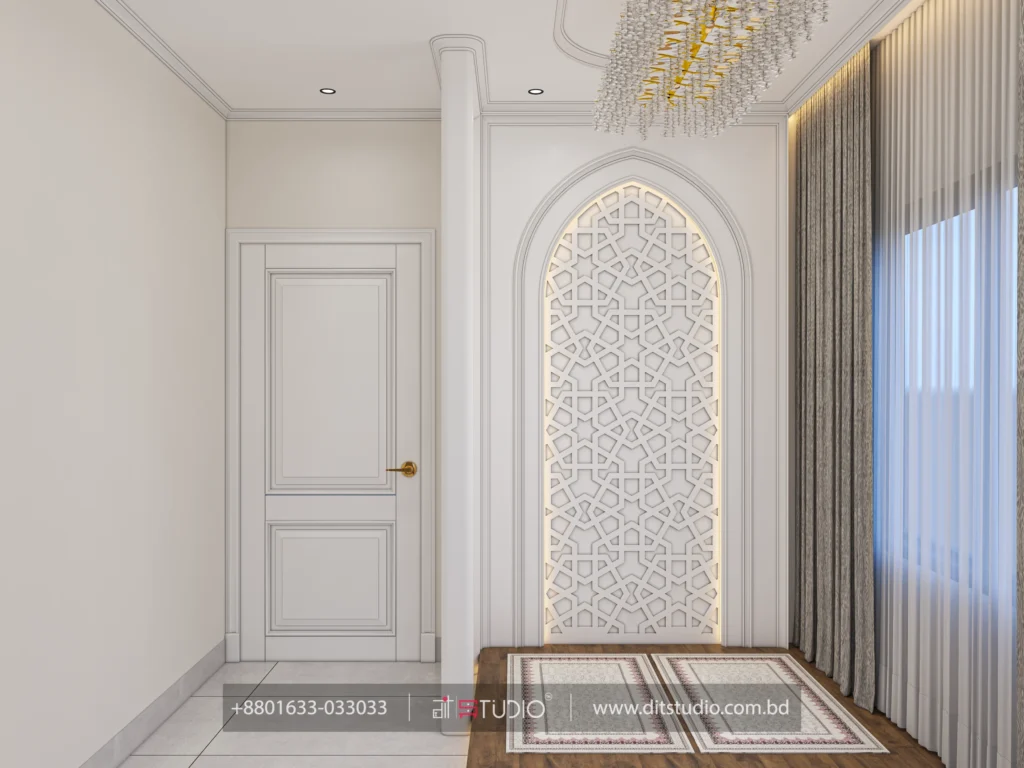
1. Confirm the Qibla Direction First
Everything else follows from this, so do it before you order furniture or fix a shelf.
The bearing can be calculated. The great-circle initial bearing from central Dhaka (about 23.81 N, 90.41 E) to the Kaaba in Makkah (about 21.42 N, 39.83 E) works out to roughly 277 to 278 degrees, measured clockwise from true north. In plain terms, that is just north of due west. As a cross-check, iHadis gives 277.6 degrees for Dhaka. Your exact figure shifts a little with where your building sits in the city, so treat this as a starting point and confirm it with a compass app or your local mosque.
Two cautions:
- Compasses point to magnetic north, not true north. The difference (declination) is small in many places, but it is a reason not to trust one reading. NOAA’s geomagnetic calculators include a declination tool if you want to correct for it.
- Steel affects readings. Reinforced concrete, grilles, wardrobe hardware and phone cases can pull a needle off. The iHadis page above likewise advises avoiding metal surfaces and magnetic phone cases.
The practical method: check with a phone compass, then with a second qibla app or website, and take the readings in the middle of the room rather than next to a window grille. Ask a family elder or your local mosque for a third check. Once you agree on a direction, mark it with masking tape on the floor first and live with it for a few days before fixing anything permanently.
2. Choose the Spot: Quiet, Clean, Out of the Traffic Flow
Walk through your flat at a busy time of day and notice where people actually move. The best spot for a prayer corner usually avoids:
- The bathroom door, both for cleanliness and for privacy.
- The kitchen and dining path, where noise, cooking smells and foot traffic are constant.
- The front door and foyer, where shoes, deliveries and visitors arrive.
- Directly under a ceiling fan’s strongest airflow, which can be uncomfortable and may disturb a mat.
Better candidates are the corner of a master bedroom, the far end of a study, a niche at the end of a hallway, or a spare room.
How Much Floor Space a Prayer Mat Needs
You do not need a large area. Prayer mats are not made to a single formal standard, so measure your own mat before planning.
As general practice, allow a clear strip of floor beyond the mat’s edges, so nothing sits where the head, hands or feet rest, and leave a clear route in and out. Side by side, each extra person needs roughly another mat width. If several family members pray at the same time, lay out your own mats and mark the floor with tape before you commit.
3. Match the Layout to the Room You Have
| Option | Best for | Main advantage | Main trade-off |
|---|---|---|---|
| Dedicated prayer room | Larger flats and duplexes with a spare room | Always ready, quiet, easy to keep consistent | Uses a whole room |
| Bedroom corner | Most 2-3 bedroom flats | No extra floor area needed | Needs a screen or storage to feel separate |
| Study or guest room doubling as prayer corner | Flats where the extra room has other uses | Makes one room do two jobs | Mats and books must store away neatly |
| Hallway or living-room niche | Open layouts | Close to the family’s daily path | Noisier, less private, needs a partition or curtain |
For a shared room, the idea is to keep the “prayer” side visually calm and the “other use” side tidy. A low bookcase, a slim partition or a heavy curtain on a ceiling track can mark the zone. The living-dining partition ideas work equally well for dividing off a corner of a larger room.
A Bedroom-Corner Layout, Step by Step
This is one way a bedroom corner could work, as a planning example rather than a fixed plan.
- Pick the corner of the room that is furthest from the bathroom door and the bed’s foot-end walkway.
- Mark the qibla line with tape and lay the mat along it, then tape the clear zone around it.
- Put a slim closed cabinet or wall rail on the side wall, so the mat and Quran stay off the floor and out of sight when not in use.
- Add a heavy curtain on a ceiling track or a low bookcase to screen the corner from the bed.
- Fit a dimmable warm wall light and keep a rechargeable lamp nearby for load-shedding.
- Leave the route to the bathroom or basin clear, with a washable runner on tiles.
4. Flooring: Comfortable, Clean and Humidity-Proof
The floor matters because it is the surface everything happens on. Dhaka’s monsoon humidity means anything that holds moisture will smell and may grow mould.
- Existing tile or marble: Fine under a mat. Add a thick, washable rug or cushioned underlay if the floor feels cold or hard on knees in winter.
- Wood or laminate: Warm underfoot, but check its moisture resistance before using it near a bathroom wall.
- Carpet: Soft, but it traps dust and damp, and is harder to keep fresh in a humid city. If you choose it, pick a washable or low-pile type and plan to vacuum often.
- A raised platform: A shallow wooden platform with built-in drawers beneath can define the zone and give hidden storage, but it adds height, so keep its edges rounded and clearly visible.
For help weighing materials against humidity and cost, see this guide to interior materials in Bangladesh.
5. Storing Prayer Mats and Prayer Items
Loose mats are the first thing to make a corner feel untidy. Practical options:
- A wall hook or slim rail so mats hang rather than pile up.
- A drawer in a bench or platform, which also protects them from dust.
- A shallow shelf or basket for prayer caps, scarves, a tasbih and a small clock or timetable.
- A fold-flat wall panel for tiny flats, which opens as a shelf and closes to look like a plain cabinet.
Keep storage closed where you can, because dust settles quickly on open shelves in Dhaka. If you want built-in pieces that fit your wall exactly, custom-made furniture usually suits narrow niches better than ready-made units.
6. A Respectful Home for the Quran and Books
Many families like the Quran and religious books to sit on their own shelf, clean and clear of everyday clutter. How high to place them is a personal and cultural choice, and families differ, so use what feels right in your household. As a design matter, a few things help:
- Place the shelf where it is easy to reach without stretching or standing on a stool, and where small children can still be taught to handle it carefully.
- Dedicate the shelf. Avoid mixing with shoes, bags, chargers or decor items.
- Choose a stable stand or rehal and a closed or glass-front cabinet if dust is a concern.
- Check the wall behind. A damp wall will damage books, so avoid external walls that show seepage or that sit beside a leaking bathroom.
If a bookshelf shares a wall with a bathroom, fix any leaks first. The article on bathroom waterproofing in Dhaka explains why that shared wall is a common source of damp.
7. Lighting: Soft, Warm and Glare-Free
Prayer corners suit calm, even light rather than bright spotlights.
- Use a warm, dimmable ceiling or wall light so you can lower it for night prayers.
- Add a low-level wall lamp or concealed LED strip behind a shelf for a soft glow.
- Avoid bulbs shining straight into the eyes of someone sitting or bowing.
- Plan for load-shedding: a small rechargeable lamp near the corner means you are not hunting for a phone torch.
The principles in lighting tips for Bangladeshi home interiors apply directly here, especially layering light so no single fitting does everything.
8. Acoustics and Ventilation
Dhaka is a loud city, so a bit of sound control goes a long way.
For quiet: Soft furnishings absorb noise. A heavy curtain, a thick rug, upholstered cushions and a bookcase on a shared wall all help. Placing the corner on an inner wall, away from the road-facing side, often matters more than any product.
For air: A prayer corner should not feel stuffy. If possible, choose a spot near a window or balcony door for cross-ventilation, and keep the mat and cloth items dry. During monsoon, a small dehumidifier or silica sachets in the storage drawer help.
If you use incense or oil burners, keep the room ventilated and keep flames away from curtains, paper and wooden shelves.
9. Wudu-Friendly Access Near a Bathroom
Easy access to a place for wudu makes daily prayer smoother. The thing to avoid is the opposite problem: a prayer mat right beside a bathroom door, with wet footprints between the two.
- Place the prayer corner a short, dry walk from the bathroom or wash basin, not directly outside the door.
- Add a non-slip mat or absorbent runner on the route so wet feet do not slide on tiles.
- Keep a small towel hook or rail near the basin.
- If you are planning a renovation, a separate wash basin outside the bathroom can serve this purpose well. Compact layouts like those in space-saving bathroom ideas for small Dhaka apartments show how to fit one in.
Anyone with knee or mobility difficulties may prefer a chair or low stool near the corner, and a grab rail near the basin. Plan those details early rather than retrofitting.
10. Keep the Look Simple
Many families prefer a prayer corner free of busy decoration. A neutral colour palette, a plain wall and one meaningful element, such as calligraphy or a simple shelf, tend to read as calm. Avoid clutter, strong patterns and stacks of unrelated items.
Frequently Asked Questions
What Is the Qibla Direction in Dhaka?
The great-circle bearing from Dhaka to the Kaaba works out to roughly 277 to 278 degrees from true north, which is slightly north of due west. Confirm it on site with a compass app or your local mosque, since compasses are affected by metal and by the gap between magnetic and true north.
How Much Space Do I Need for a Namaz Corner?
Enough for your own prayer mat plus a clear strip of floor around it, with an easy way in and out. Measure your mat, lay it on the floor and mark the outline with tape to test the spot before building anything.
Can I Use a Bedroom or Guest Room as a Prayer Corner?
Yes, many families do. The key is neat storage so mats and books are put away, and a simple screen, curtain or low bookcase to give the corner a quiet feel.
Where Should I Not Place a Prayer Corner in the Flat?
Most families avoid spots directly beside the bathroom door, in the main walkway, or next to the kitchen and entrance. Follow your own family’s practice on what feels appropriate.
What Flooring Is Best for a Prayer Corner in Dhaka’s Humid Climate?
A surface that wipes clean and dries quickly, such as tile or sealed timber, topped with a washable mat or rug. Heavily piled carpet traps damp and dust more easily.
Plan Your Prayer Corner With a Designer
If you would like a prayer corner built into a wardrobe wall, a study or a hallway niche, a home interior design consultation can fit the storage, lighting and shelving to your layout.
About This Guide
Written and reviewed by the DIT Studio design team in Dhaka, an interior design and custom furniture studio that plans and builds residential interiors for flats and duplexes across the city. This guide was researched from the sources listed below; figures were checked against each source on the date of writing, and the guide is reviewed when those sources change. Read more about the studio, see why clients choose us, browse the interior design FAQs or contact the team.