

A good dressing table (or vanity table) design in a Dhaka flat comes down to three decisions: put it where you get even daylight, light the mirror properly for the evening, and keep cosmetics in a drawer rather than out on the surface. The style of the unit matters less than those three. A wall-mounted shelf with a good mirror and a few drawers will serve you better than a large freestanding set with poor light and nowhere to plug in a hair dryer.
Key Takeaways
- Place the dressing area near a window or beside the wardrobe, and keep it out of direct sun and away from the attached bathroom door.
- Wall-mounted units save floor space, freestanding tables suit larger rooms, and small bedrooms suit a wall-mounted or wardrobe-integrated unit. Choose the wardrobe-integrated one if a wardrobe is being built anyway.
- For makeup, look for LED lights with a high CRI (90 or above) and a neutral colour temperature on both sides of the mirror, not only overhead.
- Plan sockets and drawer dividers at the design stage, and put the jewellery locker in the wardrobe. The dressing table holds only daily pieces.
- Dhaka’s humidity is hard on cosmetics. Store them in closed drawers, away from the bathroom and the window.
This guide is about the dressing area itself. For the wardrobe that often sits beside it, see our guides to custom wardrobe design in Bangladesh and sliding vs hinged wardrobe doors.
1. Choose the Placement Before the Furniture
Placement decides whether the dressing area gets used every day or turns into a shelf for stray items. The advice below is general planning practice, not a measured standard, so adjust it to your room.
Near a window. Daylight is the most honest light for judging skin tone, so a table set at a side window (light falling across your face, not behind you) works well. Two cautions for Dhaka: it is sensible to avoid a west-facing window, since afternoon sun tends to heat the surface and fade finishes, and avoid placing the mirror so it reflects the window directly, which causes glare. A sheer curtain softens both.
Beside the wardrobe. This is the most practical spot in a flat. You dress, check yourself and pick jewellery in one movement. It also lets you share a wall for sockets and lighting.
In a niche. Many Dhaka flats have a recess beside the bed or near the bathroom door where a bed or cupboard doesn’t fit. A niche can take a slim built-in table with a mirror, and it keeps the main wall free. Just leave enough room to pull a stool in and sit comfortably.
Avoid: the wall that shares the attached bathroom’s wet side, the spot where the door swings into the seat, and the foot of the bed in a narrow room, where it blocks the walkway. Layout trade-offs for compact rooms are covered in our small bedroom layouts for Dhaka flats guide.
2. Wall-Mounted, Freestanding or Wardrobe-Integrated
| Type | Best for | Strengths | Watch out for | Relative cost |
|---|---|---|---|---|
| Wall-mounted (floating) | Small to medium rooms | Frees the floor, easy to sweep under, clean look | Needs a solid wall fixing; the wall must take the load | Low to mid |
| Freestanding | Larger rooms, renters, a single piece you may move | No installation, can be replaced alone | Takes floor space; legs collect dust; often shallow storage | Low to high, depending on make |
| Wardrobe-integrated | Small bedrooms where a wardrobe is being built, matching finishes | One continuous design, fewer gaps for dust, shares power and light | Fixed in place; plan it with the wardrobe | Mid |
| Niche or built-in desk | Rooms with a recess | Uses dead space, tailored storage | Needs an accurate site measurement | Mid |
Cost depends mainly on the board you choose, the hardware (soft-close drawers, channels), the mirror and the lighting. If you’re unsure which board suits a unit that will sit in a humid room, read plywood vs MDF vs particleboard before you decide.
3. Size the Table Around How You Sit
There is no official standard for dressing tables, so the most reliable published numbers come from accessibility rules for tables and work surfaces. The US 2010 ADA Standards set the top of a work surface at 28 to 34 inches (710 to 865 mm) above the floor, which is a useful range for a seated dressing table. To pick a height within it, use the elbow rule from the UCSF Ergonomics Program: the working surface should sit at about elbow height, with elbows bent to roughly 90 degrees or more open. Then test with masking tape on the floor and a chair before you commit.
| Dimension | Reference range | Notes |
|---|---|---|
| Top height | 710 to 865 mm (28 to 34 in) | ADA work-surface range. Match it to your seated elbow height. |
| Knee space | At least 760 mm (30 in) wide; minimum 280 mm (11 in) deep at 230 mm (9 in) above the floor, and 205 mm (8 in) deep at 685 mm (27 in) above the floor | ADA 306.3 knee clearance, which counts depth only up to 635 mm (25 in). Leave the middle open and put drawers at the sides. |
| Clear space at the seat | 760 by 1,220 mm (30 by 48 in) | ADA clear floor space. Allow this in front of the table, plus room to pull the stool back and stand. |
The ADA figures are for accessible design, so they are a generous reference rather than a rule for every household. Table depth has no published standard: make it deep enough for the daily items you keep out, and remember a shallow top or floating shelf is often enough. Make the mirror wider than your shoulders so you can see both sides of your face and hair without leaning. If someone in the household uses a wheelchair or has limited reach, an open-knee design and lower drawers help.
4. Mirror Size, Shape and Position
A mirror that’s too small is the most common reason people give up on a dressing table.
- Full-length mirrors (on a wall, wardrobe door or hinged panel) help with outfit checks. A mirror on a wardrobe door doubles as a dressing mirror in a small room.
- Wide horizontal mirrors work well above a long table and make a room feel broader.
- Round or arched mirrors soften a boxy room, but they show less of your head and shoulders than a rectangle of the same height.
- Fold-out or tilting mirrors let you see the back of your head with a second mirror or angle.
Fix mirrors to the wall or panel with proper backing, and make sure the edges are sealed. Humid air gets behind unprotected mirror edges over time and darkens the silvering.
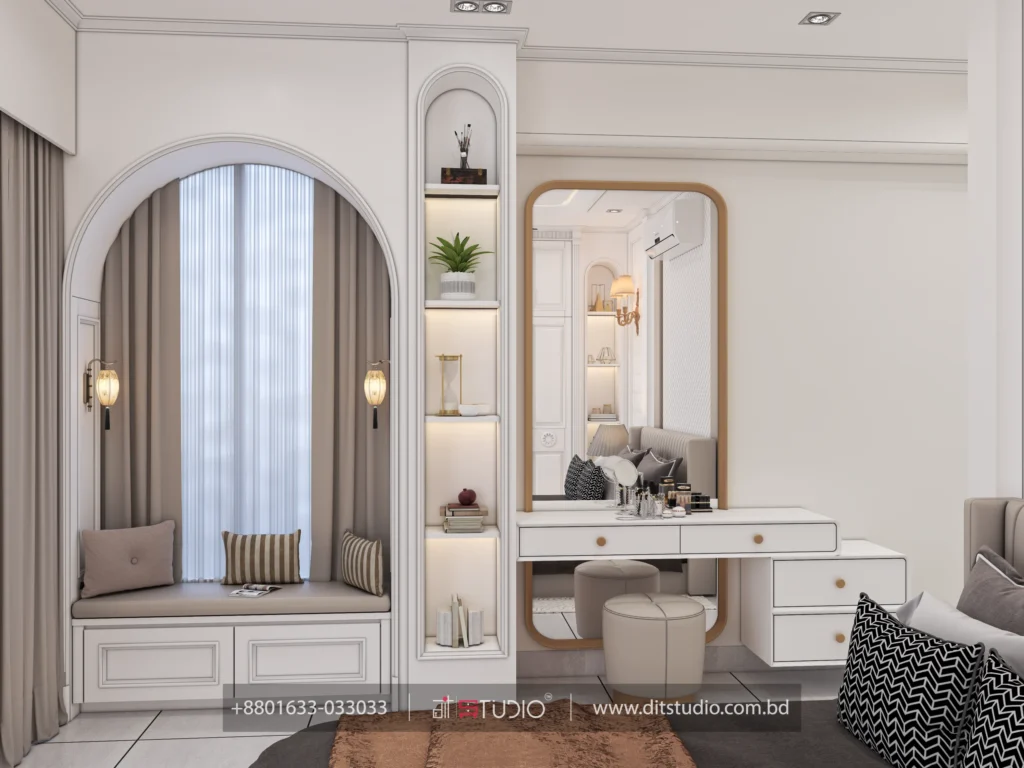
5. Lighting the Mirror for Makeup
Overhead light alone throws shadows under your eyes and nose. The better setup is light on both sides of the mirror, or a strip around it, so your face is lit evenly. Two numbers matter on the product label.
CRI (colour rendering index). CRI measures how faithfully a light shows colours. The US Department of Energy says a minimum CRI of 80 is recommended for interior lighting, and a CRI of 90 or higher indicates excellent colour fidelity. For judging foundation and lipstick shades, aim for the 90+ end. The same page notes that CRI is a weak measure for saturated reds, which is why a supplemental value called R9 is often checked, so if a maker lists R9, a higher number is better for skin tones.
Colour temperature (Kelvin). Warm light is around 2700K, and cool white ranges roughly from 5000K to 6500K, according to the DOE’s description of colour-tunable LEDs. There’s no single official “makeup” value. As general practice, a neutral white in between, or a unit that lets you switch between warm and neutral, helps you check your makeup in both home and daylight conditions. A heavily warm 2700K bulb will hide how a base blends, and a very cool one can make skin look flat.
Practical points for Dhaka:
- Choose low-wattage LEDs. They add less heat to the room, and they put less load on an IPS or other backup supply during load-shedding.
- Put a dimmer or two-mode switch on the mirror light, separate from the room light.
6. Sockets and Hair Tools
Hair dryers, straighteners and curling tongs draw a lot of power and get hot. Plan for them:
- Put at least one socket within easy reach of the seated position, either on the wall or inside a drawer.
- Use a dedicated socket for the heavy tools, not a loaded extension board.
- Add a heat-safe pad or a ceramic-lined drawer slot for cooling tools.
- Keep the cord path away from the seat so no one trips.
Have the electrician mark socket heights on the wall during the first-fix stage, when it costs almost nothing to move them.
7. Storage That Matches What You Own
Start with a list of what actually goes in the unit, then size the storage.
- Jewellery: Keep valuable pieces in a locker inside the wardrobe, not in the dressing table. Gold is a high-value item in many Bangladeshi households, so plan a small built-in locker or a drawer with a proper lock in the wardrobe, and ask your carpenter about a lock that can’t be pried off. The dressing table then holds only daily pieces, in shallow felt-lined trays with dividers so necklaces don’t tangle.
- Cosmetics: Shallow drawers with dividers, so you see everything at once and don’t dig through piles.
- Hair tools and brushes: A tall drawer or a pull-out slot with a socket.
- Skincare bottles: A narrow pull-out column at the side uses dead space.
- Everyday items: Hair ties, pins and perfume often pile up on the top. A drawer or a small tray corrals them.
8. Seating: Stool, Ottoman or Chair
A stool or ottoman that slides fully under the table keeps the walkway clear. An upholstered ottoman can also hold spare scarves or shoes if it has a lift lid. Choose a seat without arms, as arms stop you getting close to the table. A fabric that wipes clean is better than loose weave, because powder and hair spray end up on the seat.
9. Small-Bedroom Solutions
When the room can’t spare a table:
- Fold-down unit. A hinged board on the wall opens to a work surface with a mirror above, and closes flat. It suits a bedroom that doubles as a study or prayer space.
- Corner dressing area. A corner shelf with a triangular or L-shaped top uses space that would otherwise sit empty.
- Mirror-door wardrobe. One mirrored panel with a pull-out shelf inside serves as a hidden vanity.
- Desk that doubles as vanity. A fold-up mirror and a few cubbies turn a study desk into a dressing table.
10. Humidity and Cosmetics Storage
Bangladesh sits in the tropical monsoon region, and Banglapedia notes its climate is marked by high temperature, heavy rainfall and often excessive humidity. That affects both the furniture and what you keep in it.
Temperature. Cedars-Sinai advises not to store cosmetics at temperatures above 85°F (29°C), because heat can weaken the preservatives. Banglapedia puts April mean temperatures across Bangladesh at roughly 27 to 31°C, with summer highs up to 40°C in the west, so a closed Dhaka room can pass that threshold in the warm months. Keep products in a closed drawer, away from the window and from the sun on the table top. A cool, dry drawer in the bedroom is generally better than the bathroom shelf, where steam from showers adds heat and moisture.
Replacement and sharing. Cedars-Sinai also says experts suggest replacing mascara and eyeliner every 3 to 4 months. Do not share eye products.
For the furniture:
- Use moisture-resistant board or sealed edges for drawers and tops.
- Leave a small gap behind the unit on an external wall so air can move.
- Add silica gel packets or a small anti-damp bag in drawers during the monsoon.
- Wipe the surface regularly, since powder and dust build up in humid air.
Our guide to bedroom interior design in Dhaka covers the wider room context.
Frequently Asked Questions
Where should a dressing table go in a Dhaka bedroom?
Beside a window with side light, or next to the wardrobe so dressing happens in one place. Avoid the bathroom-side wall and direct west sun.
Which dressing table type suits a small bedroom?
In a small bedroom, choose a wall-mounted or wardrobe-integrated unit, because both free the floor. Pick the wardrobe-integrated one if you are building a wardrobe anyway, and the wall-mounted one if you are not, since it is also easier to clean under. Freestanding suits a bigger room or someone who expects to move. Wall-mounted needs a solid wall and proper fixings.
What kind of light is best for a makeup mirror?
Even light from both sides of the mirror, using LEDs with a CRI of 90 or higher and a neutral white colour. The US Department of Energy treats CRI 80 as the minimum for interiors and 90+ as excellent colour fidelity.
How do I fit a dressing table in a very small bedroom?
Use a fold-down wall unit, a corner shelf, a mirrored wardrobe door with a pull-out shelf, or a study desk with a fold-up mirror.
How do I protect makeup from Dhaka’s humidity?
Keep it in a closed drawer in the bedroom, out of heat and sun, and out of the bathroom. Replace mascara and eyeliner every few months and avoid sharing products.
Next Step
If you’re planning a new bedroom or reworking an old one, our custom wardrobe and bedroom design service can design the dressing area together with the wardrobe and lighting so sockets, storage and mirror all line up from the start.
About This Guide
Written and reviewed by the DIT Studio design team in Dhaka, an interior design and custom furniture studio that plans and builds residential interiors for flats and duplexes across the city. This guide was researched from the sources listed below; figures were checked against each source on the date of writing, and the guide is reviewed when those sources change. Read more about the studio, see why clients choose us, browse the interior design FAQs or contact the team.