

For a Bangladeshi kitchen with daily frying, steam and a long humid monsoon, high-pressure laminate (HPL) in a matte or textured finish is the safest all-round finish for shutters (cabinet doors). Acrylic gives the best gloss for the money but scratches and shows smudges. PU paint gives a seamless, premium look and is the most repairable by a skilled painter, but it costs more. Membrane (PVC foil) is the finish to keep away from the hob.
This guide assumes you’ve already settled the board underneath. If you haven’t, read plywood vs MDF vs particleboard first, because every finish below is only a skin. A good finish on a board that swells at the edges still fails.
Key Takeaways
- Best all-rounder: matte or textured HPL laminate, with a tested standard behind it (EN 438).
- Best gloss for the price: acrylic. Expect fine scratches and constant wiping.
- Best seamless look and repairability: PU paint, at a higher cost and longer lead time.
- Weakest near heat: membrane / PVC foil. Keep it away from the cooktop and oven.
- Edges decide lifespan. Ask how every finish is edge-banded or sealed, and check the finish chosen for doors beside the hob.
- Cost ranking in the sources reviewed: laminate and membrane at the low end, acrylic above them, PU higher, lacquered glass highest. Get written quotes per finish.
What Your Kitchen Finish Has to Survive in Dhaka
Cabinet shutters take three kinds of punishment here: hot, greasy air from tarka and deep frying; steam from rice, boiling and pressure cookers; and humidity that stays high for months. Banglapedia’s climate entry states that relative humidity is over 80 per cent everywhere in Bangladesh from June through September.
Moisture rarely attacks the face of a shutter first. It gets in at the edges, hinge holes and cut-outs, which is why edge treatment appears in every section below. For layout choices that also affect how much grease reaches your cabinets, see open vs closed kitchen in Bangladesh.
Six Cabinet Finishes Compared
The ratings below summarise one manufacturer’s published comparison (Asian Paints Beautiful Homes), which is a paint company’s view. Independent support is limited: the HPL row also draws on the EN 438 data sheets, the membrane heat rating on Dackor’s door-maker guidance, and the acrylic heat rating on Evonik’s Plexiglas temperature guidance. The PU, acrylic scratch and lacquered glass cells, and the relative costs, rest on the Asian Paints guide alone, and the veneer row is general construction logic. This is desk research, not a lab test, so treat the ratings as a starting point rather than results for your supplier’s product.
| Finish | Heat near hob | Scratch | Grease / cleaning | Repairability | Edges | Relative cost |
|---|---|---|---|---|---|---|
| HPL laminate (matte/textured) | Good | Good (matte) | Easy, wipe with damp cloth | Low: damaged sheet is replaced | Needs good edge banding | Low |
| Acrylic (gloss) | Moderate: keep a gap from the hob | Moderate, fine scratches show | Easy, but smudges show | Limited | Matching acrylic edge, near seamless | Mid |
| PU paint | Good | Good | Easy | Best: can be re-sprayed by a professional | No edge band needed | Mid to high |
| Membrane / PVC foil (also sold as thermofoil or vinyl wrap) | Poor | Moderate | Easy | Low: peeled foil often means a new door | Wraps the profile, few visible joints | Low |
| Veneer | Depends on the top coat | Depends on the top coat | Needs sealed coat | Can be refinished | Veneer or solid edge | Mid to high |
| Lacquered glass | Excellent when framed | Excellent | Very easy | Impact damage means replacement | Framed or backed | High |
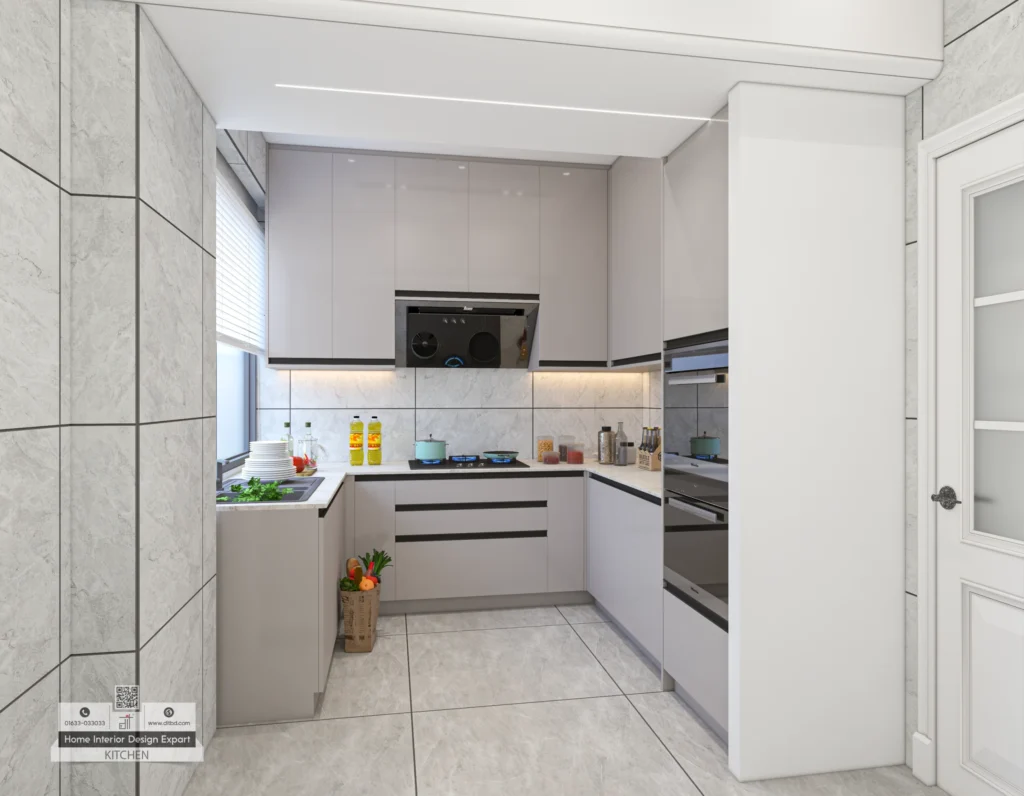
HPL Laminate: The Safest Default
Laminate here means high-pressure laminate: layers of resin-soaked kraft paper and a decorative paper pressed under heat and pressure. It’s covered by EN 438, the European standard for decorative high-pressure laminates. Cheaper “low-pressure” melamine boards are a different product, so ask which one you’re being quoted.
A Swiss Krono HPL data sheet lists the kind of numbers you can ask any supplier for: resistance to scratching of at least 3 N (EN 438-2.25), steam resistance of at least level 3 on glossy surfaces and level 4 on other surfaces (EN 438-2.14), and dry-heat resistance at the same levels (EN 438-2.16). A Print HPL technical sheet (an Italian and English sheet dated 6 July 2015, hosted on crb.ch; the sheet does not name its manufacturer) tests dry heat at 180 °C and wet heat at 100 °C, with the same minimum grades: 3 for gloss and 4 for other finishes. Two details matter for a kitchen. First, the matte and textured grades must reach a higher level than gloss on steam and heat. Second, these figures describe the laminate sheet, not the glued door. The adhesive, the core board and the edge band are separate weak points.
Strengths: wide choice of colours and woodgrains, easy cleaning, low cost. Weaknesses: high-gloss laminate shows fingerprints, a lifted edge can’t be repaired invisibly, and the door is flat unless you pay for a profile. Verdict: a sensible default for many flats, particularly in textured or matte finishes that hide wiping marks.
Acrylic: Best Gloss, Most Maintenance
Acrylic shutters bond a thin acrylic sheet to an MDF or HDF base. The result reflects light well, which helps small, dim kitchens.
Heat is the limit: Evonik says its Plexiglas GS cast sheet can be used at temperatures up to about 80 °C and the XT grade up to about 70 °C, so keep acrylic doors a gap away from the hob and oven rather than beside them. Asian Paints rates acrylic heat resistance as good in its table but names only lacquered glass and PU as the top performers for hob and chimney areas, which is why this guide rates it moderate.
On wear, the Asian Paints comparison rates acrylic as having moderate scratch resistance, says it shows smudges constantly, and describes premium UV-stabilised grades as not yellowing under normal indoor conditions. That is a manufacturer claim, so ask your supplier for the sheet’s UV-stability data and how long the colour warranty runs. Lower-grade sheet without UV stabilisation is the likelier place for yellowing in a sunny kitchen, so ask which grade is quoted.
Ask any maker for the warranty period in writing, and read what that warranty excludes.
Verdict: pick acrylic when appearance is the priority and someone will wipe the doors daily. Skip very dark gloss colours if you cook a lot.
PU Paint and Lacquer: Seamless and Repairable
PU (polyurethane) paint is sprayed on in several coats, then sanded and polished. Because there’s no sheet, there’s no edge band, and the finish can follow grooves and profiled doors. The Asian Paints guide rates PU good for scratches and excellent for moisture, and notes the downsides: professional application, longer lead time, and scratches that are hard to fix at home.
Check two things before ordering. The first is the workshop: a sprayed finish is only as good as its spray booth and dust control, so ask to see a finished door rather than a brochure. The second is vocabulary, because the word “lacquer” is used loosely: in Dhaka it can mean a sprayed lacquer or PU coat on MDF, or back-painted lacquered glass. Sprayed coats can chip at corners and need touch-up. Ask exactly which one is being quoted.
Yellowing is a known issue for some polyurethane chemistries, particularly in sunlight, and UV-stable aliphatic systems are used to reduce it. We couldn’t find independent test data for cabinet systems, so make a non-yellowing, light-colour guarantee a written part of the quotation.
Verdict: PU wins on look and repairability. It loses on cost and lead time.
Lacquered Glass Is a Different Product
Back-painted lacquered glass is non-porous, so it handles heat and cleaning very well, but it is heavy and can crack on impact. The Asian Paints guide rates it highest for heat and scratches and also highest for cost, and damage means replacing the panel.
Membrane / PVC Foil: Keep It Away From the Hob
Membrane doors are made by vacuum-pressing a PVC foil onto a routed MDF door. That makes profiled, “shaker” doors affordable. The same sources agree on the weakness. The Asian Paints guide calls membrane the finish most vulnerable to heat and moisture, with peeling a concern near the hob. A door maker, Dackor, explains that heat is the main cause of vinyl delamination. It names two hot spots: doors directly above a tea kettle and doors beside a self-cleaning oven, where the vinyl shrinks and exposes the MDF. In a Bangladeshi kitchen, think rice cookers, kettles, air fryers and pressure-cooker steam under wall cabinets.
If you want membrane, use it on the tall units and wall cabinets away from the cooking zone, and choose another finish for shutters beside the hob. Dackor also recommends a heat shield next to ovens.
Verdict: good for budget profiled doors, poor choice for hob-adjacent doors.
Veneer: Warm, but Needs a Proper Top Coat
Real wood veneer gives genuine grain, which laminate and foil only print. It then needs a sealed polyurethane or lacquer top coat to resist steam and oil, and the top coat decides how it performs, not the veneer. Veneer can be refinished, which is an advantage, but it costs more than laminate and is more sensitive to moisture if any edge is left unsealed. It suits a dry, ventilated kitchen better than a small closed one with heavy frying.
Cost: What Moves the Price
Reliable Bangladeshi shutter-only prices by finish weren’t available in the sources we could verify, so here is the relative order. The Asian Paints guide puts laminate and membrane at the low end, acrylic above them, PU higher again and lacquered glass highest, in Indian rupee ranges that don’t transfer to Dhaka. Bangladesh’s market may differ, so treat that as an order of magnitude, not a quote. Cost is driven by:
- the core board and its thickness (see the plywood vs MDF comparison);
- imported or local laminate and acrylic sheet brands;
- profiled or flat doors, and the number of paint coats;
- hinges, channels and fittings, which can matter as much to the total as the finish choice. The interior materials guide for Bangladesh covers hardware.
To see how finish choice fits into the whole project, see what affects interior design cost in Bangladesh.
Matching a Finish to Your Cooking and Layout
| Your situation | Suggested finish |
|---|---|
| Heavy daily frying, tight budget | Matte or textured HPL laminate |
| Small, dim kitchen that needs light | Acrylic in a light colour, or glossy HPL |
| Want seamless, handle-less or profiled doors | PU paint |
| Profiled doors on a budget, away from the hob | Membrane on wall units only |
| Wood look with the least risk | Wood-grain HPL rather than veneer |
| Open kitchen visible from the living room | PU or acrylic on visible faces, laminate inside |
Pair your choice with a worktop that can take the heat; our quartz vs granite comparison covers that. If you’re still deciding on the kitchen format, start with modular vs traditional kitchens.
Questions to Ask Before You Sign
- Is the laminate high-pressure (EN 438) or low-pressure melamine? Can you see the data sheet?
- How are edges sealed or banded, and on all four sides including hidden ones?
- What is the warranty, and does it exclude heat, steam or sunlight?
- Can I see a finished door from this workshop that is a year or more old?
- Which door goes beside the hob, and is it the same finish as the rest?
Frequently Asked Questions
Which kitchen cabinet finish is best for heavy oil cooking?
Matte or textured HPL laminate and PU paint both clean easily and tolerate daily wiping. Laminate costs less; PU is more repairable. Avoid membrane near the cooktop and high-gloss dark colours that show every smudge.
Is acrylic or laminate better for a kitchen in Bangladesh?
Laminate is more forgiving for scratches and cost. Acrylic gives a deeper gloss and a more modern look, but it shows fine scratches and smudges. Choose acrylic only if you accept regular wiping and the higher price.
Does PU paint turn yellow?
Some polyurethane coatings yellow over time, especially in strong sunlight, though UV-stable systems reduce this. Ask for the specific product, a light-colour guarantee in writing and a sample finished door.
What is the difference between lacquer and PU paint?
Both are sprayed coatings, and the terms are used loosely. In kitchen sales, “lacquer” can also mean lacquered glass. Ask the maker to name the exact coating and base material.
Can a damaged kitchen shutter be repaired?
PU paint and veneer can usually be refinished. Laminate and membrane are generally replaced. Acrylic repair is limited to polishing light marks.
Get Finish Samples Compared for Your Own Kitchen
If you’d like a second opinion on samples and quotes for your flat, a modular kitchen design consultation can compare finishes against your cooking habits, sun exposure and budget before anything is cut.
About This Guide
Written and reviewed by the DIT Studio design team in Dhaka, an interior design and custom furniture studio that plans and builds residential interiors for flats and duplexes across the city. This guide was researched from the sources listed below; figures were checked against each source on the date of writing, and the guide is reviewed when those sources change. Read more about the studio, see why clients choose us, browse the interior design FAQs or contact the team.