
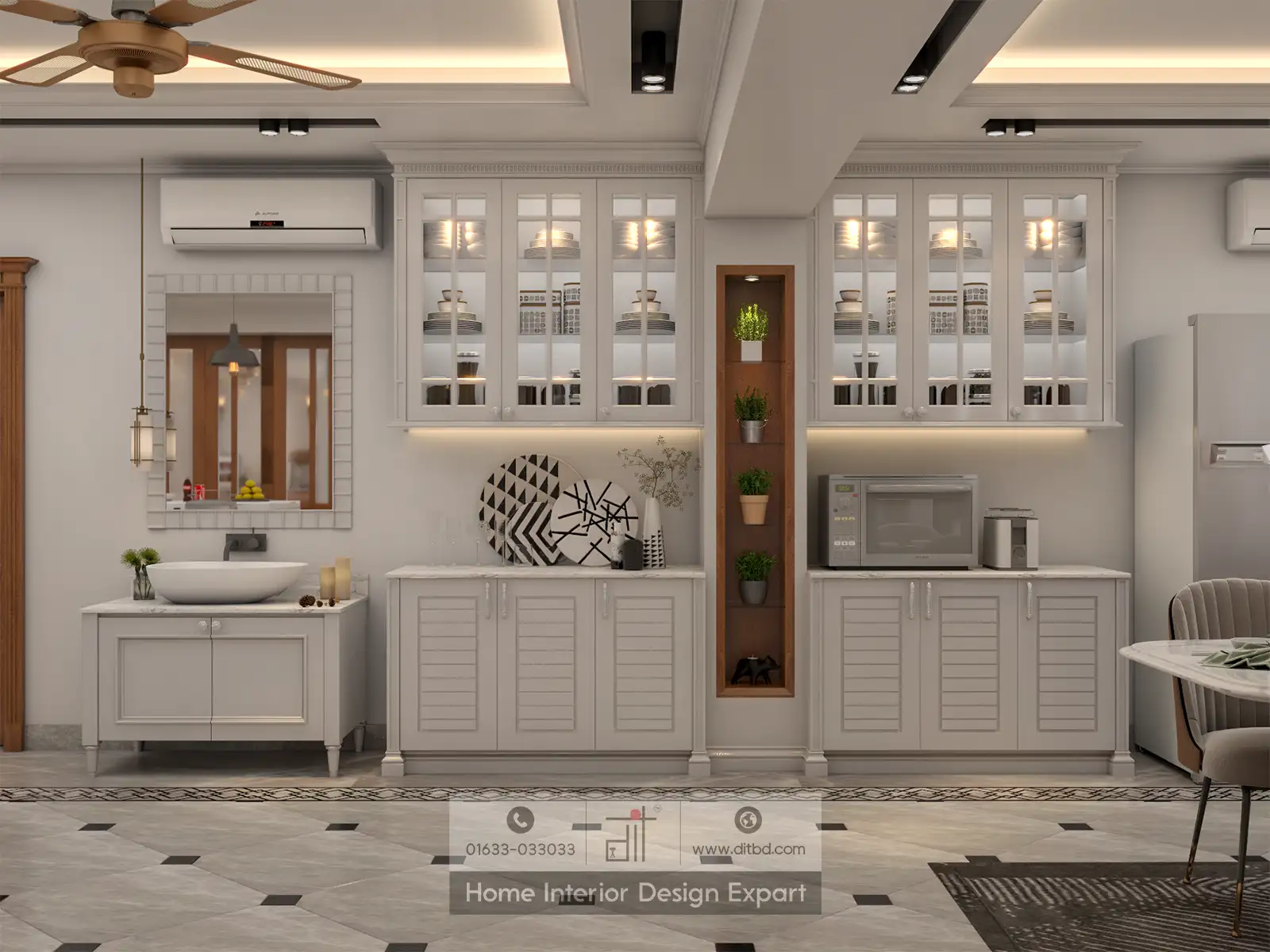
The best place for a washing machine in a Dhaka flat is wherever three things come together. You need a water supply and a drain point nearby (a standpipe, trap or floor drain). You need a dedicated earthed socket on an RCD-protected circuit. And you need enough air movement to dry the room afterwards. In most flats that means the service balcony next to the kitchen, if it’s roofed and enclosed. If not, a ventilated utility niche or the bathroom comes next, and an under-counter machine in the kitchen is the last resort. Good laundry area design for a small flat is mostly about plumbing, power and drying, not about the cabinet finish.
Key Takeaways
- Choose the location on services first: water, drain, earthed power and ventilation. Style comes after.
- A roofed, enclosed service balcony is usually the easiest spot. Bathrooms work only if the socket and splash zones are planned properly.
- Keep the socket out of the splash zone, keep earthing intact, and put socket circuits on an RCD. Ask your electrician to confirm the wiring.
- Follow the manufacturer’s installation page or manual for levelling, hose fixing and clearances. Hose heights differ between models and markets.
- Plan monsoon drying on purpose (ceiling airer, retractable line, a window or exhaust fan). Persistent damp is a health issue, not just a smell.
- Add a shelf for detergent, a fold-down ironing board and a clear route for the helper to carry baskets.
Step 1: List What Your Flat Already Gives You
Before you pick a spot, check what the builder left behind:
- Water points: kitchen sink supply, bathroom taps, any capped inlet on the service balcony.
- Drainage: a floor trap (floor drain), a sink waste, or a standpipe. A machine can’t discharge into a drain that doesn’t exist.
- Sockets: whether an earthed socket already exists near the candidate spot, and which circuit it runs from.
- Floor: whether it is flat and waterproofed. If not, see our notes on bathroom waterproofing in Dhaka, which apply equally to a wet balcony floor.
- Air: a window, grille or exhaust fan within reach.
In a newly handed-over flat, this is the moment to move a pipe or socket, before tiles and cabinets go in. The interior design handover checklist covers what to inspect on the day you receive the keys.
Step 2: Compare the Four Placement Options
| Option | Best for | Main advantages | Main risks | Relative cost |
|---|---|---|---|---|
| Service balcony beside the kitchen | Flats with a roofed, enclosed utility balcony | Water and drain often close; noise and humidity stay out of living areas; room for drying | Exposure to rain and sun if open; dust; needs a lockable cabinet or screen | Low to mid |
| Bathroom | Flats with no balcony or a very small one | No new drain needed; floor is already waterproofed | Socket and splash safety; humidity; hard to dry clothes in the same room | Low to mid, plus electrical work |
| Dedicated utility niche (a recess or cupboard) | Flats where a wall can be borrowed from a corridor or kitchen | Hides the machine; allows shelving and a pull-out ironing board | Needs ventilation; needs new water and waste lines; door must breathe | Mid to high |
| Under-counter in the kitchen | Compact kitchens where nothing else is available | Uses existing sink plumbing; worktop above | Heat and moisture near food; vibration; helper and cook collide | Mid |
Costs depend on how far new pipework and wiring must run, whether tiles or a counter must be cut, and the finish of the cabinet. Ask for these as separate lines in your quotation. Our interior design BOQ guide explains how to read those lines.
The service balcony
If your flat has a small utility balcony off the kitchen, use it. It keeps water, noise, lint and humidity away from the living rooms. In Dhaka there are two conditions: the balcony must be roofed or shaded, and it should be enclosed with a grille, a louvred door or a sliding panel so rain and dust don’t reach the machine. Build a low plinth or kerb so spills don’t run into the kitchen, and slope the floor gently towards the drain.
If you’d rather grow plants on that balcony instead, see our balcony garden ideas for small Dhaka flats. Doing both is possible, but keep plant pots away from the socket and machine.
The bathroom
This works, and it is a common fallback in flats without a utility balcony. The problem is not the water; it’s the electricity. Treat the bathroom as a wet area and be strict. Hong Kong’s Electrical and Mechanical Services Department, for instance, says any bathroom socket outlet must be at least 0.6 m from a shower basin or bathtub. That is a Hong Kong rule, not a Bangladeshi one, but it is a sensible benchmark. Place the machine on the dry side of the room, away from the shower spray, and have the electrician decide the exact socket position and type. Our guide to space-saving bathroom ideas for small Dhaka apartments shows layouts that leave room for a machine.
The utility niche
A recess with a pair of louvred doors can swallow a front-load machine, a stack of shelves and an ironing board. It looks neat, but it traps humidity unless the doors are slatted or ventilated and the machine door can swing fully open. Before building anything, measure the machine’s footprint, including the full depth plus the hose and plug at the back, and the arc of the door swing, not just the box size on the brochure. Leave the niche a little larger than those measurements. Pull-out and fold-down fittings pair well with ideas from our guide to smart furniture for small apartments in Dhaka.
Under the kitchen counter
Only choose this if nothing else fits. It shares plumbing with the sink, but the machine’s vibration, heat and damp sit next to food preparation, and the cook and the person doing the laundry will keep getting in each other’s way. If you do it, use a machine designed for built-in use, make sure the worktop above is sturdy, and leave a service gap. Our smart modular kitchen ideas cover how to fit appliances into a compact run.
Machine Type: Twin-Tub, Top-Load or Front-Load
As general practice, the type of machine changes placement, drainage and footprint, so decide it before you fix the spot. Semi-automatic and twin-tub machines are common in Dhaka flats. They are filled by hand or hose and usually drain loosely, so they suit a balcony or bathroom with a floor trap or drain point close by, and they need dry floor space beside them for the spin tub and a bucket or tray. Fully automatic top-loaders connect to a tap and drain like a front-loader, but the lid opens upwards, so they need headroom and cannot sit under a fixed shelf or counter. Front-loaders need clear floor space for the door to swing open, which makes them the usual choice for a niche or under-counter fit. Check the footprint and door or lid clearance in the manual, then size the plinth, niche or cabinet around it.
Step 3: Get the Plumbing and Drainage Right
You need three connections: an inlet tap, a drain, and a level base.
- Inlet tap: Bosch’s installation guide specifies a 3/4-inch (26.4 mm) tap for the supply hose. Tap and hose-end threads can differ, so check the machine’s hose end against the tap before the plumber closes the wall.
- Drain: Bosch lists a siphon, sink, standpipe or gully as drainage options. Its guide says to secure the hose so it can’t slip out under pressure, and that the end of the hose must not sit in the drained water, or water may be drawn back into the machine. A standpipe or a trap with a hose-fitting is cleaner than dropping the hose into a floor drain.
- Hose height: manufacturers specify a drain height range that differs by brand, model and market, and Bosch’s general page gives no single figure either. Read the manual for your exact model and tell the plumber the figure before the standpipe is cut.
- Level base: Bosch says to check the machine with a spirit level, and that all four feet must stand firmly on the floor. Incorrect levelling causes noise and vibration. Floors can slope towards the drain, so adjust the feet rather than shimming with tile offcuts.
- Transport bolts: remove all four before the first wash, and refit them if you move the machine.
Leave a gap behind and at the sides for hoses and airflow; clearances vary by model, so use the manual’s figures. Keep access for cleaning the inlet filter and pump.
Water pressure. Many Dhaka flats are fed from a gravity-fed roof tank, so pressure on a lower floor can differ from the top floor and may be weak when the tank runs low. Machines have a minimum inlet pressure, so check that figure in the manual and ask the plumber whether your supply meets it. If it doesn’t, a booster pump is a question for the plumber, not a guess.
Noise and vibration. On upper floors, a spinning machine can send vibration through the slab into the room below. Level the machine carefully and put anti-vibration pads under the feet, keeping it clear of shared walls with bedrooms where you can.
Step 4: Make the Electrics Safe
Water and power sit very close in a laundry corner, so do not improvise this part.
- Earthing: use a three-pin earthed socket and never cut off or bypass the earth connection. The Hong Kong handbook states plainly: “do not remove any earthing connection.”
- RCD protection: the same handbook says circuits for socket outlets must be protected by a residual current device (RCD), a device that cuts the supply when current leaks to earth. In a Dhaka flat, ask your electrician whether the laundry socket circuit has an RCD or RCCB, and have one fitted if not.
- Socket position: mount it above the likely splash and flood level, out of the spray path, and reachable without moving the machine. A splash cover helps on a balcony.
- Load-shedding and surges: ask the electrician about surge protection if your area has unstable supply, and avoid sharing the circuit with a geyser or air conditioner.
- Cable: no extension boards on the floor. If the plug can’t reach, move the socket.
Check the electrical section of your model’s manual, and have a qualified electrician sign off the wiring.
Step 5: Plan Monsoon Drying Before You Buy Anything
Clothes that stay wet indoors raise humidity, and persistent damp has real health consequences. The World Health Organization’s indoor air guidelines say that the most important effects of dampness and mould are increased respiratory symptoms, allergies and asthma, and call preventing or minimising moisture problems the most important means of avoiding them. The Daily Star’s seasonal property guide makes the same point for Bangladesh, warning that monsoon humidity encourages mould and mildew in apartments and recommending cross-ventilation during dry spells.
Practical options, in order of effort:
| Drying option | Where it fits | Notes |
|---|---|---|
| Ceiling pulley airer | Balcony or utility corner with a solid slab or beam above | Lifts wet clothes out of the way, so the floor stays free; fix to concrete or a proper batten, not gypsum alone |
| Retractable wall line | Narrow balconies and corridors | Pulls out when needed and disappears afterwards; check the wall can take the load |
| Fold-down wall rack | Small niches | Good for delicates; folds flat |
| Freestanding airer | Living areas in emergencies only | Moves moisture into rooms you live in; use with a fan and an open window |
Whichever you pick, add airflow. An exhaust fan or a permanent louvre in the balcony screen costs little, and a ceiling fan above the airer moves air through the cloth. Run the machine’s highest sensible spin speed so less water is in the clothes to begin with. Don’t hang a full load inside a closed bedroom overnight.
If the flat has no balcony that stays dry, a dehumidifier in a closed utility room, or a washer-dryer, are the other options. A dehumidifier draws moisture from the air without opening a window in heavy rain. A washer-dryer removes the hanging step but costs more to buy and run, and drying capacity is usually smaller than washing capacity, so read the manual. For ideas that cool and ventilate the whole flat, see our guide on natural home cooling tips for Bangladesh.
Step 6: Add Storage, an Ironing Station and a Helper-Friendly Route
- Detergents and chemicals: use a closed cabinet or a high shelf, away from the machine’s door swing and from children. Moisture-resistant boards hold up better than plain particleboard in humidity; the interior materials guide compares what is sold in Dhaka.
- Baskets: a pull-out hamper or two stacking baskets (whites, colours) saves sorting on the floor.
- Ironing station: a fold-down board on the wall, with a socket for the iron at a safe height. Never leave a plugged-in iron on a fold-down board; mount the socket where you can switch it off from the front.
- Workflow for the helper: the sequence is collect, wash, hang, dry, iron, fold, return. Place the machine, the line and the ironing board in that order within a few steps. Keep the route free of door swings and wet floors. A non-slip floor finish is worth the small extra cost.
Frequently Asked Questions
Can I put a washing machine in the bathroom of a Dhaka flat?
Yes, if the socket is well away from the shower and bath, the circuit is earthed and RCD-protected, and the room can ventilate. Hong Kong’s official handbook sets a minimum 0.6 m between a bathroom socket and a shower basin or bathtub. Ask your electrician to confirm the layout.
Is it fine to leave a washing machine on an open balcony?
It is risky. Rain, direct sun and dust shorten the life of a machine, and an exposed socket is a safety problem. Roof the balcony or enclose it with louvres, and use a lockable cover or cabinet.
How high should the drain hose be?
There is no single figure. Manufacturers give ranges per model, and Bosch’s general installation page, for example, gives no number. Read the manual for your machine before the plumber fixes the standpipe.
Do I need an RCD for the washing machine?
Hong Kong’s EMSD handbook says socket-outlet circuits must be protected by an RCD, and a laundry corner is a sensible place to follow that. It does not replace earthing. Ask your electrician to check whether the laundry circuit has one and to test it.
How do I dry clothes indoors in the monsoon without causing damp?
Use a ceiling or wall-mounted airer near a window or exhaust fan, spin the clothes well before hanging them, and keep the room ventilated. Avoid drying full loads in closed bedrooms.
Plan the Laundry Corner With Your Whole Flat
A laundry corner touches plumbing, electrics, joinery and ventilation, so it works best when it’s planned with the kitchen and bathrooms rather than added afterwards. If you want help locating the washer, drain and drying line in your flat, it can be built into a wider common space design service plan for the whole flat.
About This Guide
Written and reviewed by the DIT Studio design team in Dhaka, an interior design and custom furniture studio that plans and builds residential interiors for flats and duplexes across the city. This guide was researched from the sources listed below; figures were checked against each source on the date of writing, and the guide is reviewed when those sources change. Read more about the studio, see why clients choose us, browse the interior design FAQs or contact the team.