
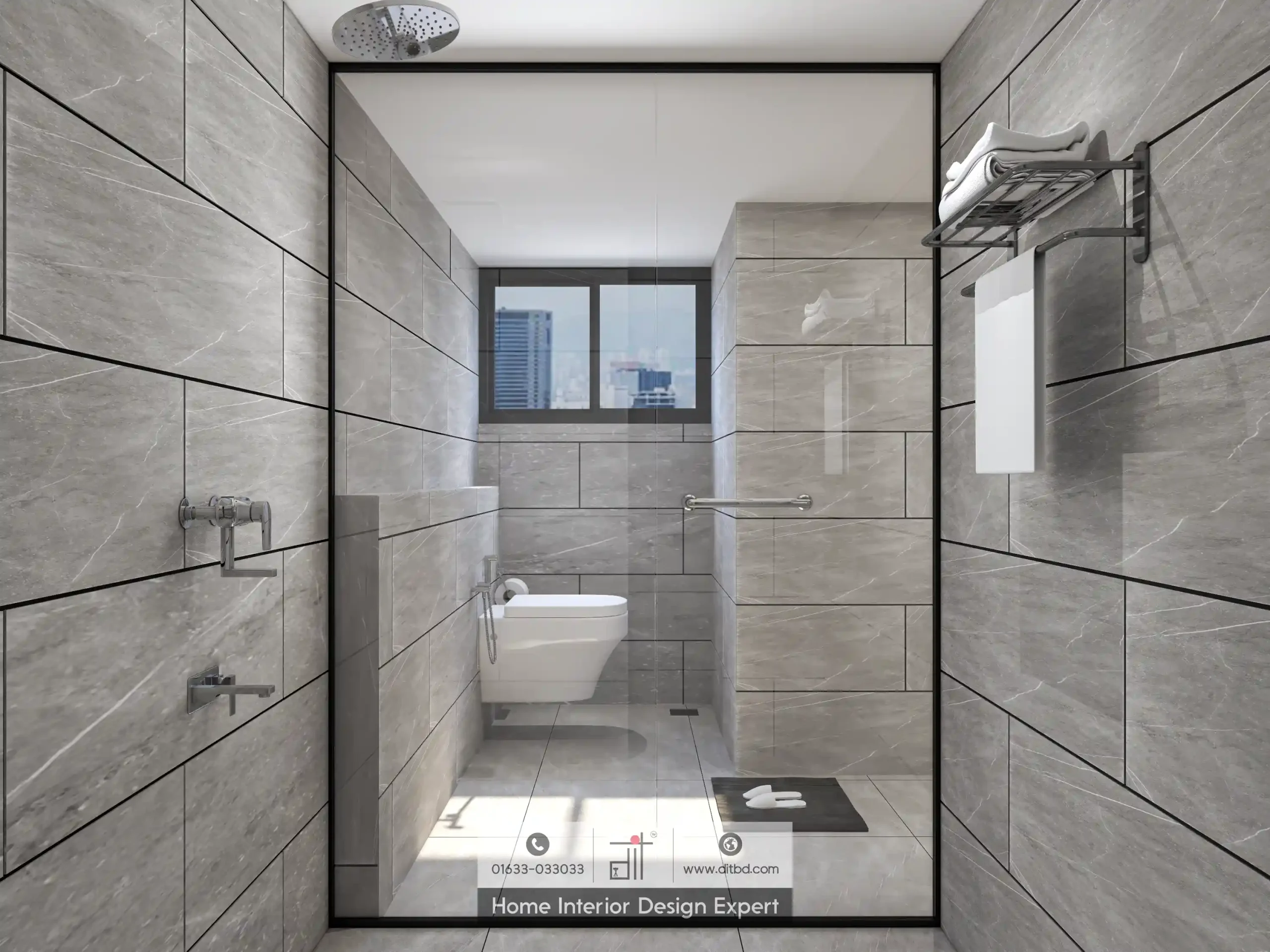
For a Dhaka bathroom, choose a matte, textured floor tile with a documented wet slip-resistance result, a lighter wall tile with epoxy or high-quality grout in the wet zone, a floor that falls gently to the drain, and fittings that cope with hard water. Everything else, from the colour of the tile to the shape of the WC, comes after those four decisions. Get the floor wrong and you have a daily fall risk. Get the fittings wrong and you will be scrubbing stains within a year.
This guide walks through each choice in the order you will actually make it, with the test standards decoded so you can question a showroom salesperson with confidence.
Key Takeaways
- Ask for a wet slip-resistance result (DCOF, R rating or pendulum value), not just the word “anti-slip” on the box.
- Textured matte floors grip better than polished ones; keep glossy tiles for the walls.
- Build the slope to the drain into the screed (the cement-sand layer under the tiles), and keep the waterproofing separate from the tile (see our waterproofing guide).
- Epoxy grout costs more but resists stains better in the shower zone.
- Hard water and iron leave stains on fittings; pick finishes you can wipe and descale easily.
Why the Floor Deserves the Most Attention
Falls are a major cause of injury everywhere, not only in bathrooms. The World Health Organization describes falls as the second-leading cause of unintentional injury deaths worldwide, after road injuries, and says about 71% of estimated fall deaths in 2023 were among adults aged 60 and over. WHO’s figures aren’t specific to bathrooms, but a wet tiled room with soap on the floor is exactly where an older relative loses balance.
Many Dhaka homes have grandparents sharing the flat, and everyone walks in with wet feet after wudu or a shower. If you’re planning for older users, read our guide to accessible interior design for inclusive Bangladesh homes alongside this one.
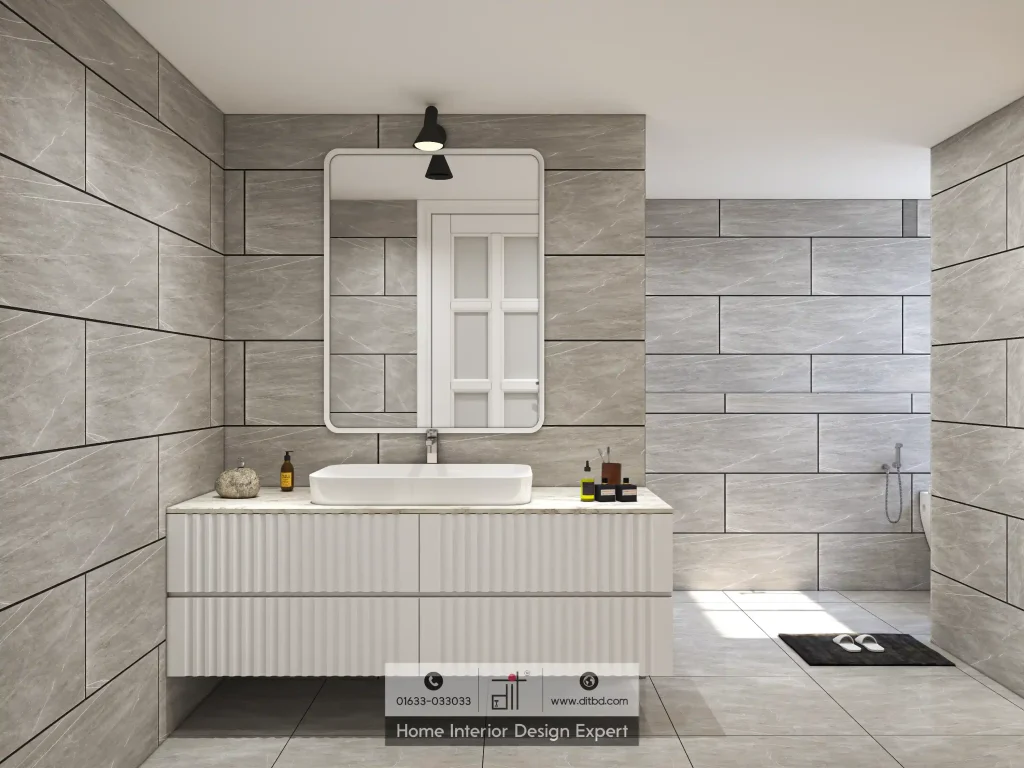
Step 1: Choose the Floor Tile by Slip Resistance, Not by Looks
“Anti-slip” on a showroom label means very little until you know which test produced it. These systems come up most often.
| Test | What it measures | Typical use |
|---|---|---|
| DCOF, ANSI A326.3 | Dynamic coefficient of friction of a wet tile | Interior floors; common on US-made and imported porcelain |
| R rating, DIN 51130 | Ramp test, walker in shoes on an oiled surface; classes R9 (lowest) to R13 (highest) | European tiles, often printed on packaging |
| Pendulum (PTV) | Energy lost as a rubber slider crosses the surface, dry and wet | Commercial floors and independent lab reports |
The European Agency for Safety and Health at Work explains that in the DIN 51130 ramp test, a tester walks over an oil-coated sample while the ramp is tilted until they slip, and that R9 meets the lowest requirement while R13 meets the highest. The same source describes the barefoot version, DIN 51097, which uses soapy water and gives A, B or C classes. That barefoot test is the closer match to a shower floor.
DCOF is measured with the ANSI A326.3 method, which is included in ANSI A137.1, the US specification for ceramic tile. Tile maker Crossville calls a wet DCOF of 0.42 or higher the industry benchmark for level interior floors walked on when wet, but adds that meeting it doesn’t make a tile suitable for every project. It also describes an “Interior Wet Plus” category for areas frequently subjected to standing water, such as shower floors, where tiles typically combine a higher wet DCOF, stronger texture and more grout joints.
What to do in practice:
- Ask the supplier which test the figure comes from and for the test report, not a sticker. If they can’t produce one, treat the tile as unrated.
- Use a higher-grip tile in the shower and a still-textured tile elsewhere. A two-tile floor is common and sensible.
- Prefer matte or lightly textured porcelain over polished tile on the floor. Polished and glazed-glossy surfaces are the ones that turn slick with soap.
- Wet-test a sample at the showroom: pour water on it, add a little hand soap, and stand on it barefoot.
Step 2: Choose Wall Tiles for Cleaning, Not for the Catalogue Photo
Walls don’t need grip, so you have more freedom here. Size, finish and height are what matter.
Size. Large-format tiles mean fewer grout lines and less to scrub, which suits a small flat bathroom. But very large tiles are harder to lay on uneven walls and waste more on cuts, so a modest format (for example 300 x 600 mm) is often the safer choice. Ask your tiler what the wall flatness allows before ordering.
Gloss or matte. Glossy wall tiles bounce light around a small, often windowless bathroom and wipe clean easily. Matte tiles hide water spots and hard-water film better. A mix works well: matte on the wet wall, gloss on the dry wall.
Height. Tile to the ceiling in the shower zone; in the dry zone you can stop lower and paint above in a moisture-resistant finish.
Step 3: Choose Cement or Epoxy Grout
Grout is where bathrooms start to look old. As general practice, cement grout is porous, usually needs a sealer, and darkens with soap and mineral deposits. Epoxy grout is generally less porous, is usually sold as needing no sealer, and is easier to keep clean, but it costs more and sets quickly, so it needs an experienced applicator who cleans residue off before it hardens. Check the maker’s data sheet for the product you choose.
| Factor | Cement grout | Epoxy grout |
|---|---|---|
| Cost | Low | Higher |
| Staining | Prone to staining; sealer helps | Generally more stain-resistant |
| Application | Forgiving | Short working time; residue is hard to remove |
| Best for | Dry-zone walls, tight budgets | Shower floor and wet walls |
A practical split: epoxy grout in the shower and on the floor, good-quality cement grout on the dry walls. Choose a mid-grey or tone-on-tone colour. Pure white grout shows every drip of iron-rich water.
Step 4: Slope the Floor to the Drain
A tile does nothing about standing water if the floor is flat. The slope is built into the screed before tiling, not added by the tiler as an afterthought. The Ceramic Tile Education Foundation notes that, in the US, plumbing code requires a stall shower floor to be sloped a quarter inch per foot toward the drain. That’s a US figure, so treat it as a reference point and confirm the exact fall with your contractor for the drain you have chosen.
Keep these points in mind:
- Slope only the wet zone toward the drain; the dry zone can be near level.
- A fall that is too steep is uncomfortable underfoot and makes large-format tiles hard to lay flat; smaller tiles or mosaics follow a sloped shower floor more easily.
- Test it before tiling: pour a bucket of water on the screed and watch where it goes. Fix puddles at this stage, because afterwards it’s a tile-breaking job.
Waterproofing sits under all of this and is a separate layer. We cover it fully in bathroom waterproofing in Dhaka.
Step 5: Divide the Bathroom into Wet and Dry Zones
Even in a 5 x 7 ft bathroom, a clear wet zone (shower, health faucet area) and dry zone (basin, door) cut down on wet footprints and wall damage. A shower curtain or a fixed glass panel does the job. If you want a visible break between zones, use a low threshold or a linear drain rather than a raised step, because a step is a trip hazard, especially for elderly users and anyone walking in with wet feet. If you’re weighing a shower enclosure against a tub, our comparison of a walk-in shower vs bathtub in a Dhaka flat bathroom covers the trade-offs, and the space-saving bathroom ideas for small Dhaka apartments show how to fit all of it into a tight plan.
Step 6: Choose Sanitaryware That Suits the Flat
WC (toilet): wall-hung or floor-mounted. A wall-hung WC leaves the floor clear underneath, so mopping is quicker and the room feels bigger. It needs a concealed cistern frame inside a built wall or a boxed-out section, which takes depth and must be planned before tiling. A floor-mounted WC is simpler to install and replace, and works well when the wall can’t be thickened. For a small bathroom in a Dhaka flat, wall-hung gives the cleaner look; floor-mounted is the lower-risk choice for a tight budget or a rental.
Health faucet (bidet spray). In most Bangladeshi homes this is standard, not optional. Fit it within easy reach of the seated user, on the side of the dominant hand, with an angle-stop valve so the line can be shut off without closing the whole bathroom. Chrome or stainless bodies last longer than plastic ones in daily use.
Hand shower and overhead shower. Many households prefer a hand shower on a slide bar, because it also helps with washing a child, an elderly relative or the floor itself. A mixer-type fitting gives temperature control, which matters if you use a geyser.
Mixer types. A single-lever mixer is simple to use with wet or soapy hands. Two-handle taps are cheaper and easier to repair.
Step 7: Plan for Hard Water and Iron
Iron and manganese in the water supply leave brown and black marks on white tiles, grout, WC bowls and chrome. The World Health Organization says iron is not of health concern at levels found in drinking water but may affect acceptability, noting that taste and appearance will usually be affected well before any health threshold. For Dhaka specifically, a 2024 study of 15 groundwater samples published in Frontiers in Environmental Science found manganese above the WHO guideline in 10 of them. It’s a small sample and it doesn’t cover your building’s tank, so the practical step is to look at your own water. Check for rust-coloured film in the overhead tank, orange rings in the WC and yellow patches on a white towel.
Design around it:
- Pick mid-tone floor tiles and grout rather than bright white.
- Choose finishes with a smooth, non-porous surface that wipes clean, and avoid heavily textured wall tiles that trap mineral film.
- Install a filter or sediment stage on the main line if staining is heavy; ask a plumber to assess your supply first.
- Fit aerators and shower heads with removable rubber nozzles so you can rub off limescale.
- Wipe fittings dry after use and descale with a mild acid cleaner suited to the finish. Check the maker’s care advice first.
For routine cleaning, see caring for interior-designed homes in Bangladesh.
Step 8: Choose Chrome or Matte Black Finishes
Chrome is the practical default. It’s widely stocked in Dhaka markets, spare parts are easy to find, and it matches nearly every tile colour. It shows water spots, but they wipe off in seconds. Matte black is striking against light tiles, but in hard-water homes it can show white limescale marks sharply, and any coloured finish can wear if scrubbed with abrasive pads. If you want black, buy from a maker that states the coating type and its care advice, and consider keeping chrome for the shower, where water hits most often. Don’t mix more than two finishes in one bathroom.
What to Check in Dhaka Showrooms
Before you pay for tiles, ask to see the box and the technical sheet, and look for these:
- Slip rating. An R rating (R9 to R13) or a DCOF figure, with the test method named. “Anti-slip” alone is not a rating.
- PEI class. A wear rating that some makers print for glazed floor tiles. In general, a higher class suits heavier foot traffic, but a bathroom sees light traffic, so slip resistance matters more.
- Water absorption. As a general rule, lower absorption means a denser tile that copes better with constant wetting. Ask for the figure for the specific tile.
- Box markings. Match batch or lot number, shade and size on every box, since they can differ between batches. Open a few boxes and check for chips and uneven edges.
If a figure is missing, ask for it in writing before ordering.
A Short Buying Order
- Fix the layout, drain position and WC type.
- Finalise the plumbing points, including the health faucet and cistern frame.
- Complete waterproofing and the slope, then do a flood test.
- Choose and lay tiles; apply epoxy grout in the wet zone.
- Fit sanitaryware and taps last, so they are not damaged during tiling.
For the wider materials picture, see our interior materials guide for Bangladesh.
Relative Cost Tiers
Prices vary by brand, import route and supplier, so treat this as a ranking, not a quote. Ask for written quotes.
| Item | Lower cost | Higher cost |
|---|---|---|
| Floor tile | Local matte ceramic | Imported textured porcelain with a published slip result |
| Grout | Cement grout | Epoxy grout |
| WC | Floor-mounted | Wall-hung with concealed cistern frame (frame and labour add cost) |
| Finish | Chrome | Matte black or specialist coatings |
Put money where it affects safety and leaks first: the floor tile, the slope and the waterproofing. Fittings are easier to upgrade later.
Frequently Asked Questions
What Is the Best Floor Tile for a Bathroom in Bangladesh?
A matte or textured porcelain tile with a published wet slip-resistance result is the safest choice. Look for a DCOF figure meeting the 0.42 wet benchmark, or an R rating, and ask for the test report. For the shower floor, choose a higher-grip option than the rest of the room.
Is Epoxy Grout Worth It for a Bathroom?
In the shower and on the floor, usually yes, because it resists stains and doesn’t need sealing. It costs more and must be applied by someone who has used it before. On dry-zone walls, good cement grout is acceptable.
Should I Choose a Wall-Hung or Floor-Mounted Toilet?
Wall-hung toilets (WCs) are easier to clean around and save visual space, but need a concealed cistern and a wall that can take it. Floor-mounted toilets are simpler, easier to replace and usually cheaper to install. Decide before the walls are built.
How Do I Stop Iron Stains in My Bathroom?
You can’t remove the cause with tile alone. Choose mid-tone tiles and grout, wipe surfaces regularly and consider filtering the supply. Ask a plumber to look at your tank and pipes.
Are Glossy Tiles Safe on a Bathroom Wall?
Yes. Slip resistance only matters underfoot. Glossy walls are easy to clean and reflect light, which helps in small bathrooms. Keep polished tile off the floor.
Plan Your Bathroom
If you’re planning a new bathroom or renovating one, a bathroom design consultation can help you match tiles, drainage and fittings to your flat’s layout and water supply.
About This Guide
Written and reviewed by the DIT Studio design team in Dhaka, an interior design and custom furniture studio that plans and builds residential interiors for flats and duplexes across the city. This guide was researched from the sources listed below; figures were checked against each source on the date of writing, and the guide is reviewed when those sources change. Read more about the studio, see why clients choose us, browse the interior design FAQs or contact the team.